Azerbaijanism — an idea linking the country's history and future

A country's history is measured neither by the number of states that have succeeded one another on its territory, nor even by the number of rulers who have left their mark in the chronicles.
Something else is far more important — what the people managed to preserve through wars, imperial borders, periods of political fragmentation, and the loss of independence. For Azerbaijan, the answer to this question is connected with historical memory, language, culture, traditions of statehood, and the idea of national unity, which has found its modern expression in Azerbaijanism.
Speaking at the opening of the VII World Forum on Intercultural Dialogue in Baku, President Ilham Aliyev recalled that Azerbaijanism unites all the peoples of the country. This idea is fundamental to understanding Azerbaijan's state ideology. It concerns a unity that does not require renouncing ethnic, religious, or cultural identity, but presupposes a shared belonging to the country, its history, and its future.
"We are all united around national ideas. One of them is Azerbaijanism. It unites all the peoples of Azerbaijan," the head of state declared.
Behind this formulation lies a long historical path. For centuries, the territory of present-day Azerbaijan was a space of interaction among various cultures, religions, and political traditions. States arose and disappeared here, trade routes passed through, the interests of major powers collided, and cities and cultural centers took shape. Political systems changed, yet the historical heritage of these lands continued to influence the subsequent development of society.
From ancient states to a national idea
One of the significant stages of the region's ancient history was Caucasian Albania — a state that existed on part of the territory of modern Azerbaijan. Its historical legacy is associated with the development of local political structures, the spread of Christianity, and the formation of distinctive cultural traditions. At the same time, the history of Caucasian Albania cannot be reduced to the history of the modern Azerbaijani nation. This is an ancient state whose legacy constitutes one of the components of the country's multilayered past.
For centuries, the region remained a space of cultural interaction. The arrival and spread of Islam, the development of cities, crafts, literature, and architecture gave this process new dimensions. Local states that emerged after the weakening of large empires also played an important role. In the 9th–16th centuries, the political history of the region was shaped, among others, by the Shirvanshahs, the Kara Koyunlu, the Ak Koyunlu, and the Safavids. These states differed in structure and scale, but each left a mark on the history of political organization, culture, and international ties in the region. Under the Safavids, whose initial capital was Tabriz, then Qazvin, and later Isfahan, the Azerbaijani language played a notable role at court and in the state's cultural life.
In the Afsharid era, associated with the name of Nader Shah, the region once again became part of a large state formation. After his death, the empire collapsed, and in the second half of the 18th century, khanates and sultanates emerged on the territory of Azerbaijan. Their rulers had their own centers of power, armies, and diplomatic interests. At the same time, political fragmentation complicated the unification of the region and increased its vulnerability to outside interference.
Attempts by individual khans to unite the Azerbaijani lands within a single state did not produce a lasting result. Subsequently, the Treaty of Gulistan of 1813 and the Treaty of Turkmenchay of 1828 cemented the division of these lands between the Russian Empire and Qajar Iran, which became a heavy blow to the traditions of Azerbaijani statehood.
However, a country's history does not end where its political independence is interrupted. The preservation of language, cultural traditions, historical memory, and social ties made it possible to maintain national self-awareness even in the absence of an independent state. That is precisely why the restoration of independence in the 20th century was not the creation of a country from scratch, but a new stage in its historical development.
The mission of Heydar Aliyev and modern Azerbaijanism
Historical heritage in itself does not guarantee social unity. It requires reflection, transmission to subsequent generations, and inclusion in the system of modern state values. In independent Azerbaijan, a special role in this process belongs to National Leader Heydar Aliyev, who gave Azerbaijanism the significance of a nationwide ideology uniting the country's citizens regardless of their ethnic origin and religious affiliation.
His historical mission was to strengthen the common national foundation of the state, drawing on language, culture, traditions, and a sense of belonging to a single Homeland. In the context of restoring independence and forming new state institutions, such an ideology was of particular importance. It made it possible to combine respect for historical roots with the tasks of modern state building.
President Ilham Aliyev, developing this idea at the forum, turned to the experience of independent Azerbaijan and emphasized that social cohesion manifested itself during the most difficult periods of the country's modern history. "If we, in Azerbaijan, did not have mutual respect among all the peoples living in the country and a real platform of inclusiveness, we would never have been able to achieve success," he noted.
These words contain an important meaning. Azerbaijanism is not limited to historical memory or cultural affiliation. It presupposes an awareness of shared responsibility for the state, its independence, and its territorial integrity. During the Second Karabakh War, as the head of state emphasized, representatives of different ethnic and religious groups united for a common goal. The symbol of this unity became that very legendary "Iron Fist."
At the same time, Azerbaijanism does not set national identity against diversity. On the contrary, Azerbaijan's experience shows that a state community can be strengthened while preserving the cultural and religious characteristics of its citizens. Such an approach is especially significant in today's world, where differences often turn into a pretext for alienation, and identity is used to draw new dividing lines.
It is precisely here that historical heritage is joined with the tasks of the future. Azerbaijan, located at the junction of Europe and Asia, has for centuries been in a space where cultures and civilizations intersect. Today, this geography is complemented by a political task — to preserve internal accord, develop intercultural dialogue, and defend the country's right to independently determine the direction of its development.
At the forum, Ilham Aliyev formulated this through an image that reflects both Azerbaijan's foreign policy approach and its internal model of social relations. State policy based on multiculturalism should contribute to "building bridges, not walls."
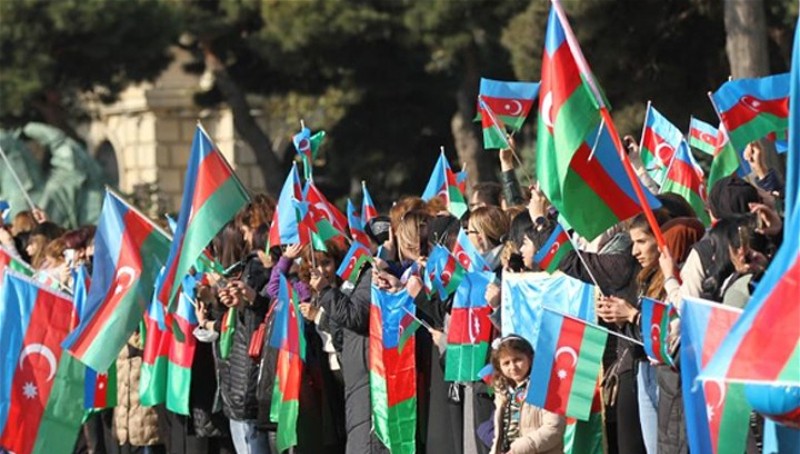
Azerbaijan's historical continuity does not mean that all the states and eras of the past can be combined into one uninterrupted national history without differences and contradictions. It consists in something else — in the ability of modern society to make sense of its centuries-old heritage, preserve its own cultural foundations, and turn them into a resource for development. Ancient states, medieval dynasties, khanates, and the experience of independence belong to different historical epochs, but together they help us understand the past from which modern Azerbaijan grew.
Azerbaijanism, which received its conceptual formulation under Heydar Aliyev and is being developed today, links these historical layers with the tasks of an independent state. Its content is revealed through the unity of citizens, respect for national and cultural diversity, and loyalty to statehood. This is precisely the meaning of historical continuity — not in the mechanical repetition of the past, but in the ability to draw from it the foundations for the country's future.