What is the price of money? Why Azerbaijan’s Ministry of Finance disagrees with the market

Over seven bond auctions, Azerbaijan’s Ministry of Finance turned down more money than it accepted. This is not a market failure. It is an argument with the market: slow-burning, but no less costly for that.
In brief
• Between 26 May and 6 October, after a pause of several months, the ministry held seven auctions of government bonds. Investors bid AZN 2,333.9m and the ministry accepted AZN 1,151.6m. It turned down AZN 1,182.3m, more than it placed.
• The cut-off price on three-year bonds was exactly 99.3366 (a yield of 7.2500%) four times in a row, and exactly 98.1634 (7.0000%) at both two-year auctions. Identical to the fourth decimal place.
• Investors, meanwhile, asked for up to 9%. At the last two three-year auctions the ministry took 4% and 7% of the money on offer.
• There is no shortage of money. The structural liquidity surplus of banks, among the main buyers of government bonds, has reached AZN 6.3bn, according to the Central Bank of Azerbaijan. The argument, then, is about price, not money.
• Over two weeks, the yield on Azerbaijan’s three-year dollar bond (a Eurobond) rose by 0.83 percentage points. The ministry’s manat cut-off did not move by a single basis point.
• For now, the budget’s cushion allows the ministry to disagree with the market. The question is how long that cushion will last.
A fever that isn’t there
In mid-August America’s Treasury Secretary, Scott Bessent, announced that he would step up buy-backs of long-dated Treasury bonds. He stated the aim plainly: to push the market back “towards equilibrium”, in other words to make government borrowing cheaper. In his telling, the market had caught a “fever” stoked by speculators.
A column in The Economist on 15 September disagreed with the diagnosis. While the secretary talked of fever, the yield on ten-year Treasuries rose from 4.65% to more than 5%. America’s government debt is about $40trn, roughly 10,000 times the size of each buy-back. The paper likened him to a borrower who puts a couple of $100 bills on the counter, looks the clerk in the eye and demands a lower rate on a million-dollar loan.
The column’s main point was about diagnosis, not scale. A broken government-bond market is easy to spot: trades stop going through, and everything else starts to break along with it. Nothing of the sort is happening. On 10 September America sold $22bn of 30-year bonds at 5.3%, and bids exceeded the amount on offer by more than 2.5 times.
The Economist’s conclusion is simple and concrete: the market is working exactly as it should. It is demanding a higher return from a government that borrows heavily and pursues policies that push up inflation (even if that government disagrees with the market).
A month on, the argument has only grown stronger. The Treasury expanded its buy-backs again, on 16 September the Federal Reserve raised its rate by 0.25 percentage points, and on 7 October the ten-year yield passed 5.35%, its highest since 2002. Auctions are still drawing demand. The market keeps naming its price and the secretary keeps arguing with it, yet he has to accept terms he considers less than favourable.
The market as the only arbiter
The American story has its own drivers: inflation, oil after the conflict around Iran, the Fed’s policy rate. But the rule it illustrates is universal.
To paraphrase Winston Churchill, the market may not be perfect, but it is still the only objective way of setting a price, and nobody has come up with anything better. The price of a bond, a flat or a currency is the point where supply meets demand. You can disagree with it. You cannot cancel it.
There is more than one way to argue with the market.
The American way: borrow at the market price and try to push it down with buy-backs.
The Azerbaijani way, as the numbers in this column will show: refuse the price and borrow only as much as the market is willing to lend at the issuer’s price. A different method, the same substance.
The issuer disagrees with the price of money that the market names, and tries to argue with it. How successfully, only the numbers can tell.
Arguing by refusal
Between 26 May and 6 October the ministry held seven auctions on the Baku Stock Exchange. On paper each one went well: bids exceeded the size of the issue. A surface reading of the results (“demand exceeded supply”) leads to reassuring conclusions.
The numbers beneath the headlines tell a different story.
|
Date |
Tenor |
Coupon |
Bids, AZN m |
Placed, AZN m |
Share of bids taken |
Cut-off (yield) |
Investors |
|
06.10 |
2 years |
6% |
207.1 |
94.6 |
46% |
98.1634 (7.0000%) |
n/a |
|
29.09 |
3 years |
7% |
267.2 |
19.6 |
7% |
99.3366 (7.2500%) |
12 |
|
22.09 |
3 years |
7% |
257.5 |
10.3 |
4% |
99.3366 (7.2500%) |
13 |
|
15.09 |
2 years |
6% |
444.1 |
361.8 |
81% |
98.1634 (7.0000%) |
8 |
|
08.09 |
3 years |
7% |
393.5 |
119.4 |
30% |
99.3366 (7.2500%) |
21 |
|
01.09 |
3 years |
7% |
499.2 |
345.9 |
69% |
99.3366 (7.2500%) |
21 |
|
26.05 |
10 years |
7% |
265.3 |
200.0 |
75% |
100.0000 (7.0000%) |
12 |
|
Total |
|
|
2,333.9 |
1,151.6 |
49% |
|
|
Take the three-year bonds.
On 1 September the ministry placed AZN 345.9m, using its right to enlarge the issue.
On 8 September, AZN 119.4m.
On 22 September, AZN 10.3m against bids of AZN 257.5m.
On 29 September, AZN 19.6m against bids of AZN 267.2m.
Demand has not disappeared: in recent weeks it has held at around AZN 260m. What has disappeared is the ministry’s willingness to meet it.
The key to this story is the cut-off price. At all four three-year auctions it was 99.3366, a yield of exactly 7.2500%. At both two-year auctions it was 98.1634, exactly 7.0000%. Demand was different every week, yet the price matched to the fourth decimal place. That is not what equilibrium looks like.
It is what a ceiling set for each tenor looks like.
The market named its price too. The lowest bid prices fell to 95.3429 (a yield of 8.80%) on 8 September and to 94.8421 (9.00%) on 29 September. Between 7.25% and 9% lies the AZN 1.18bn that the ministry chose not to take.
There is money in the market, but...
The refusals could be blamed on a weak market: too little money, too few participants. The data say otherwise. Between 8 and 21 investors took part in the auctions, and at every one demand exceeded the size of the issue.
The central bank’s own figures are more convincing still. The structural liquidity surplus of banks (excluding required reserves), among the main buyers of government bonds, reached AZN 6.3bn by the end of August, 2.2 times its level in December 2025. The central bank’s portfolio of notes has grown more than fourfold since the start of the year, and most of the banks’ excess money sits at the central bank in seven-day deposits. The interbank rate, AZIR, has fallen below the policy rate.
On 23 September the Central Bank of Azerbaijan (CBA) cut the floor of its interest-rate corridor from 5.5% to 5%, leaving the policy rate at 6.5%. The regulator was explicit about the aim: to revive the interbank market and reduce banks’ dependence on central-bank instruments. Put simply, the CBA is trying to push money out of its own vaults.
Hence a paradox. Banks are sitting on AZN 6.3bn of liquidity, yet the ministry cannot place AZN 200m of three-year bonds. So the problem is not a shortage of money.
It is the price.
The price moves, the cut-off stays put
If 7.25% were a fair market price, it would move with the market. And the market has moved noticeably in recent weeks.
The yield on the CBA’s 168-day notes rose from 6.14% to 6.61% in September.
Azerbaijan’s dollar bonds have also fallen in price. According to data obtained by First News Intelligence Unit from market participants, the yield on the sovereign bond maturing in 2029 rose by almost a full percentage point in two weeks.
Tellingly, the 2032 bond and SOCAR’s bonds moved in the same direction: this is a repricing, not noise in a single quote.
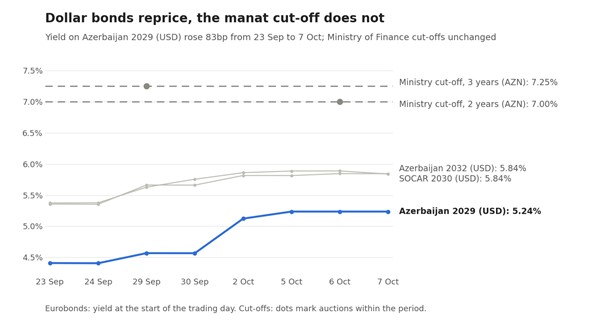
Eurobonds: data obtained by First News Intelligence Unit from market participants, 23 September to 7 October 2026. Cut-offs: results of Ministry of Finance auctions on the Baku Stock Exchange.
Over the same period the ministry’s manat cut-off did not move by a single basis point. On 6 October, when Azerbaijan’s three-year dollar bond was already trading cheaper, the ministry set the two-year cut-off at exactly 7.0000% and took AZN 94.6m of the AZN 207.1m on offer. The market price of money is a curve that breathes.
The ministry’s price is a ruler that does not move.
A ten-year bond at a two-year price
There was one auction where no refusal was needed. On 26 May, after a long break, the ministry came to market with AZN 200m of ten-year bonds carrying a 7% coupon. Twelve investors bid AZN 265.3m. The ministry placed the full amount: the cut-off price was exactly 100.0000 and the weighted average 100.0043. Practically all of the AZN 200m went at par, at a yield equal to the coupon.
To judge that price, it helps to ask how much investors were paid for duration. On 20 May the CBA’s 168-day notes yielded 6.47%. The ministry’s ten-year bonds went at 7.00%, a premium of about 0.53 percentage points. In September two-year bonds were placed at the same 7.00% while notes yielded about 6.34% (16 September), a premium of 0.66 points.
In other words, for eight extra years of maturity investors were paid less, not more, than for two.
In dollars, the market makes no such gifts to the same issuer. Azerbaijan’s bond maturing in 2032 traded at a higher yield than the 2029 bond throughout the period we observed: investors want to be paid for three extra years of risk.
- FNIU ASSUMPTION. In our view, the May placement looks more like a sale to demand that was known in advance than a competitive auction. The practice is common in many markets and is not, in itself, a violation.
- What it rests on. The term premium over CBA notes is no higher for the ten-year bond than for the two-year one. The cut-off price equals the coupon exactly. Bids covered the issue only 1.33 times, yet the whole amount was taken without a single bid above 7%. In September the same issuer heard requests of up to 9% for three years.
- What could be argued. Twelve investors took part, not a single buyer. Market conditions in May were softer than in September. For some institutional investors, demand for long bonds is not very sensitive to price.
- What would settle it. The Baku Stock Exchange order book for the 26 May auction, showing how volume was distributed by price and type of investor. CBA data on the holders of issue AZ0301250012. Statistics on secondary trading in it (we do not have these data).
Why the ministry can afford this
The US Treasury argues with the market but still borrows: the deficit has to be financed, and there is no choice. Azerbaijan’s Ministry of Finance does have a choice, and that is the key to its behaviour.
First, paradoxical as it may sound, it does not need foreign markets right now. Speaking at the Azerbaijan International Investment Forum on 26 September, President Ilham Aliyev said that external public debt stands at 5.6% of GDP and that currency reserves exceed it roughly 20 times over. As a result, in the president’s words, it could be “reduced to zero in a single day”.
The country is not issuing new sovereign dollar bonds: only two issues are in circulation, maturing in 2029 and 2032, both mentioned earlier in this article.
Second, the budget is in surplus.
From January to August state budget revenue was AZN 26,486.5m and spending AZN 22,770.6m, leaving a surplus of AZN 3,715.9m. In the first half of the year the ministry redeemed AZN 1,971.9m of bonds and placed AZN 200m at auction.
Third, the treasury has free balances and manages them. In September, for example, the ministry held five deposit auctions and placed AZN 87m with commercial banks at 6.5%. The current balance of the single treasury account is not disclosed.
So for now the ministry can afford to disagree with the market. The real question is a different one.
How long?
If the ministry does not accept the market price of money, and for now can avoid borrowing at it, how much longer can it hold the line? Open data offer no ready answer. But three figures from the ministry’s own documents show what the answer depends on.
The fourth quarter. In its August review of budget execution the ministry expects a deficit of AZN 1,497.6m for the year. To get there from an eight-month surplus of AZN 3,715.9m, the budget has to run a deficit of roughly AZN 5.2bn between September and December. Much of the surplus is deferred spending: after eight months only 54.6% of the annual spending plan had been executed. Those bills will come due at the end of the year.
The volume of debt. The same review expects domestic public debt to grow by AZN 3,405.1m in the second half, from AZN 15,982.0m to AZN 19,387.1m. Since 1 July auctions have raised AZN 951.6m. That leaves about AZN 2.45bn to find before the year is out. At current cut-offs, three-year auctions bring in AZN 10m-20m each.
Next year. The 2027 budget deficit is projected at AZN 3,166m. Of this, AZN 2,751m, or 86.9%, is to be covered by borrowing.
The cushion lets the ministry postpone accepting the price, but it does not make the price go away. Unlike the treasury, the market has no bills to pay by 31 December. It can wait.
A market without a shop window
It is easier to argue with a price when the price is hard to see.
From 2018 to 2025 the ministry published annual bond issuance plans. There is no plan for 2026 on its website. Every auction is a new issue with its own ISIN, and no existing bonds have been reopened. The market has no liquid benchmark that would show yields day by day. The price of money surfaces only in auction results, and the ministry’s press releases do not even give the number of investors or bids. Those figures come from the exchange and from market participants themselves.
What we do not know:
-
How bids were distributed by price and investor at any of the auctions;
-
How the cut-off price is set;
-
Who holds the May ten-year issue;
-
What the balance of the single treasury account is;
-
How the ministry intends to close the gap between the expected rise in debt and what the auctions deliver.
First News Intelligence Unit will send requests on these points to the Ministry of Finance, the Baku Stock Exchange and the Central Bank of Azerbaijan, and will share any answers with its readers.
What to watch
-
The cut-off price. Will it stay at 7.0000% and 7.2500%, or move towards the price the market is naming?
-
The AZN 2.45bn gap. How will the ministry close the difference between the expected rise in domestic debt and what auctions deliver: through auctions at a new price, or by other means?
-
Liquidity after the CBA’s decision. Will the money the central bank is pushing out of its instruments flow into the ministry’s bonds, and will demand rise at the price the ministry offers?
That said, we would rather see the banks’ extra liquidity at work in the economy as loans, not only in investment instruments.
We will keep following this subject, including the dynamics of the stock market and the behaviour of its main participants, the ministry among them. But it is already clear that this tug of war is far from over.
About the author:
First News Intelligence Unit (FNIU) is the analytical unit of the 1news.az newsroom, specialising in research on Azerbaijan’s financial sector and economy.
Read in other languages:
Сколько стоят деньги? О том, почему Минфин Азербайджана не соглашается с рынком
Pulun qiyməti nədir? - Azərbaycan Maliyyə Nazirliyinin bazarla nə üçün razılaşmadığı barədə