The invincible Infantino holds his ground: how Baku and Tashkent confirmed our forecast of a split in UEFA and the AFC

In the space of two days the FIFA president was received by the heads of two states, Azerbaijan and Uzbekistan. The national federations of both countries, which belong to confederations that had demanded his resignation, declared their full support for Gianni Infantino that same day, confirming the 1news.az forecast that there is no monolithic unity in the ranks of his opponents.
On Sept. 29 Gianni Infantino was received by President of Azerbaijan Ilham Aliyev. On Sept. 30, by President of Uzbekistan Shavkat Mirziyoyev.
In both cases the national football associations issued a statement of support for the FIFA president on the day of the reception by the heads of state.
Since late July 1news.az has consistently proceeded from the premise that a confederation's statement, whether UEFA's or the AFC's, is not identical to the position of its members, and that in March 2027 it will not be six confederations voting but 211 associations one by one. That thesis has been borne out step by step: by Mexico and Argentina in early August, by Grenada and St. Kitts, by six Arab federations, by the split inside the Asian Football Confederation.
On Sept. 29 and 30 it was borne out in Baku and Tashkent. And at the very highest level.
The coalition that no longer exists
To gauge the scale of what has happened, it is worth going back to August.
On July 30, in the words of the European confederation itself, "all 55 UEFA members unanimously approved the withdrawal from participation in FIFA tournaments" for as long as the FIFA Forward Enterprise project stands: the spin-off of the organization's commercial rights into a separate company, with up to 20 percent sold to outside investors.
The boycott was joined, in the words of what were by then two other confederations, by members of CONCACAF and the Asian Football Confederation. On Aug. 1 Infantino withdrew the project, but the conflict went on, now around the president himself.
On Aug. 10 three confederations sent an open letter to Zurich with six signatures: Aleksander Ceferin and Theodore Theodoridis for UEFA, Victor Montagliani and Philippe Moggio for CONCACAF, Sheikh Salman bin Ibrahim Al Khalifa and Windsor John for the AFC. Behind the signatures, allegedly, stood 143 associations out of 211. The letter asserted that the head of FIFA had abandoned his duty and undermined trust through deception.
That was the coalition's peak. But, as we predicted, that coalition was a highly ephemeral thing.
After that it began to fall apart, and it fell apart along the very line we had pointed to from the start.
On Aug. 14 the president of the Qatar Football Association, Hamad bin Khalifa Al Thani, a member of the AFC executive committee and of the FIFA Council, wrote to Salman that neither he himself nor the federation had been informed before the joint statement was issued, either formally or informally. His formulation: a collective opinion must first be established; it cannot be assumed and it cannot be created by declaration. Salman categorically rejected the claim that he had exceeded his powers, saying that he had both the right and the duty to act decisively. Qatar insisted: the president has no right to speak on behalf of 47 associations without their sanction.
On Aug. 27 UEFA suspended the tournament boycott, having received written guarantees from FIFA that the project would not return. It failed to obtain the president's resignation: in the month the boycott was in force, not a single European federation withdrew from a single tournament.
On Sept. 18 Ceferin and Montagliani sent Infantino a new letter, demanding that at least $10 million be paid to each of the 211 associations out of FIFA's reserves. The AFC's signature was no longer on that letter. On Sept. 21 Sheikh Salman sent one of his own.
In a month and a half the coalition of three confederations had turned into two signatories and three separate lines.
Baku demonstrates a position of its own
On Sept. 29 the president of Azerbaijan received the FIFA president. According to the Presidential Administration, Ilham Aliyev thanked Gianni Infantino for supporting the work of developing football around the world, including in Azerbaijan. They discussed the country's cooperation with FIFA and the prospects for the partnership.
The FIFA delegation received in Baku included the chief member associations officer, Elkhan Mammadov, the only representative of Azerbaijan holding a position of that level in world football. Before moving to FIFA in May 2022 he was general secretary and then executive vice-president of AFFA; at FIFA he headed the European member associations division and was responsible for rolling out the FIFA Forward program across the 55 European federations.
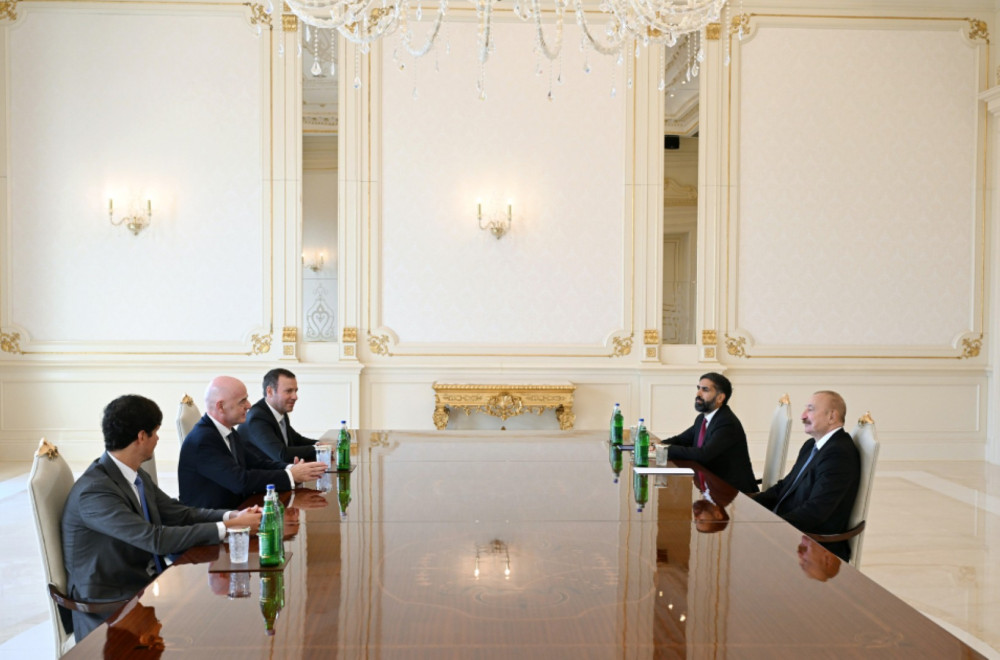
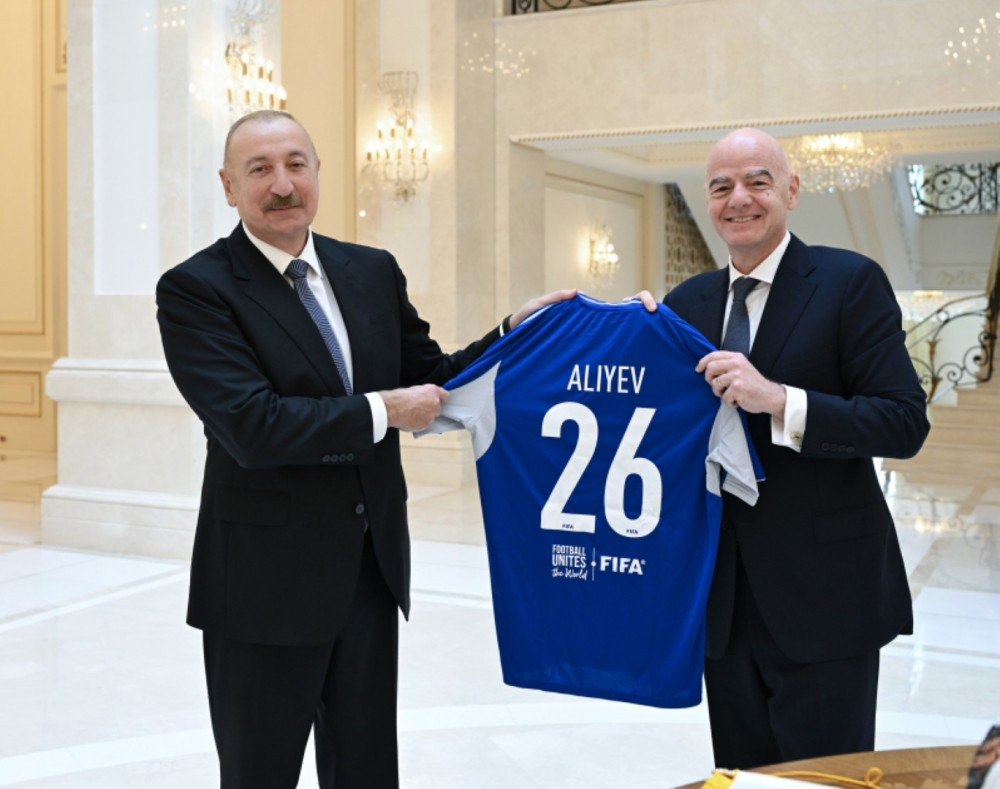
Photo from the meeting between the President of Azerbaijan, Ilham Aliyev, and FIFA President Gianni Infantino
Following the meeting, the statement from the head of state's press service made a point of noting the support that the Association of Football Federations of Azerbaijan gives to FIFA's work.
The same day AFFA issued a statement ending with a direct formulation: the association fully supports FIFA and Gianni Infantino.
The weight of that line is measured by what came before it. Since July 28, when the crisis began, AFFA had not stated its position publicly. Not when the project was withdrawn, not when the boycott was announced, not when it was suspended, not during the exchange of statements between the confederations. Two months of silence ended on Sept. 29, with a reception by the head of state.
The reception took place at a moment when three confederations were demanding Infantino's departure and some European federations were withdrawing their support for his re-election. In October Baku hosts the first ever FIFA U-15 World Cup and Festival, a tournament that did not exist before and is being held in Azerbaijan for the first time.
Tashkent stands with Azerbaijan
On Sept. 30 it was Uzbekistan's president, Shavkat Mirziyoyev, who received the FIFA president, in Tashkent. The main topic was the staging in Uzbekistan and Azerbaijan of the World Cup for players under 20. They discussed expanding the partnership, transforming the system of organizing and governing football, the training of coaches, referees and specialists, and speeding up the opening of a FIFA regional office in Tashkent.
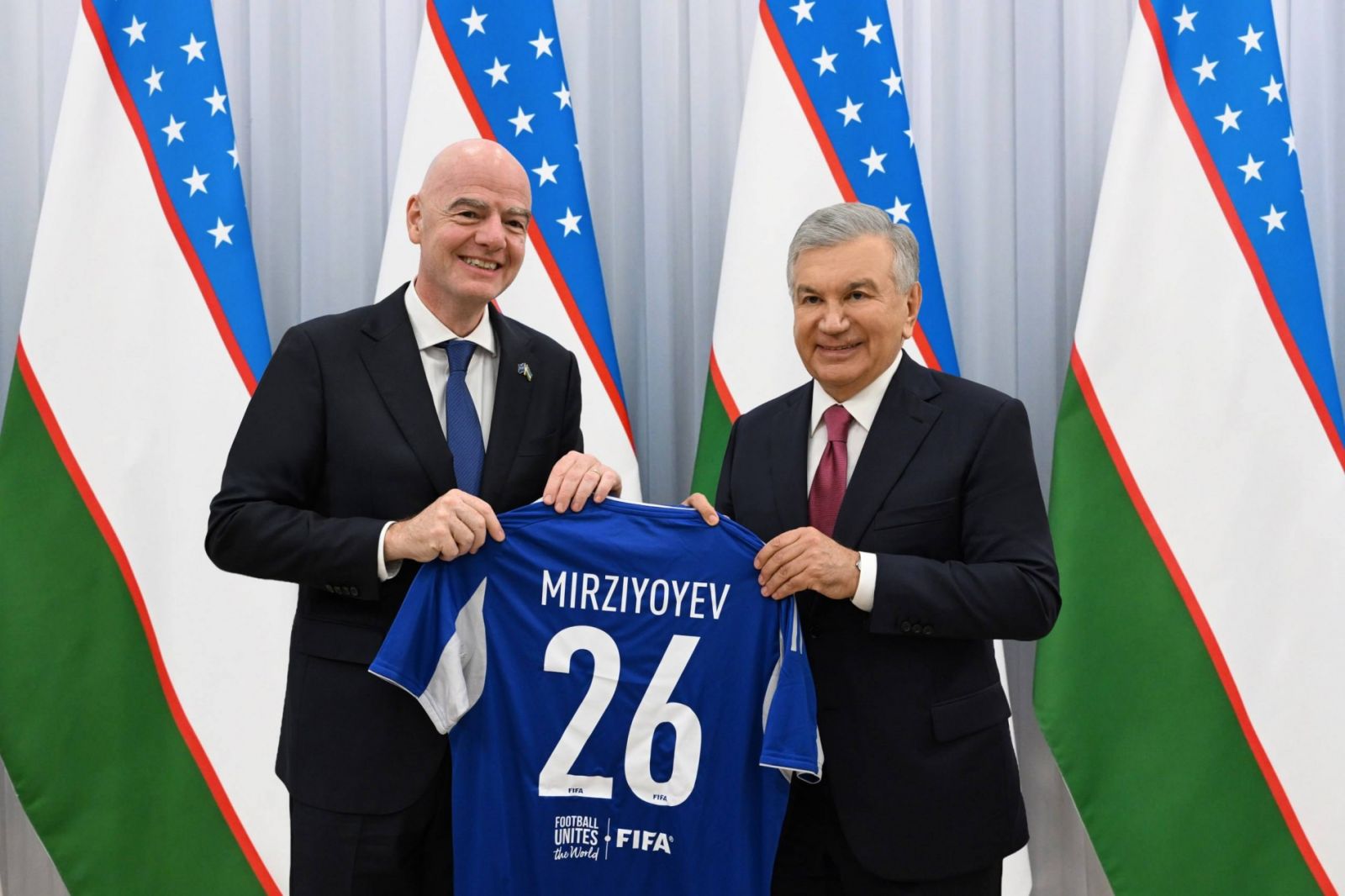
Photo from the meeting between the President of Uzbekistan, Shavkat Mirziyoyev, and FIFA President Gianni Infantino
The Uzbekistan Football Association said the same day that it fully supports FIFA and its president Gianni Infantino and will continue close cooperation with the organization.
Where the line of the split runs
AFFA belongs to UEFA, the confederation that was the first to announce a boycott and that continues to demand a change of leadership at FIFA.
The Uzbekistan Football Association belongs to the AFC, the confederation that signed the August letter against Infantino and did not sign the September one.
In the space of two days, a position diverging from the line of its own confederation was stated in two of the three confederations that came out against the FIFA president.
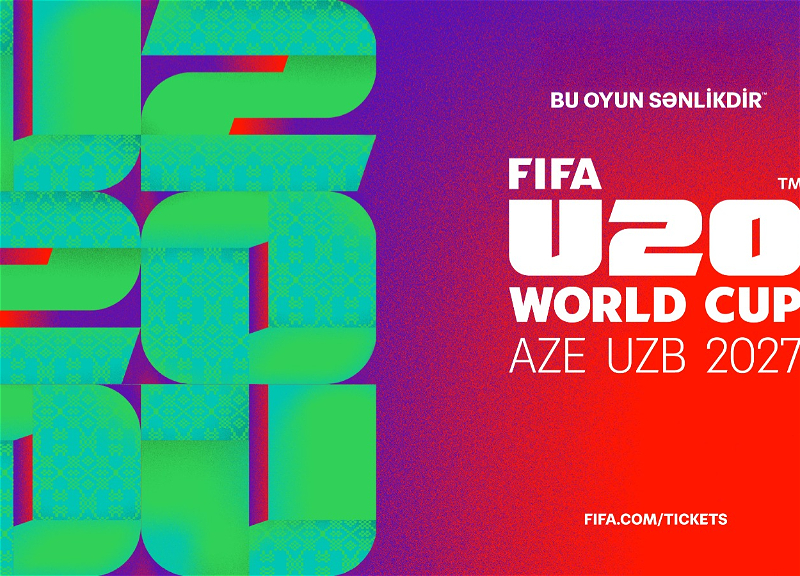
Both countries share one common denominator. Azerbaijan is hosting a tournament that did not exist before. Azerbaijan and Uzbekistan will jointly host the U-20 World Cup. Expanding the number of countries that host FIFA competitions is part of the same policy as the expansion of the World Cup from 32 to 48 teams, in which Europe's share fell from 40.6 to 33.3 percent while Africa and Asia received nine and eight direct places instead of five and four.
And here it is worth calling things by their names. For several months 1news.az has written that what is happening is not an argument between "good" administrators and "bad" ones, but a conflict over the distribution of influence between Western Europe and the rest of the world. London, Berlin, Amsterdam and the Scandinavian federations were the first to withdraw their support for Infantino's re-election, proceeding from a logic in which the voice of world football's former metropole is by default taken to be the voice of all football.
Baku and Tashkent have shown that this logic no longer works automatically. Neither Azerbaijan nor Uzbekistan chose to echo London and Berlin, and they did so publicly, on the day of a reception at the highest level. For countries that for decades were on the receiving end of other people's decisions in world football, a position of one's own is the very substance of that reform of representation the confederations are arguing about.
FIFA goes on the counterattack
It is also notable that the day of Infantino's visit to Baku coincided with FIFA's first public counteroffensive since the crisis began. On Sept. 29 the organization filed with the U.S. District Court for the Southern District of Florida an objection to UEFA's demand for documents and witness testimony on the FIFA Forward Enterprise project; the European confederation was gathering the material for a criminal complaint against Infantino in Switzerland.
In the filing FIFA stated that UEFA's application contains numerous false or misleading assertions, and that suggestions that Infantino broke any law or ethical principle are categorically without foundation. The valuation of the project is disputed separately: according to FIFA, UEFA conflated the value of the equity with the total value of the business, which exceeded $30 billion, twice the figure the European side is working with.
FIFA's main point, however, is not financial but political: the organization stated outright that UEFA filed this application shortly before the FIFA presidential election, spreading inaccurate information about Infantino. In other words, accusations of trying to influence the vote are now being made in both directions.
The arithmetic of March: can Infantino's opponents win the election?
Winning the FIFA presidential election requires 106 votes out of 211. Nominations close on Nov. 18, and the vote will take place in March 2027 at the Congress in Morocco.
Infantino's opponents still have no candidate. Nasser Al-Khelaifi withdrew his candidacy on Aug. 12. Aleksander Ceferin said on Aug. 24 that he is not interested in the post, explaining that he is more persuasive if he is not a contender for it. Who will appear on the ballot opposite the incumbent president's name is unknown.
The campaign for Infantino's resignation is being waged through confederation letters.
The campaign for his re-election, through visits to capitals and work with the national associations. And here we will recall that it is the associations that vote in the election.
And judging by what the FIFA president took away from Baku and Tashkent, his mood now is quite different from what it was a month earlier in Rabat or Monaco. You do not leave capitals where heads of state receive you, and where national federations declare their full support the same day, feeling like a man under siege.
You leave, by all appearances, full of hope.