"Yukselish," a career ladder of national scale: how Azerbaijan turned the search for managers into a national technology

In the spring of 2020, the organizers of the national competition "Yukselish" faced a choice that today would be taken apart in a project management course.
The first season was gathering pace: 11,760 registrations, two online exams, 940 candidates who had passed video interviews and were waiting for the in-person stage. Then came the pandemic. The stage could be moved online and the schedule kept. Or a national project that was gaining popularity could be halted for an indefinite period.
The organizers chose the second option, and they held the pause for a year and a half, because the point of the in-person stage is to see the candidate in the flesh, not in a video window. The final took place only in July 2021.
A decision in which the format mattered more than the calendar says more about the project than any declarations. From the very start, "Yukselish" was built not as a one-off competition with an awards ceremony but as a technology, with its own methodology, its selection funnel and rules that do not bend to circumstances.
Six seasons on, it is possible to assess what that technology has delivered.
A corporate tool on a state scale
To understand what exactly has been built, one has to notice the unusual direction of the transfer. Assessment centers, competency models, a pool of successors: this entire toolkit lived for decades inside corporations. It is how consulting firms hire partners and how multinational companies grow their top managers. States usually take a different route, through exams on knowledge of the law and service records.
Azerbaijan (which, incidentally, already had a working mechanism of the classic format, with entrance exams for the civil service) made an unexpected move: it took the corporate technology for assessing executives and scaled it up to the level of the entire country.
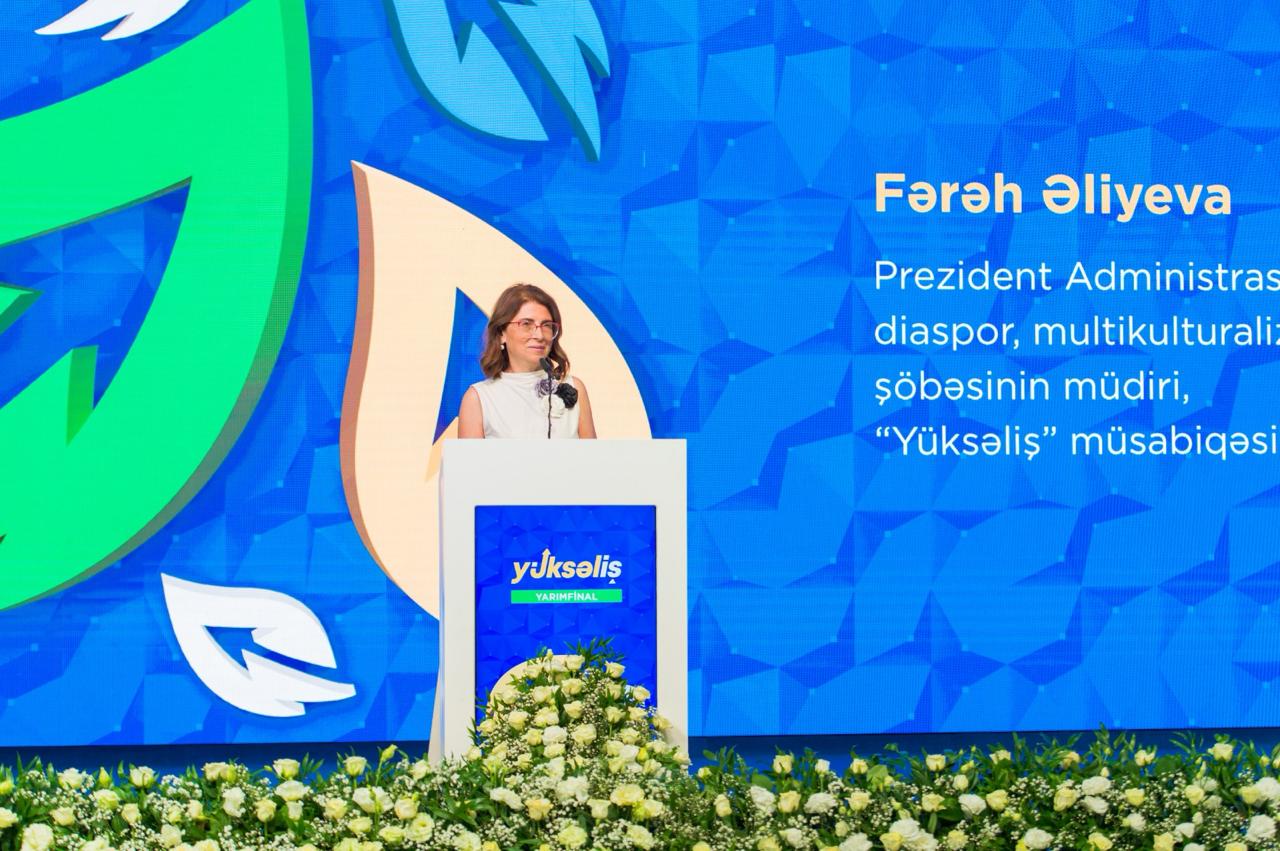
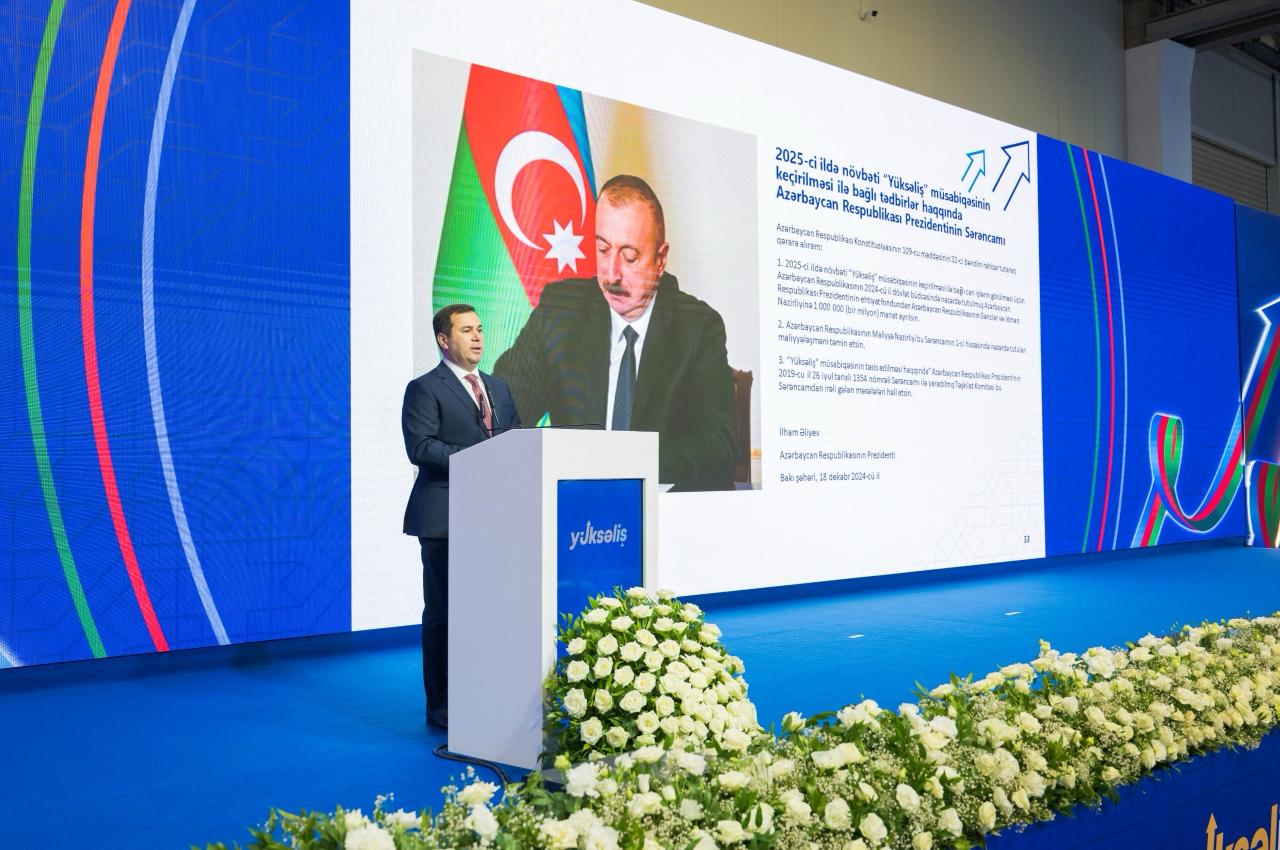
The intent was declared before the instrument. In February 2019, speaking at a conference to mark Youth Day, President Ilham Aliyev told young people that it would fall to them to run the country in the future, and he recommended that state bodies promote the young: society needs their potential and their new vision. The decree establishing "Yukselish" was signed on July 26, 2019; the goal was formulated with engineering precision: to identify promising executives with a high intellectual level and managerial qualities, and to form a personnel reserve bank. Since then, the competition has been held at the initiative and under the decrees of President Ilham Aliyev, with the direct support of First Vice-President Mehriban Aliyeva.
In the autumn of that year, renewing the government's economic bloc, the head of state called personnel reforms inevitable. And in February 2021, competitive human capital became one of the five national priorities of the "Azerbaijan 2030" strategy. The competition, launched before that strategy, turned out to be a ready-made mechanism for carrying it out.
The global lineup
There are few models in the world for the systematic search for managers, and all of them are familiar to specialists in public administration. France grew its administrators through the elite ENA school, now INSP. Britain selects graduates into the Civil Service Fast Stream. Singapore guides its best straight from university through Public Service Commission scholarships. Kazakhstan built a presidential youth personnel reserve.
Against this background, the Azerbaijani model differs in two ways.
First, in its entry point: it looks not for graduates but for people who have already made their way, citizens from 21 to 51 years old with higher education and at least two years of managerial experience, from the public and private sectors at once. Second, in what it assesses: the competition measures neither biography nor erudition, but observable behavior.
If Fast Stream answers the question "whom to train," then "Yukselish" answers the question "who can already do it." This is closer to corporate succession planning than to a classic civil service competition, and in the lineup of national models such a hybrid occupies a place of its own.
A narrow selection funnel
The arithmetic of the sixth season looks like this: 17,651 people completed registration, 8,551 passed the general knowledge exam, 1,468 the analytical exam, 331 the management skills exam, 130 reached the final, and 20 became winners. The share of those who made it through is about one tenth of a percent.
For comparison: at McKinsey, by publicly available estimates, about one percent of candidates receive an offer, an order of magnitude more. Yet the costs bear no comparison to the stakes: 1 million manats was allocated from the President's reserve fund to launch the competition, less than a single mistake in appointing a top-level executive can cost the state.

The toughness of the selection is balanced by the toughness of the rules. The competition's quota is 20 winners, but when nine finalists in the first season scored the same number of points, the organizing committee did not choose between them and declared them all winners: there were 27 of them, and that is the figure that stands on the chart.
In the second season the story repeated itself: six finalists scored equally, and there were 22 winners. The system preferred to break the quota rather than the principle of an equal score. For participants that is a signal worth more than any advertising: here the rules work even against the plan.
Over six cycles the competition has collected about 87,600 applications from 47,070 unique participants; many come back. The number of registrations has grown by half, from 11,760 to 17,651. The winners over the whole period number 136.
Behavior instead of biography
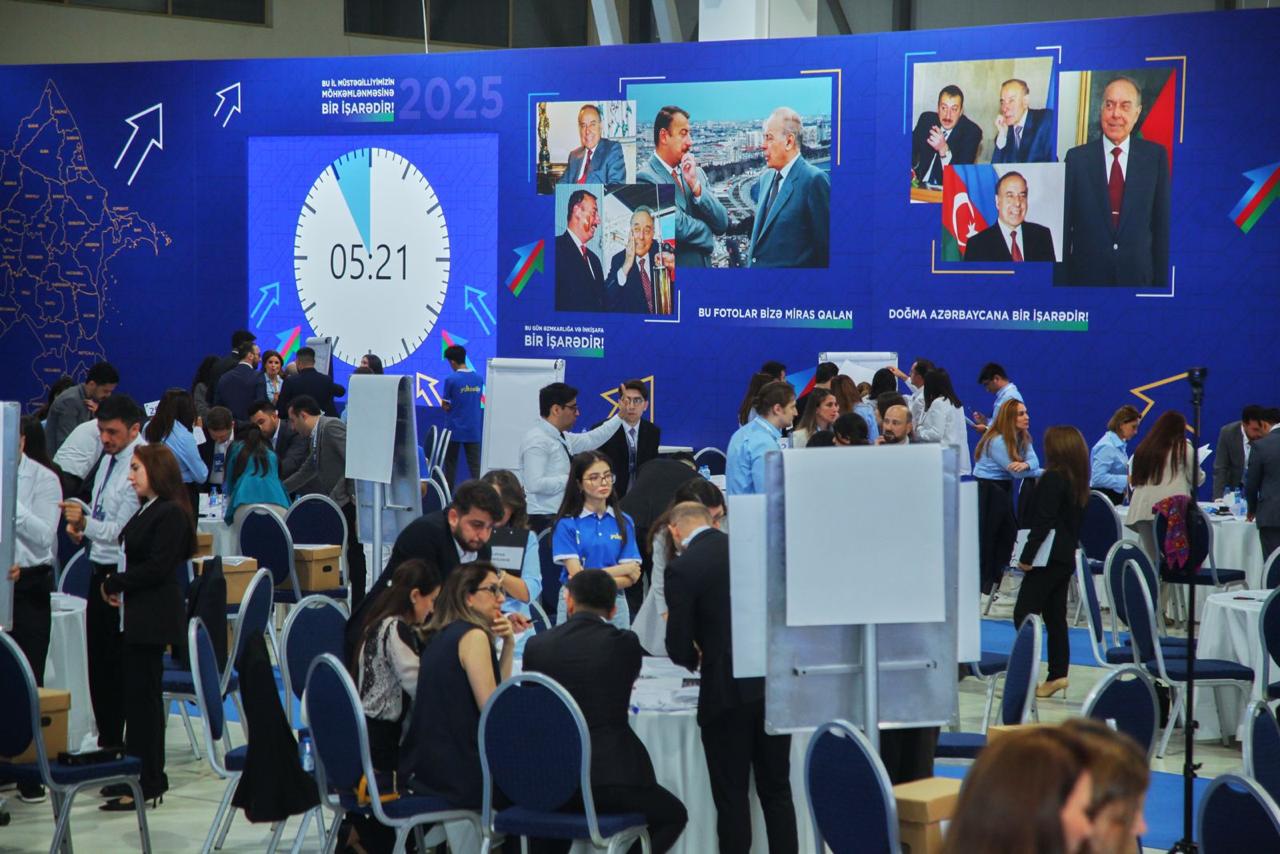
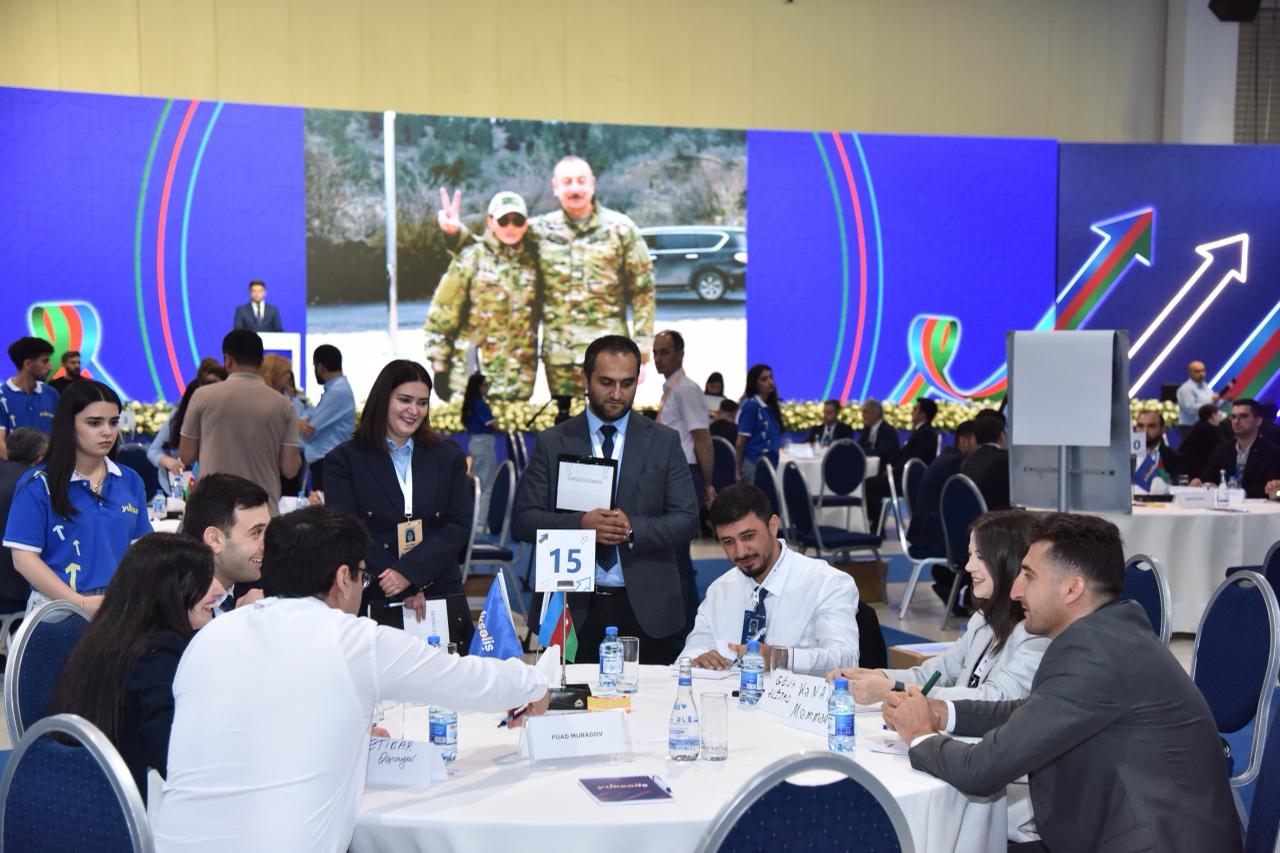
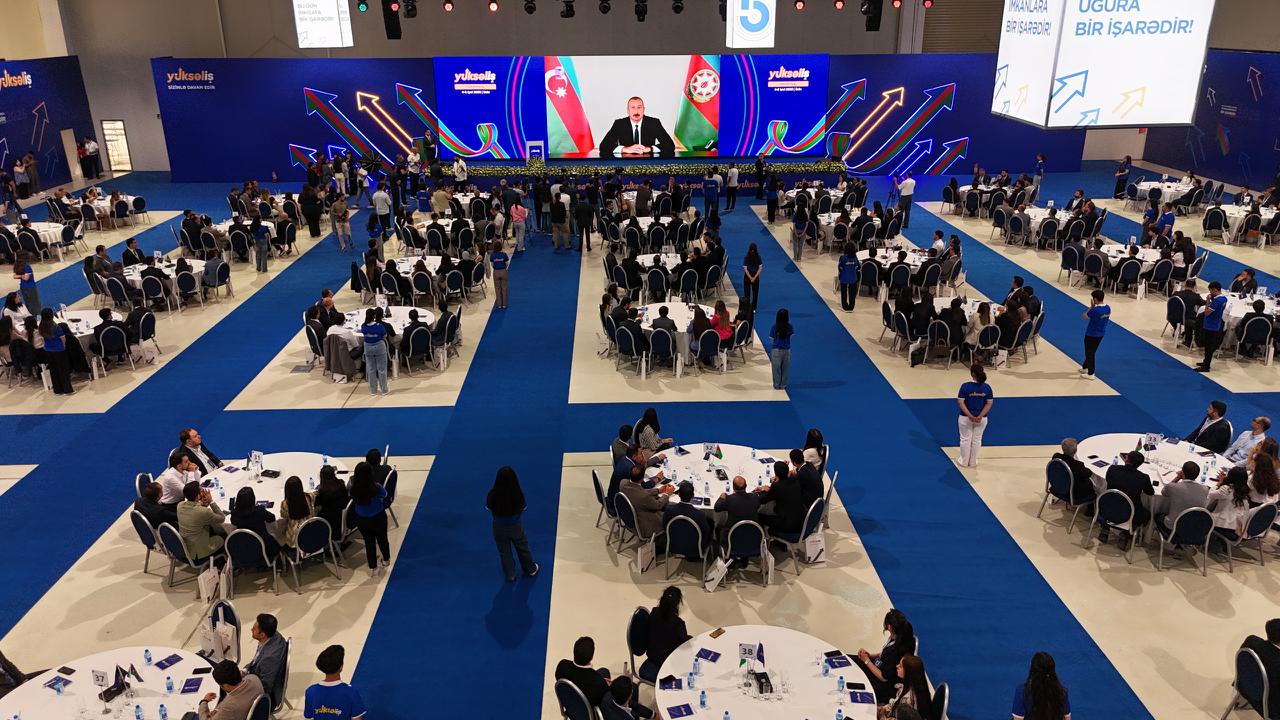
The technological core of the competition is a two-model assessment. Standardized exams in general knowledge and analytical ability screen out the bulk of applicants; then the Assessment Conference format begins. Teams of 6-8 people solve management cases in real time while trained experts record behavior: in the semifinal, across nine competencies, from strategic thinking and decision-making to adaptability, ethics and integrity; in the final, through six managerial roles: strategist, team leader, communicator, reformer, change agent, organizer. The semifinal answers the question of what a person can do, the final answers who they are within a team.
A production base of its own has grown up around the procedure. The cases are not bought in but written by an Azerbaijani team, 35-40 new ones a year, tailored to the current competency models. The models themselves are revised: budget management and social responsibility left the 2021 version, adaptability and innovative thinking came in; the portrait of the executive in demand is updated along with the times.
Before the sixth season's semifinal, about a hundred assessors went through three days of training on simulated situations; 103 experts worked in the semifinal and 58 in the final. A country that began with a borrowed practice has, in six years, grown its own full-cycle expertise, from case design to the integration of results.
A ladder out of the regions
The most underrated result of the competition is visible in the portrait of the sixth season's winners. Of the twenty, only nine are from Baku; the rest represent Gazakh-Tovuz, Garabagh, East Zangezur, Mil-Mughan, Lankaran-Astara, Shirvan-Salyan, Absheron-Khizi and Guba-Khachmaz. All twenty are graduates of Azerbaijani bachelor's programs. The youngest is 24, the oldest 38. Half come from the public sector, almost half from the private one.
In other words, the competition does not reproduce the established capital-city circle but finds people who had no direct route to the level where decisions are made: specialists from the regions, managers of private companies, graduates of local universities. Entry requires no recommendations, only citizenship, a diploma and two years of managerial experience. And the ladder forgives failure: nothing stops anyone from trying again after a failure.
Mentorship as a two-way street
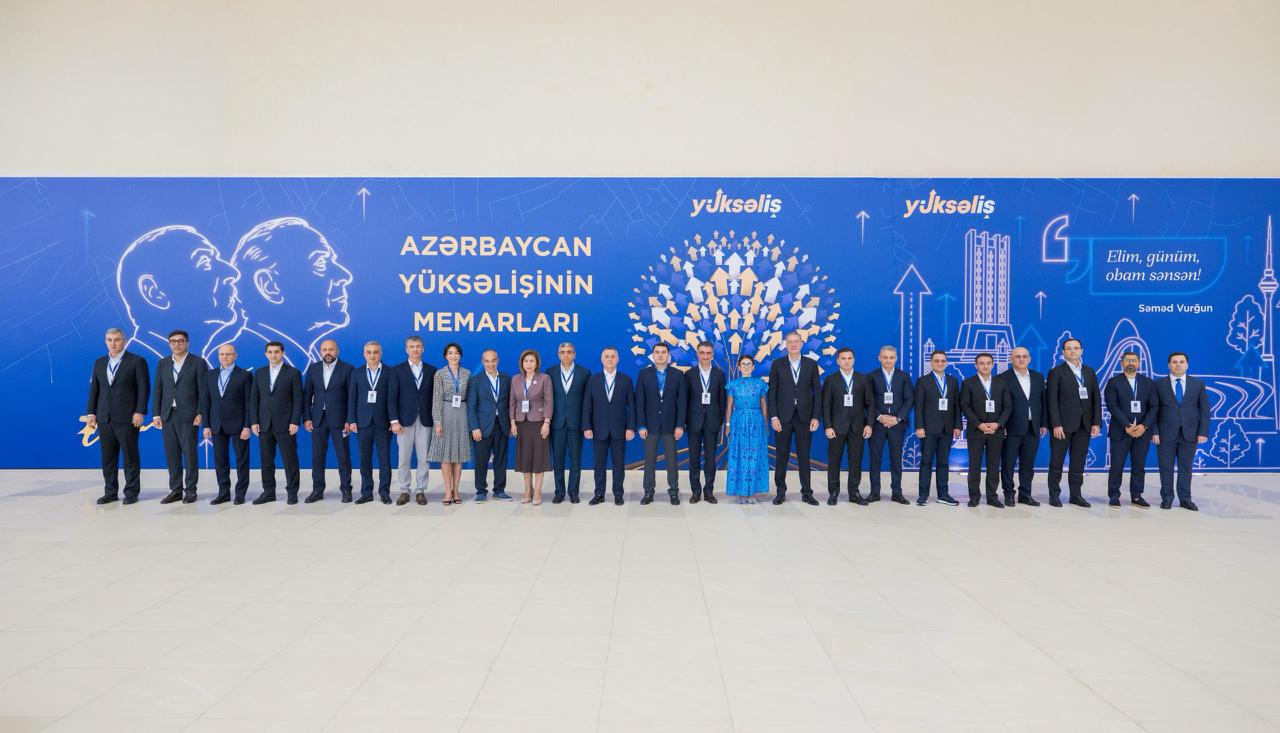
The winner receives 20,000 manats for self-development, but the main prize is a year of work on an individual plan with a mentor. The pool holds 56 mentors, and it is perhaps the most concentrated lineup of mentors among national programs of this kind: assistants to the President, twelve ministers, the Governor of the Central Bank, the chairman of the Supreme Court, the president of SOCAR, the executive director of the State Oil Fund, the heads of AZCON, AZAL, the Karabakh Revival Fund, of the largest banks and holdings, down to the head coach of Qarabağ FK, Gurban Gurbanov.
For a 24-year-old manager from Tovuz, a year of dialogue with a minister is access that an ordinary career takes a decade to reach. But the other side gains too, which is spoken about less often: an executive who regularly works through cases with a young manager from the private sector or from a region gains a channel to reality that has not been filtered by the apparatus. Mentorship in such a construction is not a ceremonial burden but a mechanism of bottom-up feedback that is rare in any system.
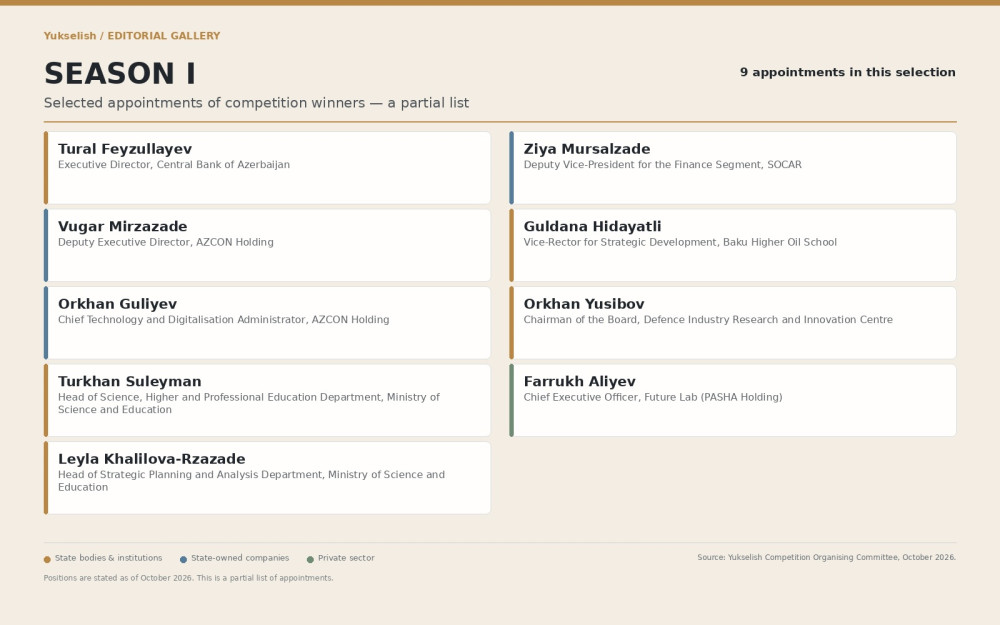
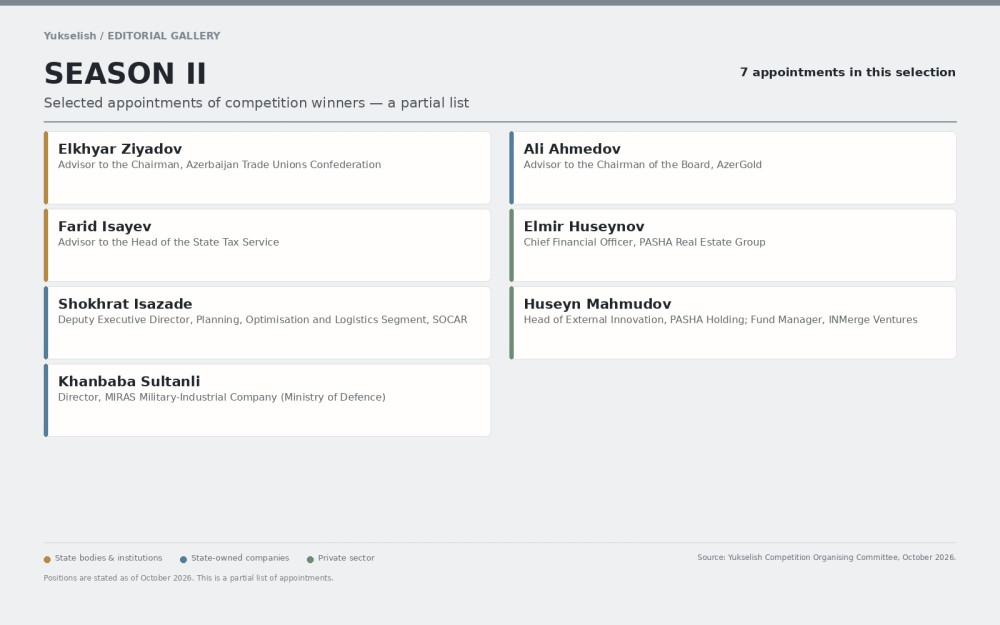
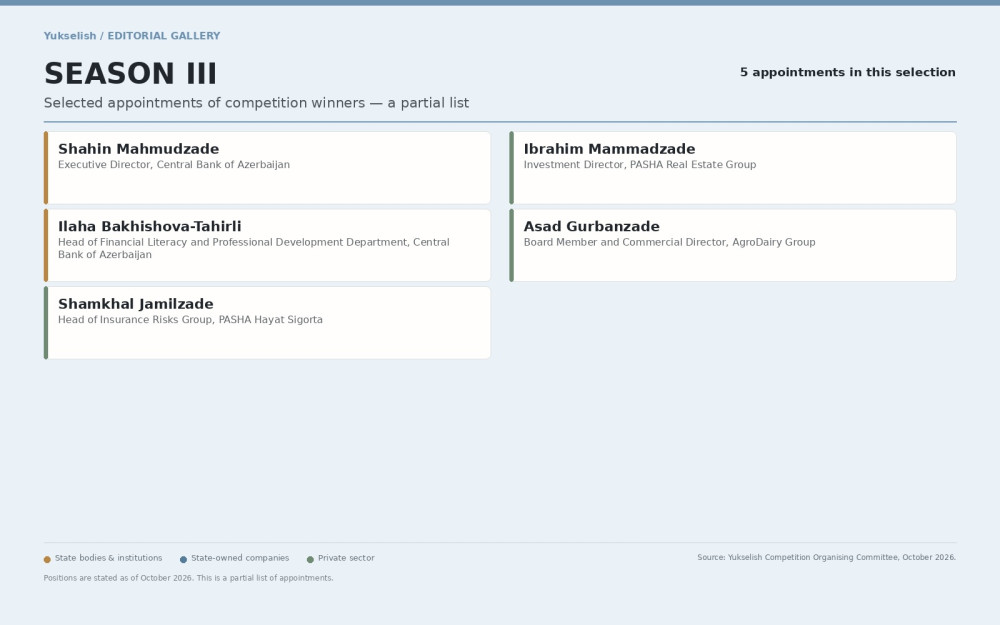
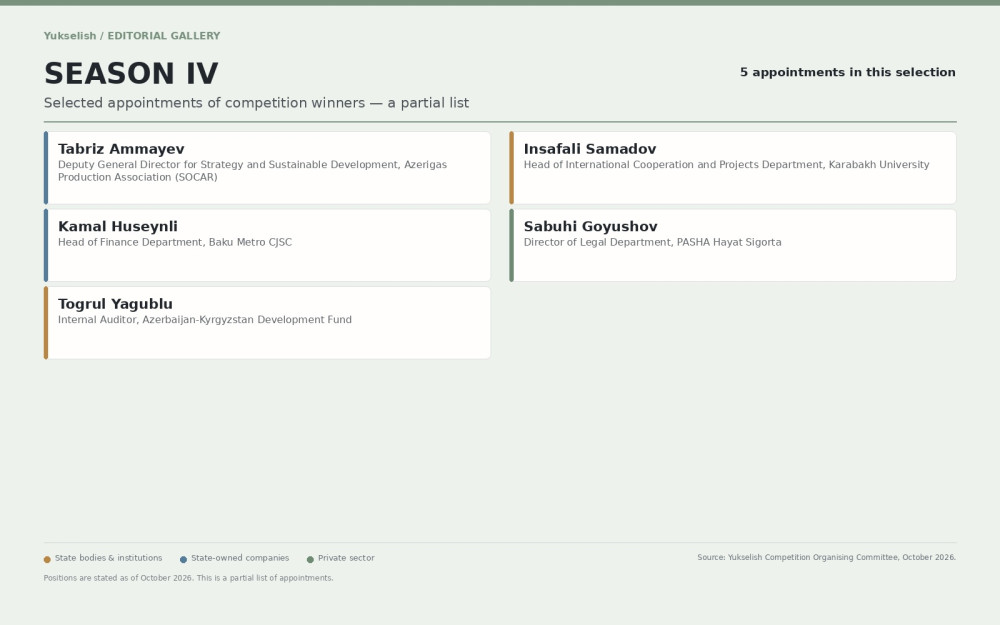
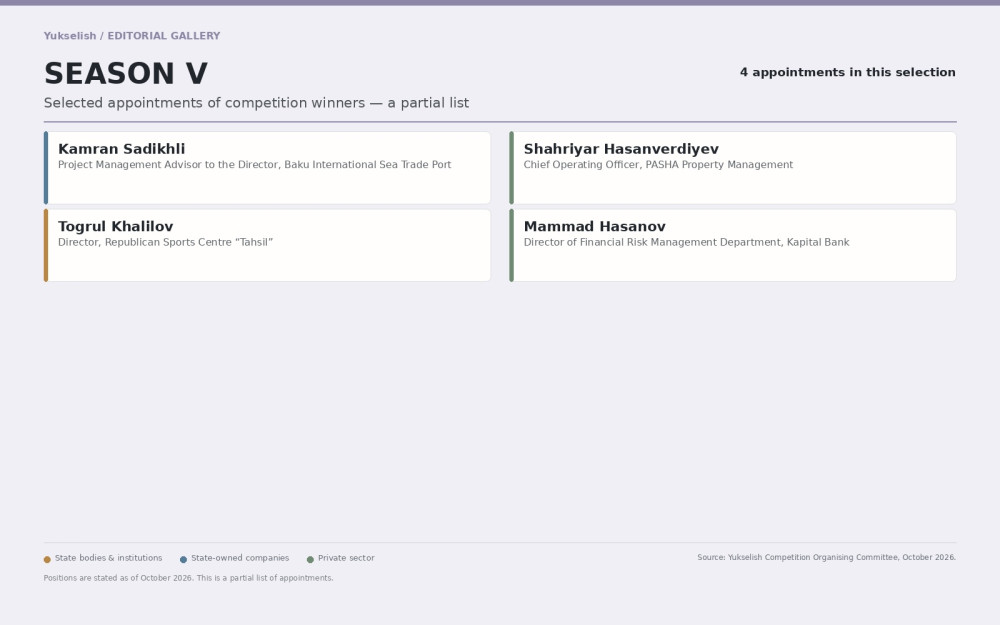
Career statistics confirm that the ladder does lead to the top floors: according to the organizers, about 52% of winners have received significant promotions or strategic appointments. Some of those appointments are public: among the winners are heads and top managers at the Central Bank, SOCAR, AZCON, ministries, the defense industry and the largest private holdings (a selective list is in the box). A separate demand for such people is created by the reconstruction of the liberated territories: a megaproject that needs a new generation of managers has found in the competition a ready source of tested personnel, and among the sixth season's winners there are people from the Garabagh and East Zangezur economic regions.
The reserve, moreover, is broader than the list of those honored. Every year more than three hundred people pass through the semifinal and about a hundred and thirty through the final, and each comes out with a competency profile drawn up by a single methodology. In six years the state has accumulated a mapped database of managers about whom it knows more than any resume can tell. It is this database, and not the awards ceremony, that is the personnel reserve bank from the 2019 decree.
The five principles the competition rests on:
- An open entry instead of elite channels. Citizenship, a diploma, two years of experience, and no recommendations.
- Behavior instead of biography. What decides is not the service record but observable actions in a case.
- The rule is stronger than the quota. An equal score gives equal status, even if the winners number 27 instead of 20.
- A first-tier mentor. Access to decision-makers is part of the prize, not a protocol gesture.
- The reserve is broader than the podium. The value of the system lies in the hundreds assessed, not only in the twenty honored.
The horizon of the future
The six seasons also hold cards that have not been played. The community of winners and finalists (already hundreds of people in state structures and in business) is asking to become a formalized institution, a kind of alumni network on a national scale. Tracking careers would turn today's percentages into a full evidence base of effectiveness. Finally, the model itself (the architecture of the competition, the methodology of the cases, the training of assessors) has matured into an export product: countries building their own mechanisms for finding managers rarely find a ready-made sample tested by six cycles.
In 2019, the phrase that the country would be run by today's young people was a promise. By 2026 it has acquired a procedure: open registration, exams, cases, mentors, and a reproducible result. In management, that is precisely what is called a technology.