Hostages of the old preamble: how Armenian revanchists are pushing the country back into a dead end

Signing a peace treaty while holding behind your back a constitution containing territorial claims against your neighbor is the height of political hypocrisy, which Armenia's political opposition stubbornly tries to pass off as the defense of national interests.
Meanwhile, it is still not entirely clear whether these politicians consider themselves very clever in their ability to push through their own scenario of "peace," or whether they consider the Azerbaijani side ready to fall for that very scenario of theirs. It is unclear…
As soon as the government of Armenia published the draft of the new basic law on November 23, the local political terrarium stirred into motion. The reason for the hysteria is on the surface. The preamble of the document finally removed the reference to the Declaration of Independence of August 23, 1990 — the very one in which the resolution on the "reunification of the Armenian SSR and Nagorno-Karabakh" is enshrined in black and white. In essence, a legal trap has finally been removed from the basic law. As long as the reference to the 1990 Declaration remained in the preamble, any peace treaty remained a worthless piece of paper. In Armenia, as in any country, the constitution stands above international agreements. This means that if the government in Yerevan changes tomorrow, the new leaders will be able at any moment to annul the peace treaty through the Constitutional Court, citing the fact that it contradicts the preamble. It is precisely this loophole for a future war that the new draft closes.
For any sane person, the answer to the simplest question is obvious. Is it normal to conclude peace with a country while leaving in your own constitution a legal claim to its territory? Would Armenia itself go for peace with Azerbaijan if the Azerbaijani constitution featured a reference to a declaration proclaiming Zangezur or Yerevan itself an inalienable part of Azerbaijan? The question is rhetorical. In such a scenario, Yerevan would raise a howl to the heavens on all international platforms from Moscow to Washington. A simple rule of reciprocity applies in international relations. You cannot demand that your neighbor respect your borders while simultaneously writing claims to his land into your own constitution. For some reason, in Yerevan this basic principle is understood only in one direction. Were even a hint of claims to Armenian territory to appear in the Azerbaijani constitution, Armenian politicians would be the first to declare peace impossible. But when exactly the same demands are justly made of them, local revanchists instantly lose their common sense.
Legal schizophrenia as a national idea
The entire political construct to which the opponents of constitutional reform are clinging today with a death grip is built on an astonishing legal trick. The opposition demands that the authorities guarantee the country's security, but categorically refuses to remove from the state's main document the legal basis for a new war. By their logic, Azerbaijan is obliged to take the word of the current government in Yerevan, turning a blind eye to the fact that tomorrow those very "patriots" could come to power in Armenia who, relying on the current constitution, will declare any peace treaty contrary to the basic law.
Prime Minister Nikol Pashinyan himself, finding himself under the pressure of reality and irreversible geopolitical changes in the region, was forced to admit the obvious. Commenting on the need for reform, he characterized the current basic law as "the constitution of oligarchy and a corrupt judicial system," emphasizing that a new document is needed for the institutional consolidation of sovereignty and the creation of a basis for long-term peace. One may feel however one likes about Pashinyan's own inconsistency, but in this case he is stating a medical fact. It is impossible to build a peaceful future on a foundation poured with the concrete of territorial revanchism.
However, for the Armenian opposition, a just peace is a nightmare in which they are deprived of their accustomed feeding trough and the only political capital they understand. For more than thirty years they sold their own society a myth of exceptionalism, by means of which they held on to power, plundered the country and preserved the conflict. Now that this myth has collapsed under the weight of reality, the only thing they can offer the country is to return to the very same whirlpool from which Armenia has barely begun to climb out.
A chorus of the aggrieved and ultimatums from behind bars
The reaction of the opponents of reform to the publication of the draft turned out to be so predictable that it could have been written word for word a week before November 23. More than ten opposition parties produced a joint pompous statement in which they tried to pass off their own unwillingness to recognize internationally recognized borders as a struggle against dictatorship. "The draft Constitution published by the authorities testifies that we are dealing not only with coercion on the part of a foreign state, but also with the concentration of power and the strengthening of an authoritarian system of governance inside the country," this collective manifesto reads. The authors of the text seriously discuss the dismantling of the system of checks and balances, although over the decades of their own rule they themselves turned these checks and balances into a decorative screen for clan rule.
Especially colorful against this backdrop was the voice of the leader of the "Strong Armenia" party, Russian-Armenian oligarch Samvel Karapetyan.
While in a pre-trial detention center, he sent out a fiery appeal, which 13 more political structures readily signed. "Aliyev's constitution will not be adopted in Armenia," Karapetyan declared categorically, accusing the country's leadership of attempting to impose on society a document allegedly dictated from outside. This short slogan contains the whole essence of their political program. Any step toward common sense, any bringing of legislation into line with the norms of the UN Charter is automatically declared "capitulation" and "Baku's diktat." The fact that preserving territorial claims in the constitution makes Armenia a pariah state in the eyes of international law is something the prisoners and their support groups prefer to tactfully keep silent about.
The parliamentary opposition picked up this baton with the enthusiasm of people who have nothing left to lose except their parliamentary mandates. The secretary of the "Strong Armenia" faction, Tigran Abrahamyan, hastened to report that all 29 deputies of his faction unanimously oppose the adoption of the new Basic Law, seeing in it the fulfillment of Azerbaijan's demands. His faction colleague Liana Manukyan went even further and proudly announced that their political force refuses even to discuss the substance of the document's text, since it categorically does not accept the exclusion of the reference to the Declaration of Independence. An amazing tactic for legislators — not to read, not to discuss, not to introduce amendments, but simply to strike a pose and boycott reality. Nor did Artur Khachatryan, a deputy of Kocharyan's "Armenia" faction, stay on the sidelines; he routinely ruled out any negotiations with the prime minister on constitutional changes and for the thousandth time demanded the resignation of Nikol Pashinyan. The dates on the calendar change, the geopolitical alignments change, but the record of the Armenian revanchists is stuck for good.
Political sleepwalkers on the edge of the abyss
The most astonishing thing in this situation is the complete detachment of the opposition strategists from the real state of affairs. They behave as if it were not the end of 2026 but the early nineties, when one could redraw borders with impunity, hiding behind demagoguery about "self-determination" and hoping for the intercession of external patrons. But the world has changed, and a new reality has taken shape in the South Caucasus, in which the territorial integrity of states is protected not by paper resolutions but by a real balance of forces.
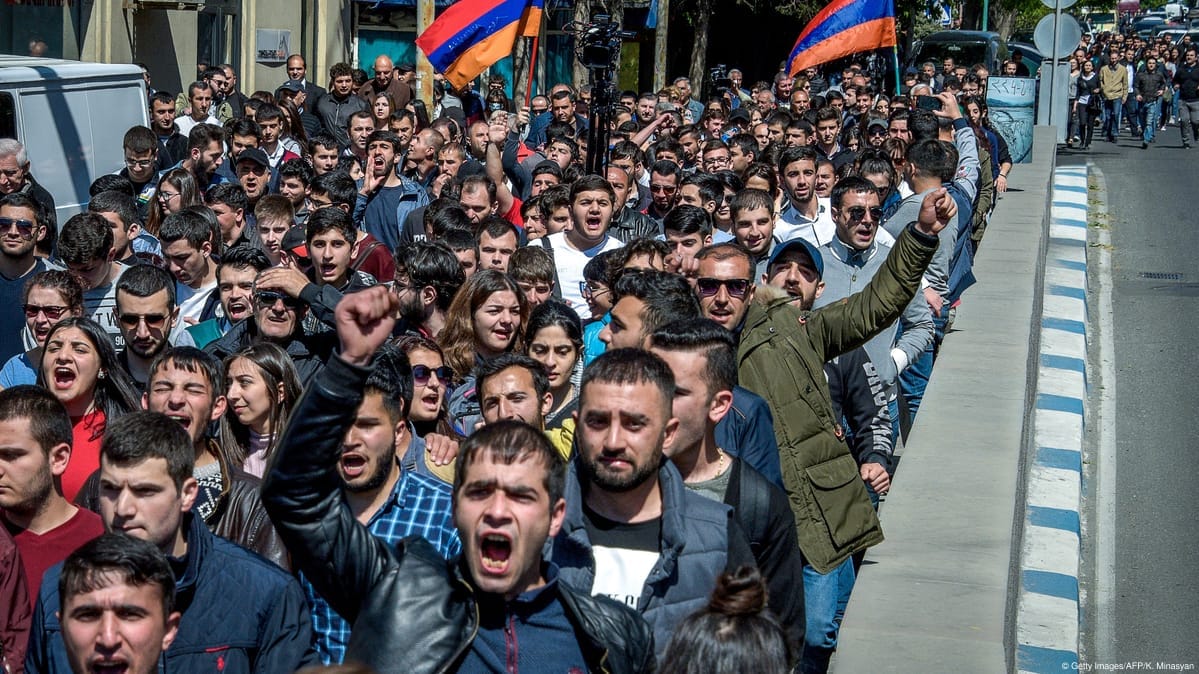
By defending the reference to the 1990 Declaration of Independence, the Armenian opposition is in effect admitting that it does not recognize the sovereignty and borders of Azerbaijan. They want to leave in the Constitution a legal hook that will allow them, at the first convenient opportunity, to again raise the question of revising the outcomes of the war. This is classic revanchism in its purest form, lightly powdered with discourse about democracy, sovereignty and historical memory.
But at whose expense is the banquet? The leaders of the opposition parties, oligarchs and former officials handing out angry interviews from warm offices or prison cells are the ones who risk the least themselves. If they succeed in derailing the constitutional reform and burying the peace treaty, it will be ordinary citizens of Armenia who will have to pay for this political adventurism. The very people who, instead of normal roads, open borders, trade and investment, will again be told to tighten their belts, live in a besieged fortress and prepare their children for yet another senseless bloodshed for the sake of someone else's political ambitions.
The price of stubbornness
Rejecting the peace agenda for the sake of preserving revanchist illusions in the constitution drives Armenia into a hopeless historical dead end. While the Armenian authorities talk about logistics hubs and integration into global transport corridors, the Armenian opposition offers the country the eternal role of a geopolitical dead end. A country that has locked itself in a cage of its own complexes and legal anachronisms.
The irony of fate lies in the fact that even the most ardent critics of the draft new constitution must understand the futility of their course. Armenia has neither the demographic, nor the economic, nor the military resources ever to realize in practice those claims that are sewn into the preamble of the current basic law. All their loud statements about the "inadmissibility of concessions" are playing to the gallery, cheap populism aimed at the most radical and uncritical part of the electorate. But in politics, one has to pay for populism for real.

If Armenian society allows the revanchists to gain the upper hand again and block the adoption of the new constitution, it will with its own hands put an end to the prospects for lasting peace. There will be less willingness to invest in a country whose basic law leaves the door open for war with a neighbor. In that case, there can be no talk of any full-fledged unblocking of communications and normalization of relations in the region. Armenia will be left alone with its unresolved problems, economic stagnation and constant fear of tomorrow.
The opposition's attempts to drag the country back into the abyss of revanchism are not a defense of statehood, as they try to present it. This is slow political suicide. History has already proven more than once that states that live in the past and refuse to acknowledge reality inevitably lose their future. And today Armenia has perhaps one last chance to prove that it is capable of learning lessons from its own mistakes rather than walking in circles behind guides who have already once led it to catastrophe.