Ghada Abdel Latif: Current World Urban Forum places serious emphasis on practical implementation of projects
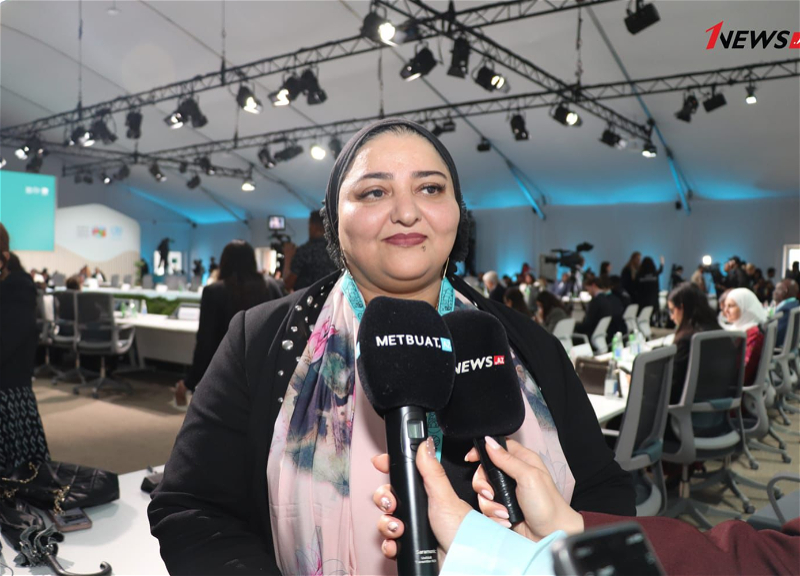
“The current session of the World Urban Forum, it seems, is placing a much more serious emphasis on practical implementation.”
As 1news.az reports, this was stated by Ghada Abdel Latif, architect, urbanist, expert on visual communications, founder and head of the “Wear Cities” project.
“Over the past 20 years, the forum has served primarily as a platform for dialogue, communication and exchange of ideas. Of course, these discussions were of great value, but questions of directly translating these ideas into reality often remained in the background.
The main difficulty has never been in the design itself — we have no shortage of ideas or technical knowledge. The real obstacles have always been related precisely to implementation: insufficient funding, fragmentation of state policy, problems in the sphere of governance, conflicts, natural disasters and global upheavals in general.
In many cases, projects are launched with partial funding — sometimes it amounts to only 40 percent of the required volume, which significantly complicates their completion. That is why the question of practical implementation is so acute.
What is truly encouraging this time is the increased attention to concrete solutions and achieving the final result. New technologies, including artificial intelligence, can significantly accelerate both planning and execution. Processes that traditionally took years can now be completed in months or even weeks, allowing solutions to be scaled faster and acted upon more effectively.
Yes, I believe progress is possible, because the foundation for it has already been laid. What matters is that today stakeholders are actively asking how to improve implementation mechanisms and how to increase the efficiency of joint work.
The reality is that problems in the housing sector are not decreasing; on the contrary, they are worsening, so action must be taken immediately.
One of the most important aspects of this discussion is the integration of “top-down” and “bottom-up” approaches. The “top-down” approach implies the leading role of the state and policy formation, while the “bottom-up” approach means direct involvement of local communities.
When authorities work closely with the population, the solutions developed are more likely to reflect people’s real needs rather than speculative assumptions. It is precisely this integration that can ensure more practical, inclusive and sustainable results,” the forum participant noted.