Key takeaways from the big interview: what Mikayil Jabbarov talked about - VIDEO
Breakdown of the economy minister’s major interview with İTV and AZƏRTAC — from GDP structure and the export model to the oil-and-gas strategy, artificial intelligence and the restoration of Karabakh.
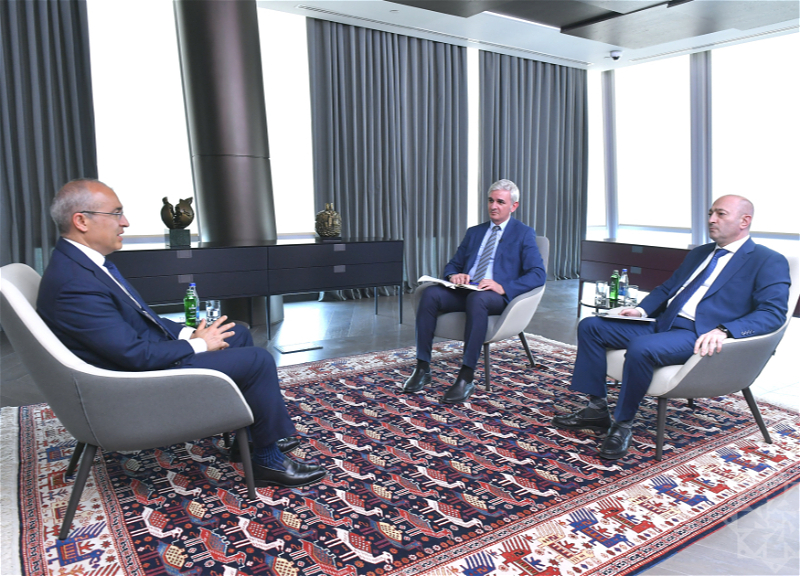
Economy Minister of Azerbaijan Mikayil Jabbarov gave a major interview to Public Television (İTV) and the State News Agency (AZƏRTAC). It is a programmatic statement in which the minister simultaneously sums up results, explains the logic of economic policy and sends signals to investors. The main thesis is contained in the title of the interview itself: the non-oil sector has already become the leading force in the country’s economy. At the same time, Jabbarov directly notes that the current year is “not ordinary.”
Below is a breakdown of what the minister said by main topics.
Where we are and where we are going
Jabbarov builds the entire conversation around the question of what kind of economy we want to see in the country. The answer is an economy that rests, on the one hand, on a solid financial foundation and, on the other, is diversified and does not depend on any single natural resource (in our case, oil and gas) or one sector.
The minister describes the strengths as follows: many years of macroeconomic and macro-fiscal stability, foreign exchange and gold reserves exceeding GDP, declining external debt and growing reserves even against the backdrop of external shocks. The limitation is the narrowness of the domestic market. Hence the conclusion on which the entire model rests: a sustainable economy cannot be oriented only toward the domestic market; it must be export-oriented. Moreover, Jabbarov interprets exports broadly — not only physical goods, but also services (tourism, financial and professional services) that also bring currency into the country.
The central figure of the interview illustrates how far the country has advanced along this path. At the end of 2025, more than 71% of GDP — 71.5% — comes from the non-oil sector, meaning the share of oil and gas is less than 30%. Twenty years ago, the non-oil sector did not even reach 45% (about 43.5%). The minister presents this shift as proof of the success of the policy — especially since over the same two decades the country experienced a deep devaluation shock. At the same time, he stipulates that the achieved level of diversification does not satisfy him as final.
Priority sectors
Jabbarov calls the definition of priorities an inclusive process — it is conducted not at the level of one department, but in coordination of the entire government, including through the Economic Council.
The minister puts non-oil industry in first place as the basis of economic sustainability: unlike trade, it requires a long horizon and is tied to human capital and know-how. He sees great potential in mining and metallurgy — thanks to rich geological resources, a significant part of which (gold, copper, silver, possibly critical minerals) is located in the liberated territories; the relevant state program is in the final stage. Also included among the priorities are the chemical industry based on oil-and-gas raw materials, agriculture as an important item of non-oil exports, transport and logistics (the Middle Corridor, the North–South route) and tourism.
Separately, the minister highlights two directions — not as sectors, but as “fundamental conditions” for a successful economy: digitalization (ICT and data centers) and energy, and specifically energy in the broad sense, not only oil and gas.
Export model
Jabbarov insists on a separate analysis of non-oil exports: policy instruments have little influence on oil-and-gas prices and volumes, whereas the state can directly stimulate non-oil exports. The dynamics, he says, are positive: over the past six years non-oil exports have approximately doubled, and in the first four months of this year they grew by more than 17%.
The minister considers two tasks key — expanding the range of products and expanding the geography of supplies. Here a limitation arises: Azerbaijan has free-trade agreements only with post-Soviet countries. He sees the way out in preferential trade agreements — growth in non-oil exports for a number of goods is already observed with Turkey, the UAE and Pakistan.
An important semantic emphasis: in the Azerbaijani context the largest investor is the state itself. Private investment is valuable not only for capital, of which, according to the minister, there is enough in the country, but also for knowledge, technology and cost reduction. Jabbarov breaks down the export breakthrough itself into four elements that need to be worked on simultaneously: product quality, recognition and brand, reliability of transport and logistics links, and availability of financing. He calls a stable trade surplus a factor supporting the manat exchange rate and price stability, in contrast to a number of countries in the region where a deficit leads to inflation and currency depreciation.
Support instruments and major projects
The minister acknowledges that some instruments have not yet been fully utilized. Among the permanent mechanisms he names industrial zones and the Alat free economic zone. Subsidizing interest on bank loans is expanding — an instrument first widely used during the COVID pandemic, now applied not only to the liberated territories or individual spheres. Measures are being developed to reduce logistics costs, as well as an innovation on VAT accounts: businesses may be allowed to use funds in separate VAT accounts for other payments to the state, primarily social insurance, in order to free up working capital. This is supplemented by investment incentive mechanisms with tax and customs benefits, broad exemptions in the liberated territories and in Nakhchivan, as well as preferential loans through the Azerbaijan Business Development Fund — more than 200 million manats per year, mainly to small and medium-sized businesses.
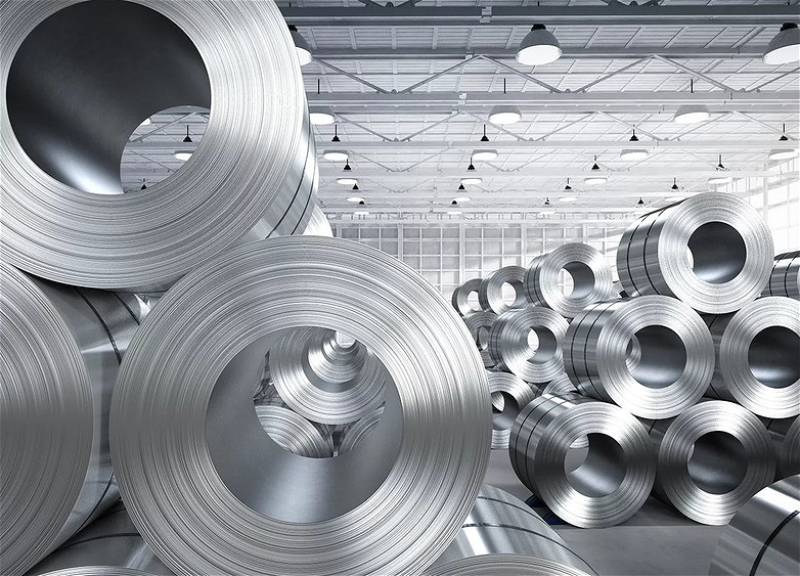
Among specific projects that will strengthen export potential, the minister highlights the Dashkesan iron ore plant (about 2 billion manats), development of the Zod deposit and doubling aluminum production. A separate block is green energy: the Masdar solar station (230 MW) and the ACWA Power wind station (240 MW) are already operating, and the “Şəfəq” project with the participation of bp and SOCAR is being implemented. By freeing up gas previously used for electricity generation, these projects expand export opportunities. The strategic framework is to see Azerbaijan not only as an energy producer, but also as an energy hub.
Oil and gas becomes energy
The minister directly acknowledges that the peak of oil production was passed 16 years ago. In 2010 about 51 million tons were produced, in 2025 — 27.7 million tons. At the same time, oil and gas still account for about 30% of GDP and remain an important source of income, for which there is no real alternative on the horizon of decades. The fundamental approach is not to tie development to fluctuations in world prices, but to seek a solution in the sustainability of the economy.
Jabbarov divides the strategy into two parts. Inside the country reserves are still large: new projects will be launched and existing ones will continue to operate — deep gas at Azeri–Chirag–Gunashli, full-scale Absheron, start of production at Babek, second phase of Umid, resources of Bahar and Gum-Deniz, the Karabakh project. Unconventional production methods are being studied, but the minister asks that they be treated as a “bonus, not the base.” Externally, SOCAR is expanding its presence not only in refining but also in production: projects in the UAE, the first entry onto the African continent (a large field in Côte d’Ivoire), participation in gas production in Israel, the purchase of the Italian Italiana Petroli (35%, two refineries and a network of gas stations), an agreement on the Uzbek Üstyurt field with bp.
The minister recalls that Azerbaijan supplies gas to 16 countries, which in the current geopolitically sensitive period increases its role, and announces the construction of a new refinery — one of the most capital-intensive decisions of recent years, with a timeline of about 5–6 years. The overall conclusion: the sphere should be approached as energy in general, and not only as oil and gas.
Digitalization and artificial intelligence
Jabbarov interprets digitalization not as a separate sector, but as an element of basic literacy of any economy. In December 2025 the Program to Support the Development of the Digital Economy was adopted; as an example, the minister cites the development in 2026 of digital transformation roadmaps for 15 selected enterprises — in order to clearly demonstrate to business the economic effect of digital solutions.
A Council for Digital Development headed by the First Vice President has been created on artificial intelligence and data centers. The most noticeable part of the interview is the announcement of a future statement: in the coming months an official announcement is expected about new data centers, including for AI tasks, with well-known global technology partners — as the “logical outcome” of the president’s meetings in Davos (January 2026) and Munich (February 2026). The minister notes that demand for the supercomputer of the Ministry of Economy already exceeds its technical capabilities, and links the prospect with the export of such services to neighboring countries due to a stable investment climate, affordable energy and telecom connectivity. The closing link is human capital and cooperation with universities.
Digital solutions, according to the minister, also remain a key tool in the fight against the shadow economy. He calls the mechanism of exempting individuals in the non-oil and non-state sector from income tax, which operated for seven years (2019–2025), the most effective: on average more than 70 thousand permanent employment contracts per year, about 500 thousand over seven years, with a parallel increase in tax and social revenues and average wages. A significant part of this result, in his assessment, was ensured by the emergence of employment from the shadows, although he considers the problem not fully resolved.
“An unusual year”
The minister directly calls the current year “unusual.” The crisis in the Gulf, he says, affects not only oil and gas, but also the prices and volumes of fertilizers and metals, and it is difficult to predict the dynamics of agricultural products. The main problem area named is a sharp decline in construction, and Jabbarov emphasizes that it concerns state, not private, construction, and is connected with the postponement of a number of state projects to the next stage. In the rest of the non-oil-and-gas sector growth is recorded, and the minister repeats the key thesis: non-oil-and-gas has become the leading force of the economy.
As benchmarks he cites average growth rates — 6% in 2021–2025 and 5.7% in 2022–2025, comparing them with the world 2.9%, 3.8% for developing countries and 3.9% for upper-middle-income countries. By sectors in the first months of the year growth was distributed as follows: ICT — about 9%, non-oil industry — 7.8%, transport — 4.5%, trade — 3.7%. Tourism is slowing due to the regional situation. The minister explains the logic of reserve policy as directing additional revenues to the reserves of the Oil Fund and the Central Bank for the sake of macro-stability; he interprets investments in the liberated territories not as expenditure, but as a long-term investment.
Karabakh and East Zangezur
Jabbarov defines the liberation of these territories primarily as a national idea, and not a purely economic task. He poses the economic question as follows: in what sequence to carry out restoration in order to obtain an optimal result — given that the first condition for return is economic sustainability, that is, guaranteed employment and activity for those returning.
The basis of the approach is the economic specialization of districts and two industrial parks. The Aghdam industrial park is oriented toward the industrial potential of the region: 31 residents and 5 non-residents, of which 13 enterprises are already operating, and in terms of the number of residents it is second after the Sumgayit park. “Araz Vadisi” (20 residents, 3 non-residents) serves transport, logistics and the functions of the Zangezur corridor. The state creates infrastructure on the principle of “laying the road in advance.” The minister sees great potential in mining (Shahbulag, Dovlatyarly, Khojaly, the “Damirli” complex in Agdere, Zod, deposits in Gubadly and Lachin) and in agriculture, where the pilot agro-park model tested in Yevlakh is being transferred. A separate bet is on services and the creative economy: the “city–university” model using the example of Karabakh University in Khankendi, including multilingual education.
The next stage is the Second State Program of the Great Return: extension of preferential terms for taxes, customs, social payments and utility connections, new incentive mechanisms, expanded access to finance, continuation of geological exploration and strengthening of human capital.
Entrepreneurship
The minister names tax payments by the private sector as the main measure of success: the tax base arises from economic activity, therefore the growth of payments indirectly reflects the pace of business development. But this, he stipulates, does not mean that entrepreneurs have no problems.
Jabbarov ties state instruments to the diagnosis of a specific difficulty: preferential loans and interest subsidies — to solve the problem of access to finance; state guarantees on loans — for entrepreneurs without collateral; investment incentives and startup certificates — for priority projects. The logic of geographic and sectoral benefits is to push business where the country needs it: industry with a long payback horizon of 7–8 years is more important to the minister than quick trade.
He openly acknowledges difficulties — access to financing, in places excessive state regulation and, separately, situations when state structures act as market participants, which raises the question of equal conditions and healthy competition. In confirmation of positive dynamics, the minister cites figures: in four months investments in fixed capital of the non-state segment of the non-oil-and-gas sector grew by more than 15%, and the share of the non-state sector in investments rose to 51.1%. The conclusion is movement in the right direction, although, according to Jabbarov, the voice of the entrepreneurs themselves is fundamentally important to him.