AFB Bank, Yelo Bank and AccessBank: a new trio tops the Central Bank’s anti-ranking in June
The Central Bank of Azerbaijan has published the complaint index of banking customers for June 2026.
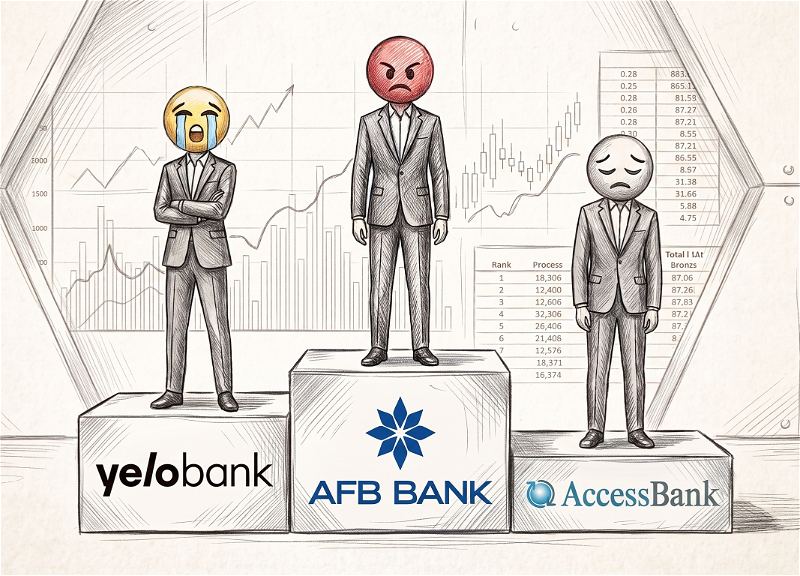
Once again the report took slightly longer than usual to arrive, but the data proved more interesting than expected. The upper part of the table is now formed by an unfamiliar combination: AFB Bank, which has topped the anti-ranking for the first time in the entire observation period; Yelo Bank, which climbed to second place with its highest index since December 2025; and AccessBank, which has held the third row for the second month running with one and the same reading — 1.99.
AFB Bank: the pause turned out to be anything but a victory
A month ago, commenting on AFB Bank’s return to the table after a “zero” April, we called its April disappearance “a statistical pause, not a turning point.” June confirmed that conclusion with room to spare: the bank did not simply return — it topped the anti-ranking with an index of 2.27. As recently as April, the regulator received not a single complaint about AFB Bank — and two months later it is the sector’s anti-leader. From zero complaints to first place — in two months.
For AFB Bank this is its first anti-leadership in all 19 months of observation: until now its best “achievement” had been 2nd place in January 2026 with an index of 3.83. With this, seven different banks have now stood at the top of the anti-ranking since January 2025: Yapı Kredi, Bank BTB, TuranBank, Yelo Bank, Expressbank, Bank Avrasiya — and now AFB Bank.
Another detail is worth noting. This latest disappearance from the list was already the third for AFB Bank over the observation period: the bank vanished from the table in May–June 2025, then in August–September, then in April 2026. But whereas it returned from the first two “pauses” into the middle of the table (5th place in July, 8th in October), this return has ended at the very top. A flickering mode of presence — now zero complaints, now the upper rows — is an unusual trajectory in itself, and against this background the April zero looks less and less accidental.
June’s anti-leadership, however, will hardly come as a surprise to readers of our April study, “AFB Bank: a diagnosis and 3 scenarios for the future of the ‘experiment bank’”. To recall the key point: in 2025 the bank staged a “credit sprint,” expanding its loan portfolio by 59.8% — against sector-wide growth of 2–3% — and we linked the surge in its complaint index at the turn of the year precisely to the aggressive expansion of the customer base without commensurate investment in service infrastructure. AFB Bank’s average index for 2025 stood at 1.49 — June’s 2.27 is half as much again. A flow of complaints disproportionate to the bank’s scale is the price of the sprint, and the June table shows that the bill has not yet been paid in full.
Let us repeat the regulator’s standing caveat: the complaint index poses no threat to banks’ financial stability or operations. But the question for AFB Bank after June is a simple one: was the April silence the result of real work with customers — or merely a lull before the next surge? So far the data point to the latter.
Yelo Bank: the “quiet lodger” that reached second place
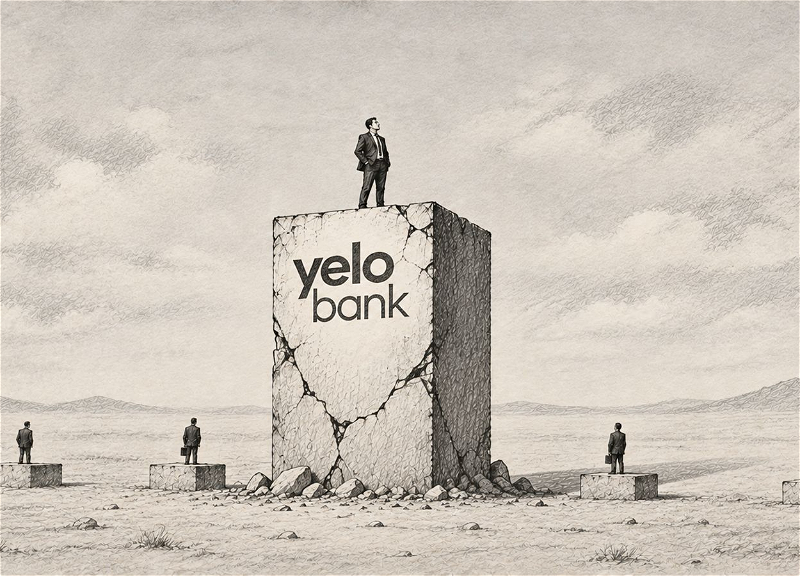
In our May review we described Yelo Bank as the “quiet lodger” of the upper rows — methodically avoiding the front pages while never leaving the upper part of the table. In June the quiet streak very nearly ended loudly: 2nd place with an index of 2.06, the bank’s highest since December 2025.
There is a calendar rhyme here as well: exactly a year ago, in June 2025, Yelo Bank topped the anti-ranking with an index of 3.75 — its maximum for the entire observation period. Back then the bank managed to slide back into the middle of the table within a couple of months. The current trajectory — 3rd, 5th, 4th and now 2nd place from March through June — traces not a spike but a methodical ascent, and that is more worrying than one-off records.
AccessBank: the swings have stopped. At the top
The strangest number in the June table is AccessBank’s 1.99. Not because it is high, but because it repeats May’s reading exactly, down to the hundredth. The bank whose movements around the table we have twice described with the word “swings” — a leap to 2nd place in May 2025, a slide into the lower half, a new leap to 3rd in May 2026 — has frozen for the first time. Unfortunately for its customers, it has frozen in the upper third of the table: two consecutive months in 3rd place with an index a hair’s breadth from 2.0.
If May’s surge could still be written off as a one-off glitch, two identical months in a row are a level, not an outlier.
The red zone is empty — for the first time in 19 months
The three stories above share a common background — one that arguably outweighs each of them in structural importance. The June table contains not a single bank in the red zone — the zone of indices above the sector average in the regulator’s own classification. Nine banks are coloured yellow, eight green. This has never happened before over the entire observation period: in May the red zone had already shrunk to a single bank, and now it has emptied completely.
The anti-leader’s index — 2.27 — is the second-“mildest” first-place reading in the entire history of our monitoring, after April’s 1.92. The range of values: 0.20–2.65 in May against 0.21–2.27 in June. Formally, the sector continues to cool.
But this medal has a reverse side: the top of the table is denser than ever.
A mere 0.42 points separate the top five of the anti-ranking (from 1.85 to 2.27), and the yellow zone holds nine banks at once, with indices from 1.24 to 2.27. In other words, the sector no longer has a single “bad bank” against whose background everyone else looks respectable. What it has is a dense group of seven to nine banks with comparably elevated levels of customer discontent — and the new trio in the headline merely leads that group, without breaking away.
Anti-leadership without a breakaway is good news for AFB Bank, but not necessarily for the sector.
Bank of Baku: a third month of growth and a personal anti-record
The trend we warned about two months in a row has not gone away. Bank of Baku has posted a third consecutive month of index growth without a single pause: 1.01 → 1.63 → 1.72 → 1.92 from March through June. That now means 4th place — and, more importantly, the bank’s personal anti-record for all 19 months of observation: the previous maximum (1.91) had stood since January 2025.
Our hypothesis is unchanged: at Bank of Baku’s scale of card issuance, every technical failure and every app update is multiplied across millions of users, and the “tax on mass scale” has turned from occasional payments into a regular one. Yet regularity is precisely what distinguishes a systemic problem from a situational one. If the growth continues in July, Bank of Baku will become the main candidate for the anti-leadership of the second half of the year.
A side observation that is hard to pass over: Bank of Baku and the month’s anti-leader AFB Bank are linked by a common shareholder — Hikmat Ismayilov owns 99.6% of AFB Bank and 31.1% of Bank of Baku, while AFB’s current chairman of the executive board, Amid Ganbarov, came precisely from Bank of Baku. In June, two banks of the same group found themselves simultaneously in the top four of the anti-ranking: 1st and 4th places. For a group betting on rapid retail growth this is an unpleasant symmetry — and something to watch in the issues to come.
Unibank: a retreat to previously prepared positions
A month ago we wrote that Unibank’s entrenchment in 2nd place with a rising index was “the worse of the two options” compared with volatility. In June the bank broke its two-month streak of second places and dropped to 5th with an index of 1.85.
Good news? Only partly. 5th place is Unibank’s “permanent registration” of the first months of the year: that is exactly the row it occupied in January, February and March. Over the six months of 2026 the bank has never dropped below 5th position, and its index fluctuates within the narrow corridor of 1.64–2.34. What we are seeing is not a de-escalation but a return to the chronicle: complaints keep arriving in volumes disproportionate to the bank’s scale — it is simply that in June other banks “overtook” it in this dubious competition.
Bank Respublika: the trend that, fortunately, never materialised
Here we must own up: a month ago, looking at the uninterrupted growth of Bank Respublika’s index since January (0.61 → 0.88 → 0.93 → 1.11 → 1.48), we suggested that summer would see the bank “among the main protagonists of the anti-ranking.” The forecast did not come true — and this is the kind of error one can only be glad about.
In June Bank Respublika’s index fell to 1.04, the bank dropped to 12th place and returned to the green zone. The streak of continuous deterioration that had lasted from January through May — the longest in the sector — has been broken. One month does not yet make a trend reversal (a caveat that has proved prophetic in our reviews more than once), but the very fact that the bank managed to break the inertia is the best result of the month among the banks of the upper half of the table.
The supporting cast: VTB’s zigzag, Azər-Türk’s record and Avrasiya’s fifth month of silence
Expressbank, May’s “number one,” dropped to 6th place with an index of 1.51 — against 2.65 a month earlier. This is already the bank’s fourth sharp move in six months: 3.01 → 2.64 → 1.82 → 2.65 → 1.51. The amplitude testifies to the instability of the bank’s internal complaint-handling process.
Yapı Kredi Bank — 7th place (1.51), continuing its descent from April’s summit. The volatile behavioural pattern we have described repeatedly is playing out fully in line with the forecast.
Bank VTB Azərbaycan continues the strangest series in the table — a strict alternation of ups and downs for the fifth month running: 11th place, 17th, 8th, 17th and now 8th again (1.32). With a small customer base every complaint moves the index noticeably, but the sheer perfection of the zigzag is beginning to raise a smile.
Azər-Türk Bank (ATB) — the best dynamics of the month: 0.39, 16th place and the bank’s absolute minimum in all 19 months of observation (the previous one — 0.56 in June 2025). After the February–March surge the bank has improved its reading for the third month in a row, and the theory that the new management team has taken complaint handling seriously keeps gaining support.
Bank Avrasiya is absent from the table for the fifth consecutive month — since the record January reading of 6.89 the regulator has not received a single complaint about the bank. There is nothing new to add; clarity, as we wrote, will come with the analysis of the audited 2025 accounts, which we will publish in the coming days.
Azərbaycan Sənaye Bankı (ASB), which returned to the table in May after six months of absence, disappeared again in June. Premium Bank, by contrast, is back — 13th place (0.83). Ziraat Bank is absent for the second month running. Rabitəbank (1.24), Xalq Bank and ABB (1.06 each), Kapital Bank (0.75) and TuranBank (0.40) — no notable movements.
PAŞA Bank closes the table with an index of 0.21, extending a unique series: 19 months of monitoring — and not a single exit from the green zone.
Dynamics of the key banks (March — June 2026)
|
Bank |
Mar 2026 |
Apr 2026 |
May 2026 |
June 2026 |
|
1. AFB Bank |
1.45 (7) |
— |
1.59 (7) |
2.27 (1) |
|
2. Yelo Bank |
1.80 (3) |
1.49 (5) |
1.96 (4) |
2.06 (2) |
|
3. AccessBank |
0.78 (14) |
0.87 (12) |
1.99 (3) |
1.99 (3) |
|
4. Bank of Baku |
1.01 (10) |
1.63 (4) |
1.72 (6) |
1.92 (4) |
|
5. Unibank |
1.64 (5) |
1.88 (2) |
2.01 (2) |
1.85 (5) |
|
6. Expressbank |
2.64 (1) |
1.82 (3) |
2.65 (1) |
1.51 (6) |
|
7. Yapı Kredi Bank |
— |
1.92 (1) |
1.75 (5) |
1.51 (7) |
|
8. Bank VTB Azərbaycan |
0.41 (17) |
1.10 (8) |
0.20 (17) |
1.32 (8) |
|
9. Bank Respublika |
0.93 (12) |
1.11 (7) |
1.48 (8) |
1.04 (12) |
|
10. Azər-Türk Bank |
2.16 (2) |
1.07 (9) |
1.04 (11) |
0.39 (16) |
|
11. Bank Avrasiya |
— |
— |
— |
— |
|
12. PAŞA Bank |
0.65 (15) |
0.52 (15) |
0.43 (14) |
0.21 (17) |
“—” denotes absence from the ranking (zero complaints during the month). The figure in brackets is the bank’s position in the ranking.
What comes next
June has left the sector in an unfamiliar configuration: the red zone is empty, there are no extreme indices, but the yellow middle is denser than ever — nine banks in the 1.24–2.27 range. This is where the plots of the second half of the year will be decided: whether AFB Bank holds on at the top or “blinks” down to zero again; whether Bank of Baku keeps rewriting its personal records; whether AccessBank’s swings unfreeze; whether Unibank’s retreat to 5th place proves a breather or the start of a decline. And the main structural question: will the red zone return — or is the sector genuinely settling onto a new, more even level.
First News Intelligence Unit will continue its monthly monitoring of the complaint index, paying particular attention to the banks occupying the upper rows of the anti-ranking. We are convinced that the quality of work with customer complaints is not only a matter of reputation, but also an indicator of the maturity of a banking business.
First News Intelligence Unit (FNIU) is the analytical arm of the 1news.az editorial team, specialising in research on Azerbaijan’s financial sector and economy.
Read in other languages:
AFB Bank, Yelo Bank и AccessBank: новая тройка возглавила антирейтинг Центробанка в июне