Ilham Aliyev attends opening of energy storage center
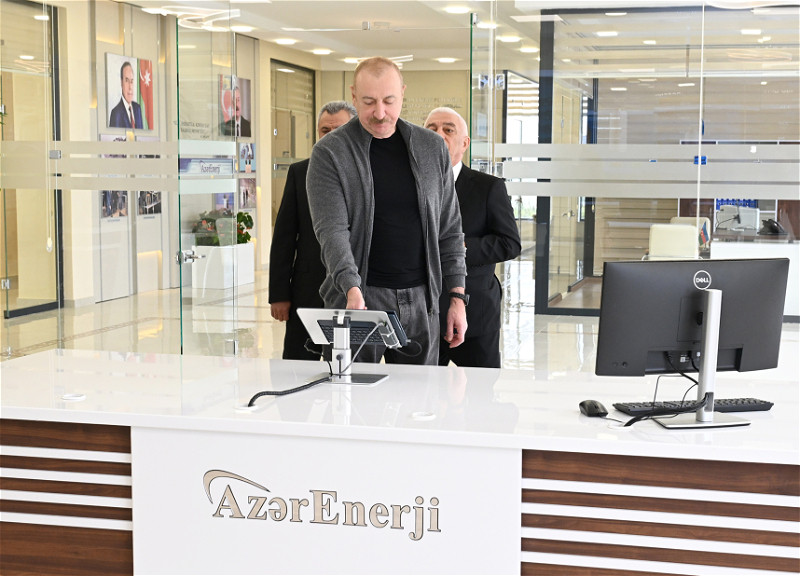
On March 25, President of the Republic of Azerbaijan Ilham Aliyev participated in the opening of the "Absharon" Battery-Based Energy Storage Center of the Open Joint Stock Company (OJSC) "AzerEnergy".
As reported by AZERTAC, the Chairman of the Board of OJSC "AzerEnergy", Baba Rzayev, informed the head of state about the "Absharon" Battery-Based Energy Storage Center.
It should be noted that Azerbaijan is entering a new stage of development in the energy sector. On the instructions of President Ilham Aliyev, OJSC "AzerEnergy", using entirely internal financial resources, has established large-scale energy storage centers with a total capacity of 250 MW and an energy storage capacity of 500 MW/h at the sites of two main substations – the 500-kilovolt "Absharon" substation and the 220-kilovolt "Agdash" substation. Centers of this scale have been created for the first time not only in Azerbaijan but also in the entire CIS region.
Within the framework of the project, 50 battery units and 13 container inverters have been installed at the "Absharon" Battery-Based Energy Storage Center. A study conducted by international consulting companies (the American TETRA Tech and the Turkish EPRA) highlighted the necessity of creating such battery systems in Azerbaijan for the safe integration of nearly 1850 MW of renewable energy sources into the energy system.
The Battery-Based Energy Storage Center is characterized by high speed. For instance, the batteries can fully charge or discharge in two hours. Energy, including that generated during sunny hours, is accumulated here and automatically supplied to the grid during peak hours when the demand for electricity increases. Thus, these systems store and retain energy, directing it for use when needed.
The implementation of such a center offers numerous advantages for the energy grid. For example, through the SCADA system, real-time control of the energy system is ensured, network stability, including frequency and voltage, is maintained, sudden energy shortages are automatically regulated, the impact of accidents is reduced, and the system becomes more reliable. Additionally, the demand for electricity during peak hours is met more efficiently, the impact of interruptions in solar and wind energy production is minimized, and it becomes possible to restore the energy system from scratch. At the same time, load changes during sunset hours are managed much more easily.
Thus, the creation of the Battery-Based Energy Storage Center makes Azerbaijan's energy system more modern, flexible, and sustainable. Especially during the period of increased solar and wind energy production, such storage systems are considered a key component of the future energy model.
A special control center for managing these systems has been established at the "Absharon" Battery-Based Energy Storage Center.
A modern management building has been constructed on the premises, and extensive landscaping and greening works have been carried out.
The head of state was also informed about the integration of renewable energy sources into the energy system and the digital transformation of the energy system.
It was reported that in the near future, large volumes of renewable energy sources will be integrated into the energy system, and by 2028, more than 2100 MW of green energy will be available in the grid.
Taking this into account, the main phase of work within the AZURE project has already been completed. This project is being implemented for the sustainable and safe integration of 2 GW of renewable energy sources into Azerbaijan's energy system, increasing the share of green energy in the energy supply of Baku, including the Alat Free Economic Zone, and directly connecting the 500/330-kilovolt "Navai Green Energy" node to the country's energy system, transforming it into one of the main nodal substations.
Under the project, a 500-kilovolt transmission line stretching 65 km has been laid from the "Absharon" substation to the "Navai" substation, and a 330-kilovolt transmission line with a total length of 181 km has been laid from the "Banka" and "Bilyasuvar" solar power plants. In the future, it is planned to lay a 500-kilovolt transmission line stretching 235 km from Mingachevir to the "Navai" substation, and a 330-kilovolt transmission line with a total length of 103 km from Guba, Alat, and Gobustan.
Over the past 7 years, a 4700-km fiber-optic cable infrastructure has been created, along with a central SCADA system covering more than 550 energy facilities.
Online diagnostic technologies (AGC, WAMS/WACS), accident forecasting, and diagnostic systems based on artificial intelligence are being applied in the energy system. A high-precision forecasting system is being developed for solar and wind power plants.
To achieve fully automated management of the energy system, a Digital Management Department has been established within the internal structure of OJSC "AzerEnergy".
It is forecasted that electricity consumption will increase by approximately 17 percent by 2032. During this period, renewable energy capacities of 8 GW will be created.
The main goal is to export green energy to European markets through the Black Sea Cable, regional energy corridors, and other projects. The capacity of the Black Sea Cable will be 1300 MW of green energy.
The head of state pressed the button symbolizing the opening of the "Absharon" Battery-Based Energy Storage Center.