Our Tea is the Most Effective Diplomatic Tool: The Story of Roza Ramazanova in Malaysia
Malaysia is one of the most dynamically developing countries in Southeast Asia, where tropical nature coexists with modern megacities, and a multilingual cultural environment shapes a unique rhythm of everyday life.
People from all corners of the world come here to work, study, and build new professional paths, gradually turning the country into a hub for international specialists and young families who have decided to relocate in search of opportunities and a new life.
Imagine that one day the familiar world map changes, and home is on the other side of the globe. Amidst eternal summer, warm rains, and a multitude of cultures speaking different languages.
All of this has become part of Roza Ramazanova’s story. For three years, she has been living in Malaysia, balancing her professional career as a Supply Chain specialist with motherhood, while sharing insights about the culture, traditions, and modern life of Azerbaijan with those around her. In a conversation with 1news.az, the native of Azerbaijan spoke about her family’s life in a country so far from her homeland.
- When did the idea of moving first come to mind? And why did you choose Malaysia?
- The idea of moving came in 2023 when I received a job offer in Malaysia. The decision was made quite quickly, as the country immediately resonated with me on a personal level. The proximity of religion, the genuinely respectful attitude of people toward each other, the multicultural environment, and the sense of safety for a family with children were key factors in the choice. And a pleasant bonus—summer all year round. At first, it seemed like a dream, but today it has become part of our daily life.
- Are there things in Malaysia that feel much more convenient than in Azerbaijan? Or, conversely, are there things that still feel unfamiliar and challenging?
- In Malaysia, the overall atmosphere of life is particularly comfortable. People here are calm, polite, and open, with great respect for personal boundaries, so adaptation happens quite easily. What feels most unfamiliar is the climate. Summer all year round initially felt like a resort bonus, and we kept waiting for a change of seasons and a “real autumn.” Over time, it became clear that autumn isn’t planning to arrive here. Eventually, we accepted the local reality, where air conditioners have become our constant and reliable companions.
- Were there stereotypes or misconceptions about Azerbaijan that you had to dispel?
- Yes, quite often. Unfortunately, not everyone is well-informed about Azerbaijan, and this has become an internal motivation for me to be more active. Sometimes people are genuinely surprised that we have a modern country with a rich culture, deep history, and very strong family values. I always say that if people know little about a country, it means we have a wonderful opportunity to tell them about it properly.
- What in your stories about Azerbaijan sparks the most interest among people?
- The first thing that Azerbaijan is often associated with is Formula 1. And that immediately generates lively interest. Then come questions about the language, religion, and traditions. And after that, usually, tea. I’ll admit, I’ve already treated many colleagues to traditional Azerbaijani tea. It’s probably the most effective diplomatic tool.
- Were there school or community events where you represented Azerbaijan? How did that happen?
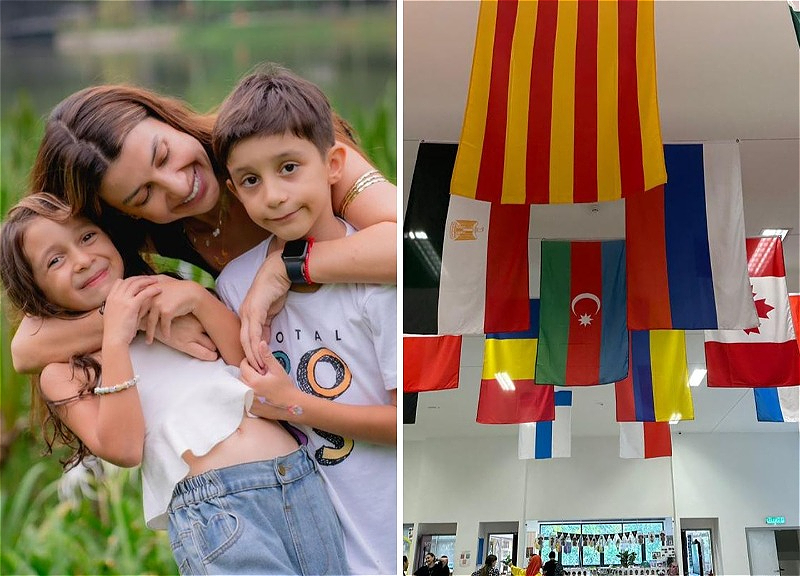
- Yes, and one moment was especially significant for me. When my son Farhad started school, I noticed that among the flags of different countries, there was no flag of Azerbaijan. I officially approached the school administration, and within a month, our flag was hanging among the others. It was especially symbolic that this happened almost on November 8—Victory Day. For me, it was a moment of immense pride because, thanks to my son, the flag of our country appeared in a school in Kuala Lumpur. This is very important both for raising children and for fostering a sense of patriotism—quietly, with dignity, and through actions.
- How did your children handle the change of country and environment?
- The children adapted to the move surprisingly easily. Perhaps because they are very open and kind, and at the time of the move, they were quite young. My daughter Amina was only 4 years old, and for her, the whole world was a big adventure. Sometimes I feel that it was the children who taught us to adapt faster than we expected.
- Was it easy for the children to make friends in an international environment?
- Very easy. Even too easy. They quickly made friends from different countries, and now their social circle is much wider than mine. Sometimes I catch myself thinking that I still have a lot to learn from them, especially when it comes to communication and openness to the world.
- Thank you for your answers, and we wish you all the best!
Jamilya Sujadinova