Not just a farewell: What lies behind the Russian ambassador's presence at Balayan's funeral
Funerals are not only about saying goodbye to a person. In politics, they are always about signals. About choosing a side. About demonstrating values.
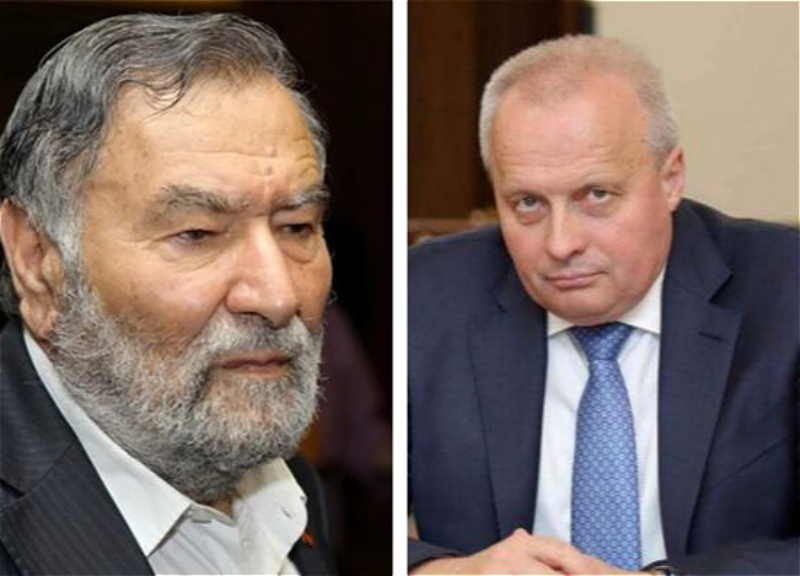
The presence of the Russian Ambassador to Armenia, Sergey Kopyrkin, at the farewell ceremony for Zori Balayan, whose radical ideas, historical falsifications, texts, and public speeches have for many years shaped the ideological foundation of Armenian chauvinism, fueled an atmosphere of hostility, and became one of the cornerstones of Armenia's occupation policy, a policy of terror and genocide against the Azerbaijani people, goes far beyond diplomatic protocol. This is not a gesture of courtesy—it is a marker of which figures are still perceived as 'one of us,' which ideologies are not only uncondemned but also receive tacit approval.
In Armenian public discourse, Balayan has been portrayed for decades as a cultural figure, a writer, the 'voice of the nation.' However, behind this facade lay a much harsher and more dangerous reality. Zori Balayan was not merely a participant in the informational support of the conflict—he was one of its architects.
His texts, speeches, and political appeals formed the basis of the radical separatist thinking that led to the occupation of Azerbaijani territories. He systematically promoted theses about alleged 'historical injustice,' consistently denied Azerbaijan's territorial integrity, and justified the forcible seizure of our lands.
A special place in this ideological construct is occupied by his 2013 appeal to Russian President Vladimir Putin. This letter was not just a piece of journalism. It was a political manifesto containing an attempt to draw Russia into legitimizing the occupation of Azerbaijani territories.
In his open letter, Balayan reproduced key myths of the Armenian nationalist narrative. Among them was the claim that Karabakh was allegedly 'transferred' to Azerbaijan 'by Joseph Stalin's decision.' This thesis has been repeatedly debunked by historians, yet Balayan used it as a tool for political manipulation.
Balayan went further. He did not limit himself to Karabakh. His rhetoric also hinted at claims to other Azerbaijani territories. This was no longer a matter of historical interpretation—it was an overt program of territorial expansion. At the same time, he attempted to portray Azerbaijan as a state allegedly 'destroying Armenian cultural heritage,' while completely ignoring documented facts of the destruction of Azerbaijani monuments in the occupied territories. Such an approach can only be described as deliberate disinformation.
A key element of the letter was a call for Vladimir Putin to visit the then-occupied territories of Azerbaijan. This was not merely an invitation. It was an attempt to secure symbolic recognition by Russia of the results of the occupation.
This is where the broader logic of Balayan's actions becomes evident. His rhetoric over many years was synchronized with the Kremlin's interests in the region. He promoted theses that objectively increased Armenia's dependence on Russia and created additional levers of pressure in the South Caucasus.
In this sense, Zori Balayan acted not only as an ideologue of Armenian radicalism but also as a conduit for external influence.
A telling episode occurred on February 26, 1988, when Mikhail Gorbachev received Zori Balayan and Silva Kaputikyan in the Kremlin as representatives of the separatist movement in Karabakh. The very fact of this meeting became a crucial signal: a movement that was destructive and unconstitutional gained access to the highest political level of the USSR. This became one of the turning points when separatism began to move from the margins into the realm of major politics.
Balayan understood this perfectly and consciously exploited it. His strategy was built not only on propaganda but also on direct pressure through public appeals to the leadership of the USSR and later Russia. He openly acknowledged the effectiveness of this tool: 'I wrote an open letter to Leonid Brezhnev, didn’t ask anyone; this genre is very important, it brought us benefits. I wrote to Mikhail Gorbachev—didn’t ask anyone.'
In essence, this was a deliberate tactic—the use of media and political pressure to advance the separatist agenda through external centers of power. This is the key role of Balayan: he did not merely transmit ideas; he built channels for their legitimization at the highest level.
Therefore, his activities should be viewed not as the individual stance of a publicist but as part of a broader political technology in which ideology, propaganda, and external influence operated in sync.
Why the ambassador's presence is a signal
Against this backdrop, the participation of the Russian Ambassador to Armenia, Sergey Kopyrkin, in Zori Balayan's funeral takes on a fundamentally different meaning. In diplomacy, there are no 'random' gestures, especially at this level.
Moreover, such actions create a persistent impression that, in Russian political logic, revanchist rhetoric is not only uncondemned but continues to be seen as a tool of influence. This is not about memory or respect for the deceased—it is about political selection: who is recognized, who is supported, and who is ignored.
This is especially telling against the backdrop of Russia's official statements about a 'balanced' position in the South Caucasus. An obvious contradiction emerges: on one hand, rhetoric about neutrality; on the other, symbolic gestures that directly associate Russia with the ideologues of the conflict. Such duality cannot go unnoticed.
Amid the promotion of a real post-conflict agenda, the restoration of trust, the rejection of the language of hostility, and the recognition of new realities, a selective approach is demonstrated: convenient figures from the past, even with overtly radical backgrounds, receive tacit legitimization.
Support, even if symbolic, for such figures signifies an attempt to preserve old tools of pressure on the region.
In this context, Sergey Kopyrkin’s participation in the farewell to Zori Balayan appears not as a diplomatic formality but as an element of a broader line: an unwillingness to fully part with the legacy of conflict and revanchist narratives that were used to maintain geopolitical control. This is why this gesture is read unequivocally. It is not about the past but about current priorities.
Conclusion: A signal that was heard
For Azerbaijan, this is a signal: despite the changed reality, despite the restoration of territorial integrity, certain forces are still ready to rely on old narratives.
Today, the South Caucasus is undergoing a qualitatively new stage. Realities have changed. The balance of power has changed. But, as practice shows, the thinking of some actors remains the same.
Figures like Balayan are a legacy of the past that should remain in the past. However, their symbolic rehabilitation indicates that the revanchist agenda has not disappeared. It has merely transformed.
And this is precisely why the response to such signals must be clear.
The story of Zori Balayan's funeral is not an isolated episode. It reflects a deeper problem: the unwillingness of some political elites to abandon outdated, conflict-driven models of thinking.
The presence of the Russian ambassador at Balayan's funeral became a kind of litmus test. It showed where the real line of political sympathies lies.
And this signal has been heard in Baku.