French voyage with a double bottom: What do the 'peaceful' flights to Yerevan hide?
In big geopolitics, coincidences are a rare guest, and coincidences often serve as a signal for deep analysis.
When the visit of a high-ranking official to a European capital suspiciously coincides in time with the activation of heavy transport aviation on the same route, questions arise to which official Paris is in no hurry to give transparent answers.
An investigation by the AnewZ television channel highlighted specific logistical activity between France and Armenia, forcing a fresh look at the Elysee Palace's declarations about striving for stability in the South Caucasus.
Read on the topic:
Against the background of prolonged silence from official structures, the nature of these aerial maneuvers gives serious grounds to believe that behind the screen of ordinary flights lies something more than standard trade turnover or humanitarian missions. In the conditions of an unfinished peace process, any secrecy in matters of military supplies turns into a powerful factor of distrust capable of undermining the architecture of regional security.
Aviation logistics mysteries
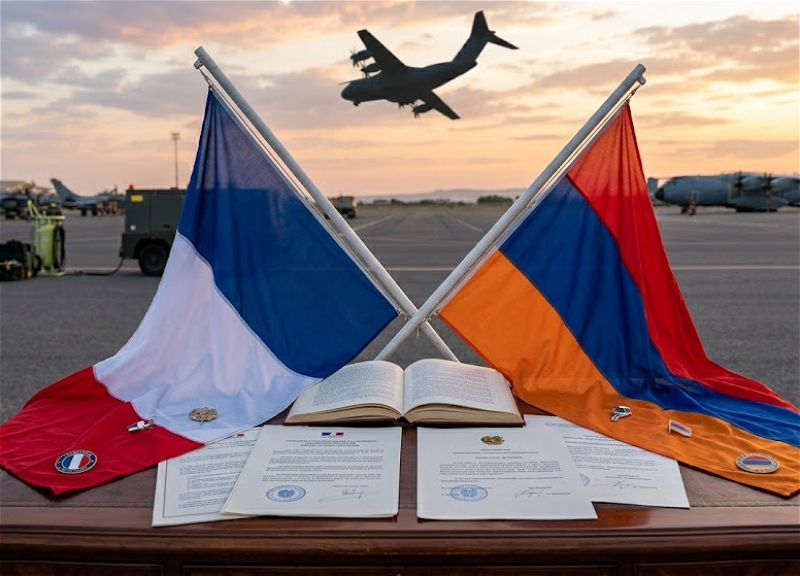
Tracking service data that formed the basis for AnewZ's exclusive material records a series of flights connecting French military facilities with Yerevan's Zvartnots airport. Air communication between states is in itself a routine procedure, but the geography of departures makes one think. The fact that the aircraft take off not from civilian air hubs but from points integrated into France's defense infrastructure allows for a reasonable assumption about the specific nature of the cargo being transported.
It is noteworthy that the investigative journalists do not make categorical statements but merely note the fact that the frequency of flights increased precisely during the period of intensified contacts between the defense departments of the two countries. The regime of limited publicity in which these flights are carried out only strengthens the likelihood that military property is in the belly of the aircraft. When the tonnage and frequency of flights find no reflection in official reports on humanitarian or civilian cooperation, natural suspicions arise of covert equipment transfers, which looks like a risky game in the conditions of a fragile peace. The same assumption is prompted by statements from representatives of the Armenian leadership regarding the importance of strengthening the country's defense capability through diversification of sources of military products, among which France is mentioned as one of the main suppliers.
Chronology and facts: Logical connection
One of the weightiest indirect arguments in favor of the version of hidden militarization is the sequence of events. Nikol Pashinyan's visit to France and subsequent meetings between Armenian Defense Minister Suren Papikyan and his French counterpart Sebastien Lecornu created a political foundation followed by practical implementation. The demonstration of French Bastion armored vehicles and preparations for the operation of CAESAR self-propelled artillery units spotted on Armenian territory chronologically correlate with transport aviation activity.
The logical chain is traced quite clearly: political agreements in Paris - a series of closed transport flights - and subsequent confirmation of the presence of modern equipment in the arsenals. The large-scale show planned for May 28 in Yerevan, where the latest purchases are to be put on display, can in this context be perceived not as an internal government report but as an attempt to demonstrate Armenia's new military capabilities with targeted external support. In this situation, the Elysee Palace's foreign policy, dissolved in military logistics, effectively turns France into a direct sponsor of militaristic sentiments, feeding revanchist circles in Armenia with the illusion that the language of force can still be effective.
Geopolitical compensation at the expense of the Caucasus
Analyzing the motives of the French side, it is hard to get rid of the feeling that Paris is trying to use the South Caucasus as a platform to compensate for its strategic failures in other regions of the world, particularly in Africa. The Elysee Palace apparently views Armenia as a key foothold, a convenient tool for preserving its influence in opposition to other global players. Under the cover of rhetoric about "protecting sovereignty," accelerated rearmament is taking place, masked as strategic partnership.
Officially confirmed plans for the supply of Mistral 3 air defense systems, radars, Airbus H145 attack helicopters, and other equipment indicate that Paris is consciously betting on strengthening Armenia's military potential. Such a course effectively removes France from the ranks of constructive participants in the dialogue, turning it into a party responsible for upsetting the balance of power. When a state prefers the status of arms supplier to the role of constructive participant in regional processes, it automatically assumes the risks associated with possible escalation caused by a false sense of security on the receiving side.
Reality versus revanchism
The current situation raises justified concerns, since strengthening the military component during peace negotiations is a path that can lead to destabilization. Official Baku has repeatedly emphasized that the militarization of Armenia deals a direct blow to the peace agenda. However, France's actions, including the covert flights, indicate Paris's readiness to ignore these warnings for the sake of its own ambitions.
The flights identified by AnewZ provide the factual basis for understanding the real scale of military-technical cooperation. The use of aviation corridors for military needs and disregard for regional security interests paint a portrait of a country whose actions are aimed at supporting one side to the detriment of overall stability. The decorations of French "peacekeeping" have finally given way to calculations for a long-term military presence.
Today the situation is perfectly clear. While Azerbaijan is focused on constructive and integration projects within the region, France and Armenia appear to be busy constructing new threats. However, no secret flights from Paris will change the fact that the fate of the region is now determined not in European offices but on the soil of the South Caucasus, where peace and creation have become the non-alternative priority.