Business racketeers in revanchist masks in Armenia
As Armenia approaches another electoral cycle, the political landscape is rapidly heating up, bringing with it the return of familiar tactics in the struggle for power.
The Armenian opposition is once again stepping into the arena under the slogans of 'national salvation,' but behind this rhetoric, there is an increasingly clear attempt not at development, but at revanchism—a return to the old system of influence and control over resources.
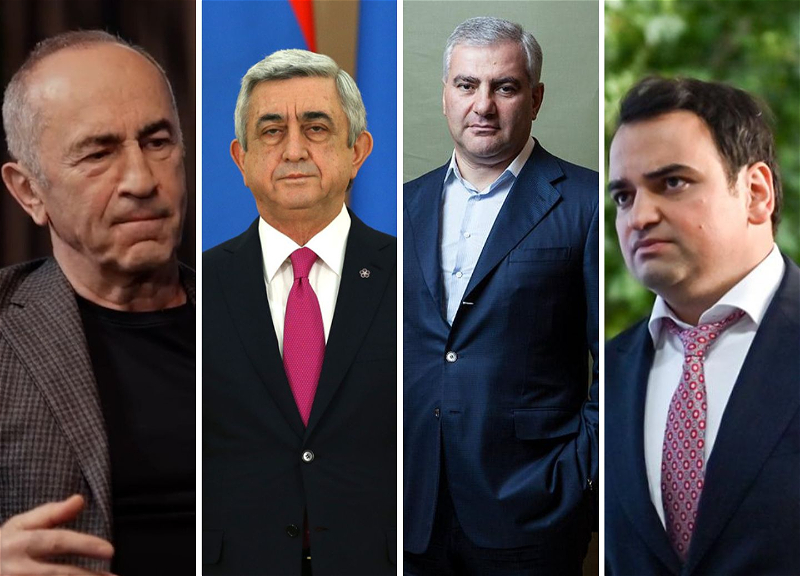
Key figures in the current Armenian opposition, such as Robert Kocharyan, Serzh Sargsyan, Samvel Karapetyan, Narek Karapetyan, and other representatives of the former elite, are becoming active precisely during the pre-election period. They are banking not on a substantive agenda, but on the emotional mobilization of society. Under the guise of 'patriotic' rhetoric and discussions about security, a campaign is unfolding where the main tool is fear—primarily through the escalation of anti-Azerbaijani sentiments.
Thus, the electoral campaign in Armenia is increasingly taking on the characteristics not of a competition of programs, but of a struggle for control over public perception, where the theme of an 'external threat' is used as a universal mechanism for consolidating the electorate and simultaneously diverting attention from issues of corruption, criminal legacies, and methods of pressuring businesses, which were characteristic of the previous political system.
Electoral fear as a tool of power
Why does the Armenian opposition actively use anti-Azerbaijani hysteria during the pre-election period? The answer is obvious. These figures systematically exploit the factor of Azerbaijan and Turkey, promoting narratives about an allegedly inevitable 'threat' and scenarios of 'territorial seizure.' The reason is simple: the lack of real political capital and a clear program for the country’s development.
Against the backdrop of a protracted conflict, fears and distrust toward Azerbaijan indeed persist in Armenian society. It is on these phobias that the political strategy of the revanchist camp is built. This is an attempt to convert fear into electoral votes—because they have no other effective tools. These forces are unable to offer an economic agenda or a strategic vision for Armenia’s future.
Hence the flood of statements about 'impending aggression,' 'plans for seizure,' and other scenarios that have nothing to do with reality. Meanwhile, official Baku consistently declares the absence of any military intentions toward Armenia. Moreover, the sides have initialed a peace treaty, which in itself refutes the narratives of 'preparation for war.' All talk about Azerbaijan allegedly intending to 'seize Gegharkunik or Zangezur' is nothing more than political myths, deliberately spread by revanchist circles in an attempt to regain power.
Criminal cases and shadow activities of Narek Karapetyan
Against this backdrop, the figure of Narek Karapetyan—nephew of Russian oligarch Samvel Karapetyan, head of the Tashir Group, currently under house arrest—deserves special attention. It should be noted that within the framework of criminal proceedings, Samvel Karapetyan has been charged with tax evasion, money laundering, large-scale property theft, and public calls for the seizure of power.
The political agency of Narek Karapetyan, vice-president of Tashir Group, raises serious questions. In essence, we are talking about a person whose public role is largely determined by his background—his status as a representative of a billionaire family—rather than personal achievements or political experience.
Previously, Narek Karapetyan was accused in Armenia of extortion on a particularly large scale. According to entrepreneur Vahé Parazyan, Karapetyan, using threats and physical pressure, attempted to force him to hand over a large sum—10 million euros.
According to the publication 'Hetq,' entrepreneur Vahé Parazyan, along with his brother, ran a construction business in Russia and won a major tender from Gazprom worth about 7.5 billion rubles. However, their activities soon intersected with the interests of structures linked to Samvel Karapetyan.
According to Parazyan, in 2016, Karapetyan demanded that they cease cooperation with Gazprom, threatening deportation from Russia if they refused. After their refusal, the pressure intensified, contracts with Gazprom were terminated, and Vahé was soon detained in Moscow and arrested on charges of 'extortion and kidnapping.'
As Parazyan claims, while in custody, he was offered to 'resolve the issue' for 10 million euros, which were to be transferred to Karapetyan. He refused. As a result, his family faced prolonged persecution and was forced to leave Russia. After a year and a half, the charges were not substantiated, and Parazyan was released.
This episode is seen as an example of comprehensive pressure on business, using both informal threats and administrative resources.
It was revealed that Narek Karapetyan acted on behalf of his uncle, Samvel Karapetyan: the demand to pay 10 million euros was his wish.
Notably, the demand for money from Parazyan and other entrepreneurs was accompanied by references to a 'fund for assistance to Artsakh.' Thus, financial claims were presented under the guise of a 'patriotic mission' and supposedly charitable goals. In essence, this demonstrates a scheme in which the theme of 'assistance to Artsakh' was used as a tool of pressure—a rhetorical cover for extortion disguised as a socially significant initiative.
Another revealing episode from Narek Karapetyan’s biography is related to his 'service'—or rather, the lack thereof.
In January 2026, a case was opened against him in Armenia on charges of forging documents or evading military service through deception, as reported by the newspaper 'Haykakan Zhamanak.' According to media reports, during a medical examination, he simply did not undergo some of the mandatory procedures—a detail that, to put it mildly, casts doubt on the legality of the exemption he received.
Under this article, Karapetyan faces 3 to 6 years in prison. At the same time, he previously openly stated that he did not serve in the army, and the exemption, as claimed, was granted due to 'health reasons.'
A perfectly reasonable question arises: what kind of 'patriotism' and 'national responsibility' can we talk about when its proponents prefer to distance themselves even from basic obligations to the state? Especially against the backdrop of loud statements and attempts to speak on behalf of 'national interests.'
Economy of occupation: money laundering and arms smuggling
The role of Samvel Karapetyan himself during the occupation of Azerbaijani territories also deserves special attention. This is not just about political support, but direct participation in financing processes of illegal settlement in Karabakh. According to available data, Karapetyan provided financial assistance to the so-called 'regime,' directing funds for resettlement and infrastructure projects in the formerly occupied territories. These actions were accompanied by active construction and the creation of artificial economic activity aimed at consolidating the results of the occupation.
In fact, this was a scheme in which 'investments' were used not only as a tool of political influence but also as a mechanism for laundering funds. Thus, financing illegal settlement and construction became part of a broader practice—with elements of capital laundering under the guise of 'charitable' and 'national' initiatives. The liberation of Karabakh dealt a blow to Karapetyan’s personal interests, as he used this gray zone as a space for money laundering.
If episodes of pressure on businesses and dubious 'charitable' schemes demonstrate the methods of operation of this environment in the economic sphere, other facts elevate the issue to a much more serious level—related to security and military components. Here, we are talking about Samvel Karapetyan’s activities during the conflict, where, according to investigations, his role went far beyond ordinary business activity.
On June 18, 2021, the General Prosecutor’s Office of Azerbaijan announced an international search for the head of the Tashir Group, Samvel Karapetyan, on charges of organizing smuggling supplies of weapons, ammunition, and military equipment during the hostilities in Karabakh.
According to the investigation, from 2001 to 2021, Karapetyan participated in a large-scale scheme of illegal arms transportation. Together with David Galustyan, owner of Royalsys Engineering, and Ara Abrahamyan, general director of KOMEX, he facilitated the supply of large-caliber combat weapons, ammunition, explosives, and devices to Armenia. The smuggling was carried out by air, bypassing the Customs Convention on International Cargo Transportation and the Treaty on Conventional Armed Forces in Europe. Passenger flights, an Armenian Air Force Il-76TD cargo plane, and an Ilyushin-76TD transport aircraft purchased by Ara Abrahamyan were used. The cargo was sent to Armenia and then to occupied Karabakh and adjacent regions of Azerbaijan.
The General Prosecutor’s Office initiated a criminal case under the relevant articles of the Criminal Code, and the investigation was assigned to the Investigative Department of the General Prosecutor’s Office. Samvel Karapetyan, David Galustyan, and Ara Abrahamyan were charged under Articles 100.1, 218.1, 228.3, 279.1, and 206.4 of the Criminal Code, a measure of restraint in the form of arrest was chosen for them, and all were placed on the international wanted list.
Kocharyan-Sargsyan tandem: systemic corruption and billion-dollar embezzlement
If individual episodes of pressure on businesses and dubious financial schemes could be presented as isolated cases, the overall picture points to a much deeper problem—systemic corruption embedded at the highest levels of power. This refers to the political legacy of the Robert Kocharyan and Serzh Sargsyan tandem, under which the fusion of business and state took on an institutional character.
The activities of business structures during that period were not just linked to politics—they were effectively dependent on it. Earlier, entrepreneur Silva Hambardzumyan accused the former presidents of receiving bribes during Kocharyan’s tenure. According to her, in 2008, she transferred 14 million dollars to the then Minister of Nature Protection, Republican Party of Armenia MP Aram Harutyunyan.
'I finalized a deal with Arabs, and to ensure I wasn’t interfered with, I paid both President of Armenia Robert Kocharyan, Prime Minister Serzh Sargsyan, and Armen Gevorgyan,' Armenian media quoted Hambardzumyan as saying. According to her, this concerned the sale of 100% of the shares of a mining company to an Arab sheikh. The deal amounted to 40 million dollars. 'Not a single mine was sold without their involvement,' Hambardzumyan stated.
Currently, Robert Kocharyan is involved as a witness in the case of his successor, Serzh Sargsyan. This pertains to a criminal case related to the privatization of land plots near the military pantheon 'Yerablur.' The deal was concluded in 2005, when Kocharyan was president, and Sargsyan was the Minister of Defense. The lands were on the balance sheet of the Ministry of Defense.
Overall, during their presidencies, Kocharyan and Sargsyan misappropriated 20-30 billion dollars from the state, as previously reported by the Armenian portal 1in.am. 'Just in the episode of acquiring the Congress Hotel, Kocharyan is accused of an act involving the misappropriation of 6 million dollars, bribery, or money laundering. On just one of the bank accounts of Serzh Sargsyan’s brother, 30 million dollars were discovered. There is no doubt that during the presidencies of Robert Kocharyan and Serzh Sargsyan, billions of dollars were stolen from the state, with some estimates suggesting 20-30 billion dollars,' the publication noted.
Another notable figure from the circle of Robert Kocharyan and Serzh Sargsyan is Armen Gevorgyan. Over the years, he held key positions: under Kocharyan, he was Secretary of the Security Council and head of the presidential administration; under Sargsyan, he was Deputy Prime Minister.
Today, Gevorgyan is accused of laundering over 13 million dollars, which directly points to the systemic nature of corrupt practices during that period. According to the Anti-Corruption Committee of Armenia, between 2004 and 2018, 39 real estate properties in the country were registered under him and his associates. Notably, the contractual value of these assets was about 1.96 million dollars, while their real market value exceeded 12.7 million dollars—a classic scheme for concealing income and laundering funds. Additionally, 10 more properties in the Czech Republic, registered under affiliated persons, were identified, with a total value exceeding 1 million dollars. Gevorgyan’s case is not an isolated incident but a reflection of the entire model of power of that era, where top officials built stable schemes for enrichment.
Revanchism against peace: a bet on destabilization
In the end, we are dealing with a group of political actors for whom anti-Azerbaijani rhetoric is a tool for retaining attention, mobilizing the electorate, and simulating political activity in the complete absence of a real agenda. Today, they are striving for high politics, actively exploiting the theme of an 'external threat' to divert attention from their own corrupt legacy.
At the same time, their strategy is becoming increasingly obvious: the focus is not on the country’s development, but on revanchist sentiments and an attempt to roll the region back to a logic of confrontation. Illusions about 'recovering what was lost' and revising the established reality in the region are presented to society as a political alternative, although in reality, this is a path to new isolation and internal instability.
In fact, this is an attempt to nullify the emerging peace agenda between Azerbaijan and Armenia, replacing it with aggressive rhetoric and myths about 'inevitable confrontation.' In this logic, fear once again becomes the main political resource, and any steps toward normalization become objects of criticism and sabotage.
However, behind the loud statements about 'national interests,' the old motives are increasingly visible—control over financial flows, redistribution of assets, and a return to a model in which politics serves as a cover for narrow group interests. That is why revanchism in this case is not a strategy for the future, but an attempt to restore a past that has already proven its failure.