Requiem for the Minsk Group: when the scenery burned and the actors fled
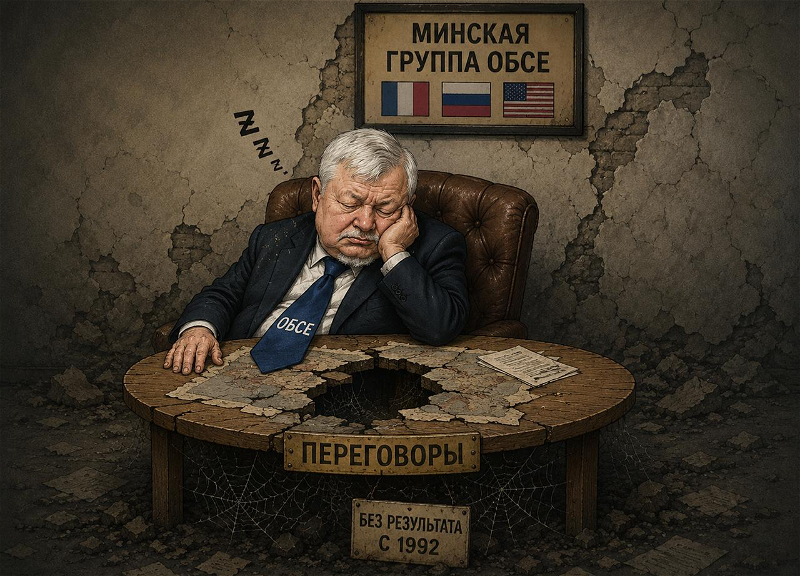
In political history, there are structures that exist not to solve problems but to preserve them in a state of perpetual waiting.
For decades, international diplomacy has tried to convince the world that stability matters more than justice and process more than results. The brightest example of this approach was the OSCE Minsk Group — a construct whose recent final disappearance into oblivion drew a line under an entire era of simulated settlement.
This collapse became the logical finale for one of the most protracted and useless diplomatic constructs in modern history. If one looks at things soberly, three decades of this structure’s activity resemble not so much an attempt to achieve peace as a well-staged spectacle in which the scenery remained unchanged for years and actors in expensive suits replaced one another while maintaining icy indifference to the essence of the issue. To understand why this format ultimately ended up on the scrap heap of history, one must recall how it all began and in what atmosphere of “constructive ambiguity” Azerbaijan was forced to exist for many years.
The Minsk Group emerged in the early 1990s as a mechanism meant to stop the bloodshed and find a path to a just peace. In reality, however, something else was seen: paralysis of will seasoned with the geopolitical calculations of the great powers. The fact that Russia, the United States, and France — three nuclear powers and permanent members of the UN Security Council — became co-chairs seemed as though it should have guaranteed ironclad enforcement of international norms. After all, these same countries once voted for the four well-known 1993 UN Security Council resolutions demanding the immediate and unconditional withdrawal of Armenian occupation forces from Azerbaijan. Yet the paradox lay in the fact that the same hands that signed those resolutions in New York did everything within the Minsk Group to ensure those demands were never fulfilled. Instead of compelling the aggressor to comply with international law, the co-chairs spent years engaged in “shuttle diplomacy” that more closely resembled elite tourism around the region paid for by taxpayers.
Their interests, despite formal disagreements elsewhere in the world, coincided remarkably on the Karabakh issue. All three powers found it advantageous to maintain the “status quo.” The frozen conflict gave them leverage over both Baku and Yerevan, allowing them to play the role of “indispensable mediators” indefinitely.
This consensus meant that any Azerbaijani initiative to restore territorial integrity ran into a chorus of voices from Washington, Paris, and Moscow repeating the mantra: “There is no military solution to the conflict.” This phrase became a kind of diplomatic shield for the occupation. In essence, this diplomatic trio told the victim of aggression in plain language: “Sit quietly, accept the loss of land, and wait while we come up with something.” And they could take forever to come up with something.
Matters reached the point of absurdity and outright insolence that today provoke only a bitter smile. At one point, the term “Northern Karabakh” began to be actively circulated in expert and diplomatic circles close to the co-chairs. This was a classic example of an information operation aimed at legitimizing the seized territory. The term referred to those parts of the region that Armenia sought to present as “disputed” or “subject to exchange.” The mediators’ logic was simple to the point of cynicism: if such a name were introduced into international lexicon, Azerbaijan would have to “return” what already rightfully belonged to it, at the price of new concessions. It was an attempt to create a parallel reality in which the borders of recognized states depended on the mood of diplomats.
While the co-chairs enjoyed receptions in Baku and Yerevan, the quiet destruction of an entire civilization was taking place on the occupied territories. This occurred not in the remote Middle Ages but in the era of satellite internet and high-precision cameras. Before the eyes of the Minsk Group, Azerbaijani cities turned into “Hiroshimas of the Caucasus,” as Agdam would later be called. Mosques in Shusha, Fuzuli, and Zangilan were not merely destroyed — they were deliberately desecrated and turned into cattle sheds. And what did the Minsk Group do? Nothing! At best, it expressed “concern,” and even that only in cases of military escalation along the line of contact between Azerbaijani and Armenian armed forces. Moreover, with the full connivance of the mediators, illegal settlement of the seized lands was carried out. For years, Armenia transported settlers from Middle Eastern countries there, built infrastructure, and appropriated the property of expelled Azerbaijanis. The co-chairs visited these places, saw the new settlements, and fully understood that this was a direct violation of the Geneva Conventions, yet in their reports it appeared as “construction work” that did not hinder the peace process.
The figure of Andrzej Kasprzyk, the personal representative of the OSCE chairman-in-office, deserves special mention as a symbol of this endless stagnation. His mission, like the co-chairmanship institution, lasted for decades. The only difference was that the co-chairs changed every two or three years while Kasprzyk remained in his post throughout those years, merely rotating his field assistants. A man whose job was to monitor the front line turned his position into a rentier lifestyle. Kasprzyk managed to rent comfortable housing for himself in all key points of the region — in Baku, Tbilisi, Yerevan, and even in Khankendi. While soldiers in the trenches watched each other through sights, the diplomat moved from one villa to another, enjoying Caucasian hospitality and the status of an untouchable field arbiter. His reports were so evasive and sterile that it was impossible to determine even who opened fire first or who violated the ceasefire regime. It was diplomacy in the style of “both yours and ours,” where the main goal was not solving the problem but preserving the post itself and its attendant privileges.
Everything changed in the fall of 2020. Azerbaijan did what the mediators called impossible — it found a military solution. The 44-day war destroyed not only the Armenian army but also the decade-long achievements of the Minsk Group. When, after the signing of the trilateral statement, the co-chairs decided to visit Baku in December 2020, the reception given to them by President Ilham Aliyev became the moment of truth for the entire structure. The president’s phrase — “I did not invite the Minsk Group. But when I was informed that the Minsk Group wanted to come, I said — let them come, I do not object” — sounded like a verdict. It was not merely a diplomatic barb but a statement of fact: you are no longer needed; you are too late forever. Seeing the co-chairs’ faces at that moment was priceless — people accustomed to lecturing the parties in a mentoring tone for years suddenly found themselves superfluous.
Ilham Aliyev repeatedly emphasized in his speeches that the Minsk Group not only failed to help but deliberately obstructed progress. They engaged in imitation of activity, creating the illusion of a process where there was only regression. As noted in analytical materials of the time, the Minsk Group format became a tool for encouraging occupation. Instead of calling the aggressor an aggressor, they equated the sides, effectively offering Azerbaijan to pay for its own land. This is precisely that colonial mindset in which three “big brothers” decide the fate of a small people based on their global chess games.
After Azerbaijan fully restored its sovereignty and raised its flag in Khankendi, the existence of the Minsk Group looked like a ridiculous anachronism. Attempts by revanchist circles in Armenia to revive this corpse were not only a useless exercise but also an obvious insult to logic. This format will remain in textbooks as an example of grandiose hypocrisy. History judged everyone: the mediators who dreamed of an eternal “status quo” and led a luxurious lifestyle found themselves on the sidelines, while the people who for thirty years were fed promises and “European values” decided their own fate. The OSCE Minsk Group did not merely go to the scrap heap of history — it went there branded with diplomatic disgrace, leaving behind only mountains of paper and disillusionment with institutions that were supposed to safeguard peace but in reality safeguarded only their own comfort and the interests of the occupier.