No dogs allowed: Why Baku is not yet ready for pet-friendly culture
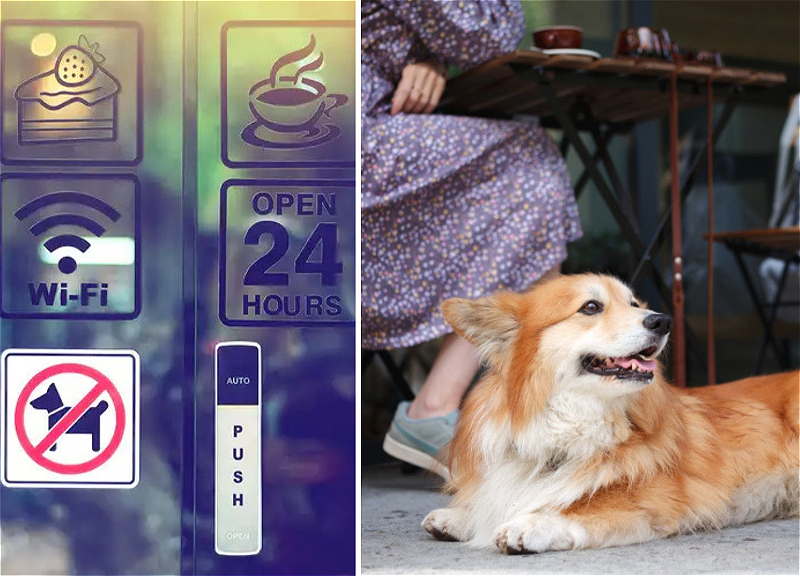
Pet-friendly culture has long been one of the indicators of a modern city's maturity, and it’s not just about being able to enter a café with a dog or travel on public transport.
🐾Pet-friendly refers to establishments (cafés, hotels, shops) that welcome visitors with pets. This implies the availability of water bowls, designated areas, friendly staff attitudes, and the ability to comfortably stay with a pet. Most often, this applies to dogs, but sometimes the rules extend to other animals.
First and foremost, it’s a matter of societal attitudes toward animals, the quality of urban environments, the level of service, and the ability to consider the interests of different groups of residents. Where a pet is seen as a family member, a more humane and comfortable space is created for everyone. In Azerbaijan, this topic remains sensitive and largely unresolved.
Overall, Azerbaijani society still faces a noticeable issue with the culture of attitudes toward animals, particularly dogs. For a significant portion of people, a dog is still perceived not as a companion or family member, but as a source of danger, noise, or inconvenience. Fear, prejudice, a lack of habit for responsible pet ownership, and insufficient education create an environment where pet owners face constant restrictions. Even in the capital, where urbanization is higher and society is more open to new ideas, life with a pet often turns into a daily search for compromises.
At the same time, the number of people choosing to get a pet is gradually increasing, and with it, the demand for infrastructure, veterinary clinics, grooming services, training, pet hotels, convenient transport, and, of course, pet-friendly spaces is growing. However, at this last stage, owners most often encounter closed doors.
The editorial team of 1news.az decided to independently investigate the situation and assess how ready Baku is for the presence of pets in public spaces. To do this, we contacted a number of popular cafés and restaurants posing as regular visitors to obtain the most objective and honest responses without prior notification of preparing an article.
So, we asked all establishments the same question: "Can I come with my dog?"
The results of our experiment were quite revealing.
Coffee shops:
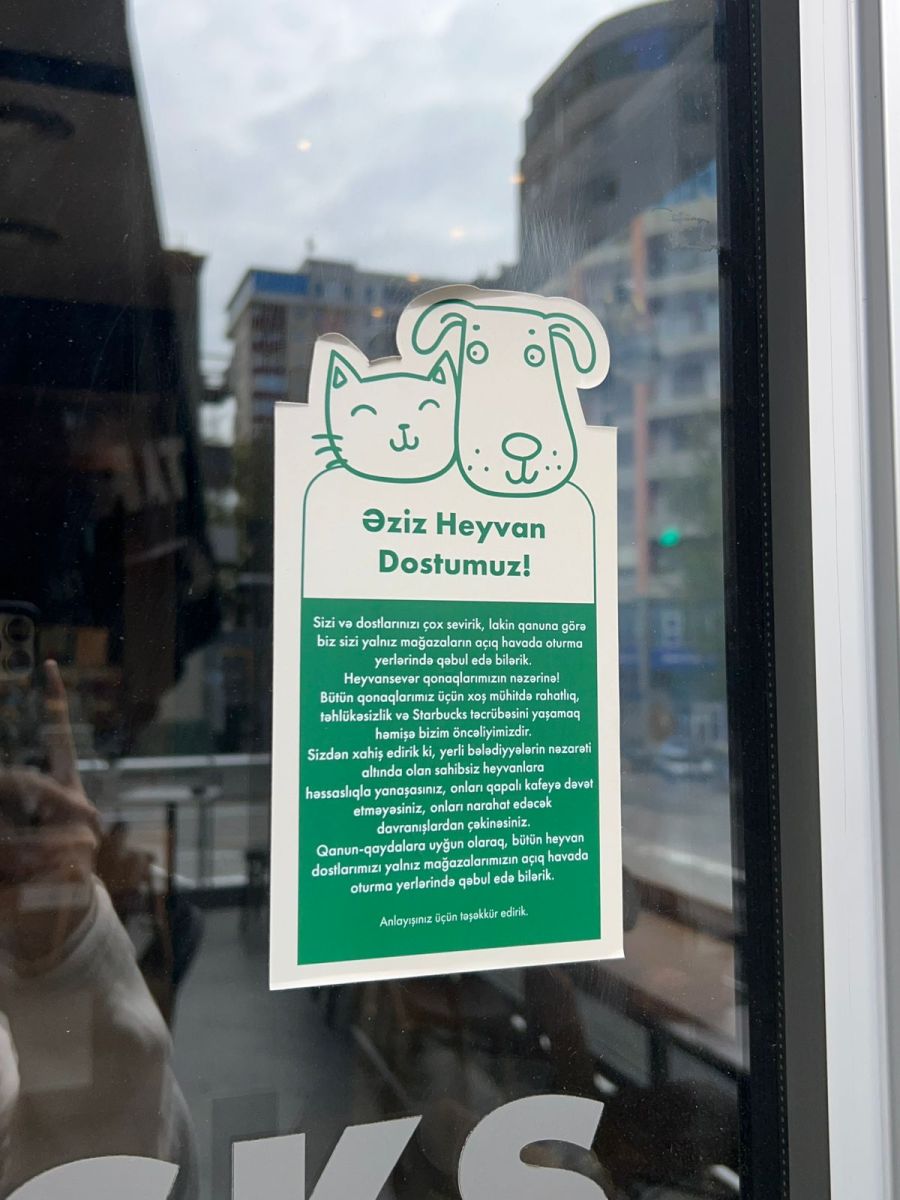
At Starbucks, a sticker at the entrance explicitly prohibits any animals.

At Gloria Jean's Coffees, we were also informed of a refusal.
At Drinkit, entry is allowed only for animals up to 30 centimeters in height.
At Zebra Coffee, entry with pets is prohibited.
Among the surveyed coffee shops, only Costa Coffee granted full permission.
*
The situation is no better in restaurants that we contacted.
At PAUL, visiting with animals is not allowed.
At Syrovarnya, they informed us that only small dogs are accepted.
At Kolorit, permission applies only to small dogs and only at one branch ("Torgovaya").
At MariVanna, the restriction is up to 10 kilograms.
At Borani, the refusal was explained by potential noise that could disturb other visitors.
At Eva, only small pets are accepted as well.
These responses demonstrate that the issue lies not only in the ban itself but also in the approach, where an animal is evaluated solely through the lens of potential discomfort. Instead of rules for responsible visitation, leashes, carriers, behavior control, and sanitary norms, most establishments opt for the simplest solution—restrictions based on size or a complete refusal.
Nevertheless, the situation extends far beyond the restaurant business, as many markets and hypermarkets in Baku display signs prohibiting animals at the entrance.
A similar practice exists in a significant number of shopping centers, where sometimes only small pets carried in arms are allowed. Pharmacies, too, are mostly closed to visitors with animals.
.jpg)

A separate issue concerns mobility, as moving around the city often becomes a challenging task for pet owners. In the Baku metro, the transportation of small animals is allowed only in containers or cages that prevent the animal from getting out freely, while free transportation is prohibited. On the railway, small pets can also be transported only in special containers, with restrictions on the weight and size of the carrier. For medium or large dogs, such conditions effectively create a barrier.
The situation with taxis is ambiguous, as many users still face refusals from drivers when ordering a regular car. At the same time, taxi services in Azerbaijan lack a separate category for trips with pets.
Another sensitive topic is walks, as in many public spaces, pet owners note the appearance of signs prohibiting dog walking. At the same time, there are virtually no alternatives in the form of fully-fledged specialized areas, fenced zones for animal socialization, or safe off-leash walking spaces in the city. In other words, dogs are banned from one place without being offered another.

Against this backdrop, the contrast with several European countries, where pet-friendly policies have long been the norm of urban life, is particularly striking.
In Germany, for example, dogs often accompany their owners to public places, and the culture of training and socialization is considered standard. In many cafés, hotels, and shops, the presence of animals is not seen as an exception but as part of everyday life. Dogs can sometimes even be seen at workplaces and in university lecture halls.
In Italy, especially in the northern part of the country, dogs accompany their owners not only on walks but also in establishments, tourist areas, and often in shops. In many cities, a pet on a leash is a familiar part of the urban environment.

Prague is also considered one of the most comfortable European cities for dogs. Owners can find housing, cafés, recreational areas, and convenient transport. In some cases, dogs are transported for free.
In Belgium, the Netherlands, Switzerland, and Poland, a common practice allows animals on public transport under clear rules such as leashes, muzzles if necessary, behavior control, and respect for other passengers. Many cities have dog parks, bins, free cleanup bags, and clear infrastructure to help maintain cleanliness.
The main difference in these countries is not that they "love dogs more"; no, the key distinction lies in the systemic approach. Pet owners are trusted, but at the same time, requirements are imposed on them, the city creates conditions, and individuals are obliged to follow the rules. As a result, animals do not become a widespread problem for those around them.

Azerbaijan also needs to move in this direction, as the increase in the number of pet owners has already occurred, meaning the societal demand for change is real. This is not about allowing animals everywhere without restrictions; the main point is clear rules for visiting establishments, accessible transport, walking areas, educational programs on responsible pet ownership, and respect for the rights of other citizens.
All of this directly affects not only the comfort of pet owners but also the general societal attitude toward them. When a dog becomes a familiar part of the urban environment—calmly accompanying its owner in a park, a café, on transport, or walking on a leash down the street—people gradually lose the sense of alienation and threat.
People stop perceiving animals as something dangerous, unpredictable, or disruptive to public order. Fear is replaced by familiarity, and then by calm acceptance.
It is the regular and civilized presence of animals in public spaces that shapes a healthy culture of coexistence. Children learn from an early age to interact with dogs correctly, understand boundaries, respect living beings, and not show cruelty.
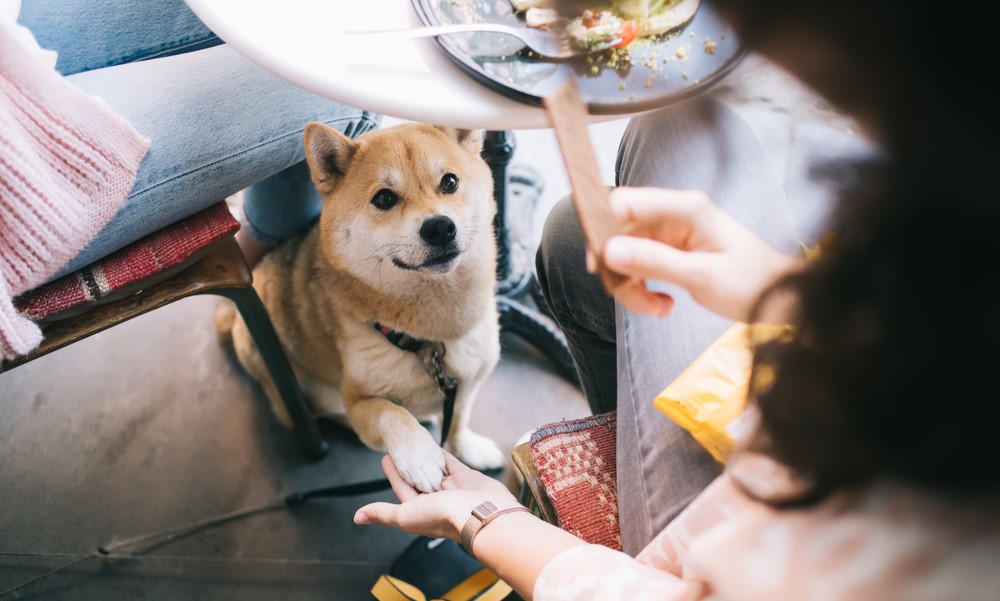
Adults who previously might have been wary of animals eventually see that a well-behaved dog on a leash poses no threat, and a responsible owner can control the situation. This reduces levels of anxiety, aggression, and everyday intolerance.
It is also telling that in countries with a developed pet-friendly culture, despite much greater freedom for pet owners and a larger number of pets overall, there is no constant public conflict around this topic. Mass complaints, panic, or heated debates are significantly less common than one might expect. The reason lies in the normalization of animals’ presence, the existence of rules, owners’ responsibilities, walking infrastructure, and a habit of considering each other’s interests. Thus, when the system works, a dog also ceases to be an irritant.
Moreover, an open urban environment encourages more responsible behavior from owners themselves. Where a person has the opportunity to go out with a pet to a park, enter an establishment, or use transport, they are more likely to invest in the animal’s upbringing, socialization, training, and adherence to behavioral norms. When a prohibitive model prevails everywhere, the motivation for responsible interaction also decreases.

In other words, the more often society sees pets in a normal, controlled, and natural context, the more tolerant and calm attitudes toward them become. Aggression gradually disappears, the number of stereotypes decreases, and the culture of handling animals reaches a more mature level.
A pet-friendly environment is not just a trend or a whim of dog owners. It is an indicator of a modern city where the interests of different residents are taken into account, and humane attitudes become part of everyday culture. While Baku is only taking its first steps in this direction, without them, the capital risks remaining a city where, for many residents, a pet is not a joy but a constant limitation.