Level Tower: an ultra-premium club residence, a new level of living in the heart of Baku - INTERVIEW
The Baku property market entered 2026 in better shape than a year earlier.
After a cautious 2024, last year brought back both rising prices and investor interest: according to research by the International Bank of Azerbaijan (ABB), the primary market recovered over 2025 and gained noticeable ground on the secondary segment, and the price gap between new builds and completed housing, once quite tangible, has nearly closed.
Real estate reaffirmed its reputation as a defensive asset, with returns that compete with bank deposits and securities.
At the same time, buyers of premium housing have become considerably more demanding, and that is arguably the biggest shift of recent years. Today it is not enough to put up a handsome building and call it “premium”, all the more so because Azerbaijan, like many other countries, has no legally established housing classification, and every developer fills “business”, “premium” and “ultra-premium” with a meaning of its own.
The projects that win are those whose positioning is backed by specifics: ceiling heights, building density, engineering, the level of service.
That is the context in which Level Tower deserves a closer look.
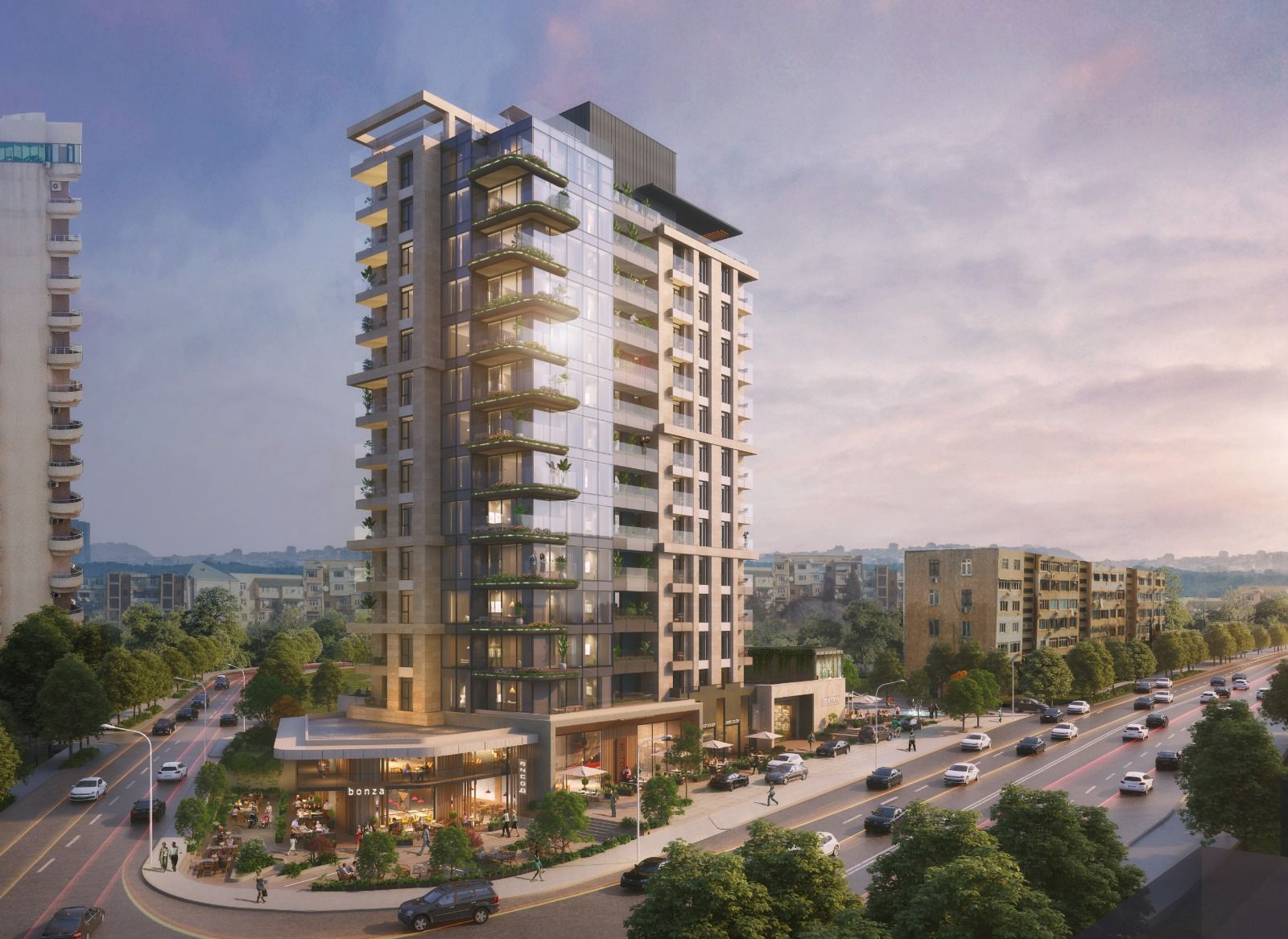
It is the first signature project by Level Construction, a company active on the market since 2015 and known for the Breeze Tower residential complex in White City. The 14-storey tower is going up in the Yasamal district, at the intersection of Mikayil Mushfig and Ismail bey Gutgashinli streets, within walking distance of Central Park, the Flame Towers and the metro, with Caspian Sea views from most of the apartments.
Construction is scheduled for completion in the second half of 2028.
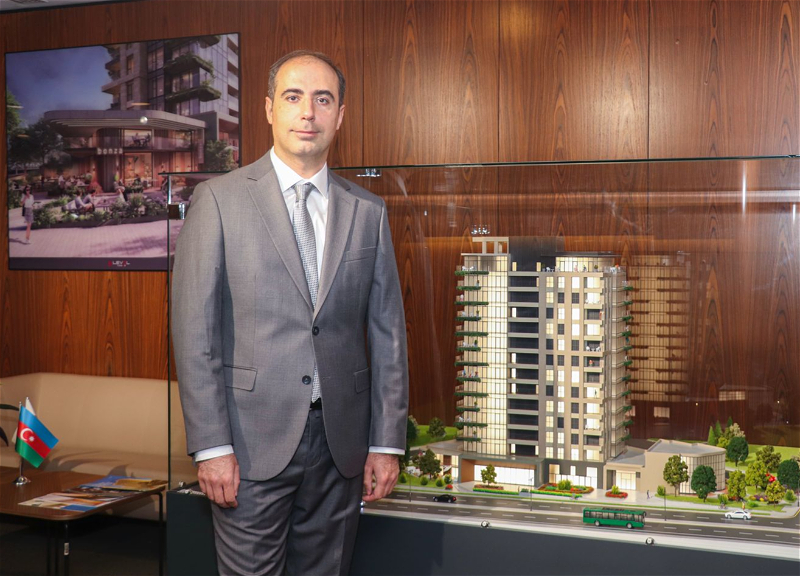
We spoke with the head of the Level Tower project, Orkhan Aliyev, about what the company means by premium housing and why it has bet on a private, club-style format.
— Let’s start with the market. It spent 2024 in wait-and-see mode and moved into recovery in 2025. How do you judge the timing for launching the project right now, especially given that buyers in the upper segment have become far choosier?
- The Azerbaijani property market has shown steady, I would even say conservative, growth for many years, and for buyers it has always been a protected asset. Since independence I cannot recall a period when housing prices in this country actually fell. There have been global crises that affected us too, but what happened then was slower growth, not decline.
.jpeg)
.jpeg)
.jpeg)
As for premium buyers becoming choosier, that is normal and, to my mind, healthy. People no longer buy an apartment on the spot: they study the developer, its reputation, its previous projects. Especially in the premium segment, where prices are high. We are entering the market at exactly the point where the winner is not the one who builds a lot but the one who builds precisely, for a specific, well-considered demand. And we see that as our advantage rather than a risk.
— Azerbaijan has no official housing classification: everyone reads the word “premium” in their own way. The very name Level points to a “level”. What exactly do you put into that concept? After all, security, a reception desk and central heating can be found in practically any decent new build today.
- You are right: communal heating, a reception, security, underground parking, playgrounds, an entrance lobby have all been on the market for a long time, and of course we offer them too. But that is not what lifts a project a step higher. For us the name Level is a claim to establish a new standard of quality housing in Baku, and that standard has to be filled with details.
Take one of the most common complaints among residents of new buildings: thin walls. The neighbours’ music, conversations, children running around upstairs, footsteps, a suitcase being wheeled across the floor. It is a constant source of discomfort. Between our floors and between apartments we have designed a dedicated soundproofing system that removes the issue almost entirely: neighbours simply do not hear each other.
Then there are the service details you do not usually find. Besides the lobby with a reception on the ground floor, there will be a separate waiting room for personal drivers and assistants, so they have a space of their own. There will be a shared fireplace lounge, and a dedicated spot for receiving couriers: since the pandemic, delivery has become part of everyday life, and it makes sense for a building to have a place where an order or a parcel can be handed over comfortably. Add to that privacy itself: this is a club format of just 60 apartments. And, of course, the location, the very centre of Baku, next to the parks, within walking distance of the city’s key spots.
— You mentioned technology. How does that show up in everyday life?
- The building will have a smart home system. A simple scenario: you are out, and someone comes to your door. Say your parents have arrived and they have no key. From your phone you see on camera exactly who rang the apartment, and you can open the door remotely. No need to drop everything: you might be working out a floor below or have stepped out to the shops, yet you stay fully in control of who has come to your door and why. These are the small things that add up to the feeling of an entirely different standard of living.
— The project has just 60 apartments across 13 residential floors, roughly five per floor. For a building of this scale that is unusually low density. Is this a deliberate bet on privacy?
- Entirely deliberate, on privacy and on the club character of the building alike. We settled on it at the very start, after analysing the market: there is an acute demand today precisely for premium, club-style housing. And premium housing, I am convinced, cannot mean 400 or 500 apartments with an enormous number of residents. A club residence, a high price, a central location: to me that implies privacy and security, a life made up of just 60 apartments, five to a floor. That was the key idea from day one: fewer apartments and a club format. That is what we worked towards.
.jpeg)
.jpeg)
.jpeg)
.jpeg)
— The market has gone compact in recent years: the average apartment in Baku has shrunk to around 87 square metres. Your line-up, meanwhile, goes up to 270 square metres, and the layouts carry names of their own: Aura, Horizon, Zenith, Grand, Pearl, Prestige, Signature, Exclusive. What kind of buyer is this move against the general trend aimed at?
- You noted it correctly: the shift towards smaller living space has held for many years, and it is not just a Baku story. The American, European, Russian and Turkish markets are all clearly moving towards smaller footprints, because the price per square metre keeps rising and so do utility costs: gas, electricity and so on. People want to live in their own home while spending less. It is a global trend, and Baku follows it.
Our line-up really does cover different formats. The smallest apartment is 59 square metres, a two-room studio. The largest is 270 square metres, and there is only one such apartment in the whole complex. It is an exclusive unit on the top floor with four-metre ceilings, a penthouse of sorts. It is one of a kind, not a mass product and not a departure from the general trend; the Baku trend today does point towards smaller space. We simply see this one apartment as the pearl of the project: an exclusive for a single family. There is no second apartment of that size in the building.
— Who is the architect, and what makes the building a signature design rather than a standard one?
- The architecture was developed by SP Architects, a Turkish firm headquartered in Istanbul. It is one of Turkey’s largest design and architecture firms, with extensive experience across Turkey, Azerbaijan and Europe. Working with them, we shaped a project that answers the expectations of the most discerning audience. I should add that the Turkish specialists also addressed the seismic resistance of the project: if needed, the building can withstand an earthquake of up to magnitude 8. Another emphasis was on ideal internal layouts with minimal loss of space, plus the things future ladies of the house will love: laundry rooms, an ironing area, a guest bathroom and so on.
Where does the premium quality come in, and what are the new solutions? First of all, the ventilated facade and the glazing. Panoramic windows take up about half the facade area, opening fine views of the city centre and the Caspian Sea. Practically four apartments out of five on each floor have a direct, unobstructed view of the sea, and for Baku residents that has always carried special value: prestige, and that particular sense of calm.
The facades are finished in porcelain stoneware and marble. These materials help keep the interiors cool in summer, so less air conditioning is needed, and hold warmth in winter, which cuts heating costs as well. Full-scale insulation materials are used throughout. We placed a separate emphasis on greenery: every balcony is landscaped, as is the area around the building, planted with perennials and climbing plants. The building and its surroundings will be genuinely green. That is a detail we worked through specifically with the Turkish practice.
— What is the ceiling height, and how are the apartments handed over: turnkey or white box?
- The standard ceiling height on all floors is 3 metres 45 centimetres. That is generous: 3.15 to 3.30 is typical on the Baku market today, and we position ourselves as premium housing. The top, fourteenth floor has four-metre ceilings; the apartments there are more exclusive.
All apartments are delivered as white box, with the insulation materials I mentioned and waterproofing in the bathrooms. Why white box rather than a completed fit-out? I believe a discerning audience is very particular about materials: everyone has their own idea of the colour palette, the quality of ceramics, finishes, kitchen furniture. We do not want to squeeze clients into a standard mould. So we hand the apartment over as a white box, and each resident then fits it out and furnishes it to their own taste.
.jpeg)
.jpeg)
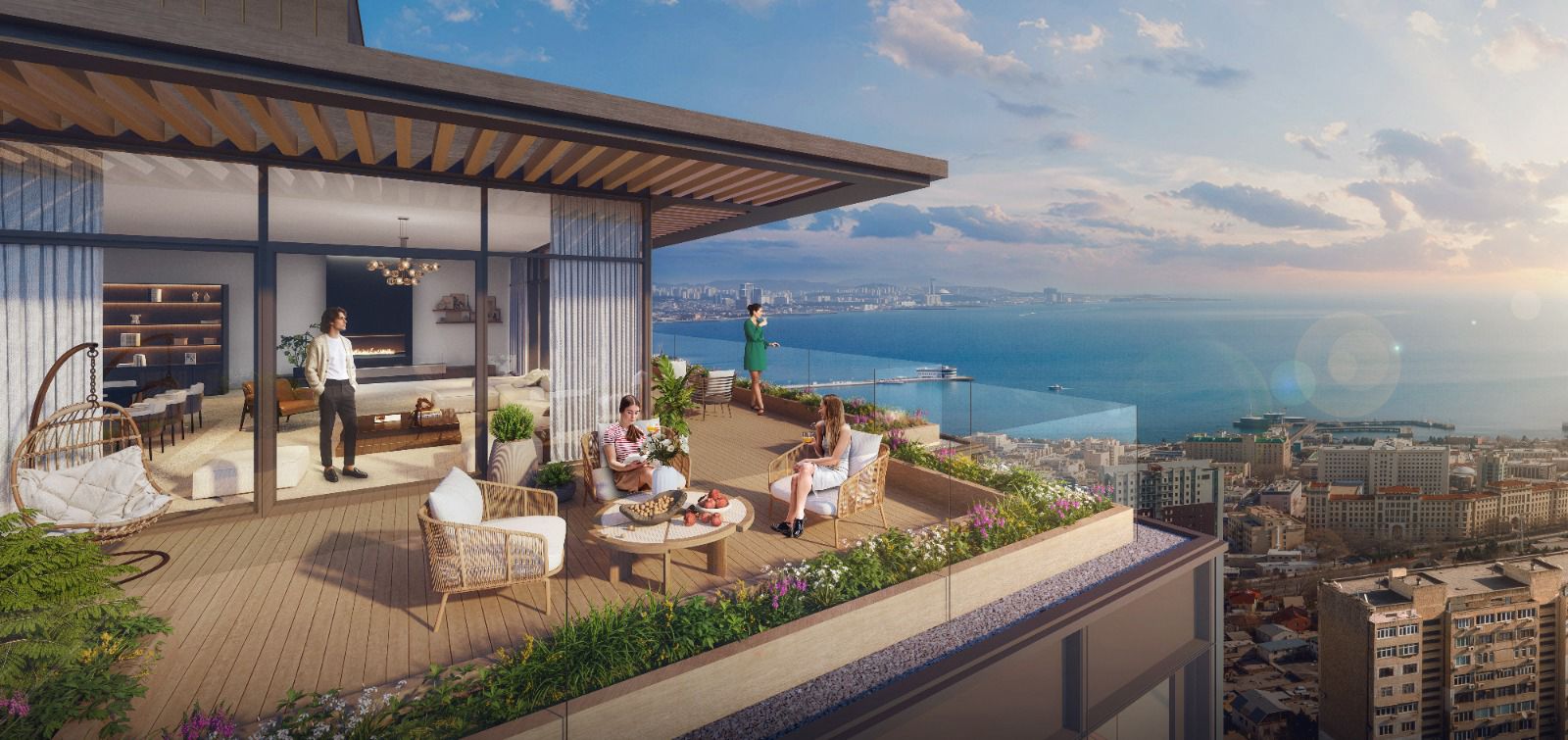
— What does the resident infrastructure include? Are there a pool, a spa and the shared spaces typical of the premium format?
- Let me start with the fact that the project sits in the city centre, and the centre always means parking headaches. So residents get a two-level underground car park: 122 spaces for 60 apartments, or at least two cars per family.
We also took account of the global shift to electric vehicles: the car park will have charging points, so a car can be charged right under the building.
Beyond parking, there is a dedicated gym, free for residents, with cardio and strength zones, plus a sports ground for children. There will also be a separate room for yoga and pilates, again free for residents.
A pool is something we deliberately left out: the complex is private and compact, and there is simply nowhere to fit a proper pool zone. But a spa area, yoga, pilates and the fitness block will certainly be there for our residents.
— Will there be a concierge service and a professional management company? Who will run the building after handover? It is often the standard of day-to-day operation that separates true premium from a merely well-built new development.
- A very fair question. Premium housing presupposes a concierge service, and we will certainly have one, around the clock, to handle residents’ wishes and requests of any kind.
As for the management company, that, to my mind, is a big problem of the Baku market. Buildings keep going up, while professional teams that know how to run them properly, so that comfort and quality hold up two and five years after handover, are almost nowhere to be found. Usually the developer manages its own building. We intend to do it differently: once the apartments are handed over and title is registered, the building will pass to a professional management team selected through a tender.
I am convinced that developers are not the right people to manage a building well afterwards. A developer’s job is to build a good house; service and operation should sit with a professional outsourced company. As Level Construction, we do not plan to manage the building ourselves going forward. Our working principle is simple: let everyone do what they are strong at. So we will hire professionals and keep their work under control.
— The location is the intersection of Mikayil Mushfig and Ismail bey Gutgashinli streets, close to the centre, the metro, the Flame Towers, with a sea panorama. What makes this spot valuable for the premium format specifically, and do you see potential for price growth here?
- The survey of the site showed that unobstructed views of the city centre and the sea open up from the third floor already, not just from the upper ones. In effect, any buyer gets access to a Caspian view.
People sometimes say Yasamal trails the Narimanov and Nasimi districts on price. I would not agree. Yasamal is very large; yes, parts of it are cheaper, but the area around Central Park, the Narimanov monument and the Flame Towers is essentially Baku’s amphitheatre, with wonderful views and air that is cleaner than in the low-lying parts of the city. Prices here are unquestionably higher. That Sabail, as the traditional city centre, is more expensive, I will grant; but this particular spot by Central Park, given the transformation of the area and the programme to demolish dilapidated housing, has serious growth potential.
My forecast: by the time the project completes, at the end of 2028, prices in this area and in our building will rise by at least 40%. For an investor that is an attractive figure, whether they are buying for rental income, for resale of the finished unit or to live in themselves. Growth of 40 to 50% over two years beats any banking product on the Azerbaijani market today. On top of that, construction costs are rising, materials are getting dearer, and the new development coefficients are lowering permitted building heights across the city. All of this, as I see it, will keep pushing prices up in the coming years.
— The ground floor is set aside for commercial space. What pool of tenants do you envisage, and how will it work for the building’s image?
- Once again it comes down to location. The Mushfig-Gutgashinli intersection is the city centre, a very busy spot for both car and foot traffic. So the ground-floor retail will interest investors and residents of the surrounding buildings alike.
That said, given the premium character of the building, there will be no restaurants with live music, no large grocery markets and nothing of that sort. We want a calmer atmosphere. Think coffee shops of well-known brands, franchises, cafes with patisseries, tea and coffee: the formats that are current and in demand in Baku today. A terrace is planned in front of the ground-floor units, so residents and guests will always have a coffee shop or a cafe at hand. A bookshop is possible. In short, formats without crowds, noise or the constant unloading of goods. Our residents’ peace comes first.
— What is the price range, and what terms apply at the sales launch?
- And here we come to the question readers care about most. The down payment is 40%. After that, over two years, the buyer can pay off the balance in instalments directly to us, with no interest and no extra bank charges. In effect it is an in-house interest-free instalment plan.
A bank mortgage is also an option, of course: the same 40% down payment and a longer term of 10 to 15 years, though that is a banking product with its own interest.
Prices depend on the floor, the layout, and the number of rooms. At the same time, we are flexible in sales: we are always ready to consider a client’s counter-offer and find terms that fit both the project’s status and the buyer’s interests. What matters most to us is the client’s satisfaction down the line.
— How do you picture your target resident?
— These are business people and investors. Those drawn to rental income in a central location and to an asset that grows in value. Unique locations like this are becoming scarcer in Baku: developers are mostly moving beyond the city limits, towards Khirdalan and Masazir, and that is no longer the centre, that is territory the city is expanding into.
Our audience is top and middle management of private and state corporations, oil and gas company managers, doctors at private clinics, senior and mid-level managers at banks and insurance companies, as well as investors from Azerbaijan and the wider region: people interested in steady growth in housing value and in long-term rental income.
— Completion is slated for 2028. What stage is construction at now?
- We plan to complete the project by the end of 2028. What matters for the buyer is that the company already has a record of on-time delivery: the 20-storey Breeze Tower residential building in White City. Today’s Azerbaijani buyer has grown more discerning; they do not buy an apartment on the spot but study the developer, its reputation and past projects, and in the premium segment, where prices are high, that matters especially. So keeping to schedule is one of our priorities.
Right now we are at the very start; the project has only just begun. The declared construction period is two years, meaning future buyers will receive their keys in the second half of 2028. A good developer is one who delivers on their word, clearly and on time: every declared deadline, material and amenity has to be honoured one hundred percent.
— Level Tower is Level Construction’s first project under its own brand. What comes next, and where do you see the company on the Baku market?
- Our focus is housing, and housing only. We do not build roads, bridges or tunnels. We specialise solely in residential projects, and only in the business and premium segment, which is why we favour mostly central locations: the Nasimi, Khatai, Sabail and Yasamal districts.
The company is already in talks with the urban planning committee and the district authorities on new projects. These will rise on the sites of the old four- and five-storey Soviet housing stock, the Stalin-era buildings and the Leningrad and Minsk series; in their place we plan to put up modern high-rise buildings.
I am confident that within the next three to four months the Level Construction team will announce the launch of new residential projects, in that same business and premium segment where we feel confident.
You can learn more about the Level Tower project via the links:
Read in other languages:
“Level Tower”: ultra-premium “Klub evi”, Bakının tam ürəyində yeni həyat səviyyəsi - MÜSAHİBƏ
Level Tower: ультра-премиальный «Клубный дом», новый уровень жизни в самом сердце Баку - ИНТЕРВЬЮ