Middle corridor: how Baku and Beijing can strengthen global trade
The global economy is undergoing a period of profound transformation.
Traditional routes of international trade are changing, states are revising their logistics strategies, and transport infrastructure is increasingly becoming one of the key instruments of geopolitical influence.
Under these conditions, countries capable not only of ensuring the stability of international shipments but also of offering effective solutions for new global supply chains are acquiring particular value.
In this case, the reference is to Azerbaijan and China, whose strategic rapprochement is becoming one of the important factors shaping the future configuration of the Eurasian space.
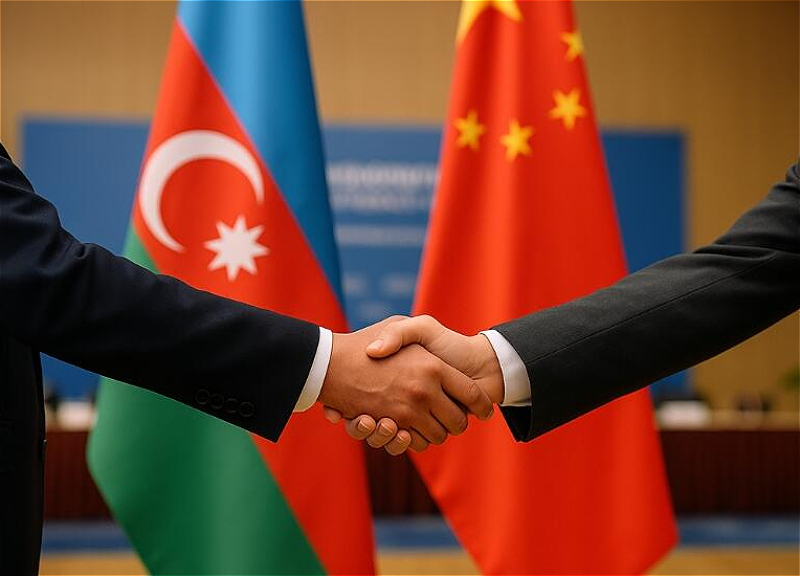
The joint declaration on comprehensive strategic partnership between Azerbaijan and China has become a qualitatively new stage in the development of bilateral relations. Whereas only a few years ago the interaction of the two countries was primarily associated with trade turnover, today it is already about comprehensive long-term cooperation covering virtually all areas—from industry and the digital economy to green energy, high technology, and large-scale infrastructure initiatives.
It is characteristic that political agreements have quite rapidly begun to transform into practical results.
President of Azerbaijan Ilham Aliyev drew attention to this feature at the Shusha Global Media Forum:
“After my state visit to the People’s Republic of China last year and the signing of the Declaration on Comprehensive Strategic Partnership, there has been a very significant activation in cooperation in all spheres: political, economic, transport—everywhere. We are very pleased about this and attach great importance to it. Today more Chinese companies are already present in Azerbaijan. Some of them are already making large investments, and some are participating in various infrastructure projects.
During my state visit I met with the leadership of many leading Chinese companies, and I am glad that their activity in Azerbaijan is already yielding results; moreover, they work very efficiently, quickly, and with very high quality.”
These words of the head of state reflect one of the main features of the current stage of cooperation—the high speed of implementation of joint projects. For the modern world economy, where investment decisions are increasingly made taking into account political stability, predictability, and the effectiveness of state governance, such dynamics are of particular importance.
In recent years, economic ties between Azerbaijan and China have strengthened significantly. The presence of Chinese business in various sectors of the Azerbaijani economy is consistently expanding. Investments are directed primarily to areas that determine the country’s long-term development: renewable energy, the production of electrical equipment, transport infrastructure, logistics centers, industrial parks, and information and communication technologies.
Cooperation in the field of green energy is of particular interest. Azerbaijan is consistently implementing a large-scale program of energy transformation, seeking to become one of the leading producers of environmentally clean electricity in the region. This course creates broad opportunities for Chinese equipment manufacturers and investors who possess serious technological advantages.
As President Ilham Aliyev noted:
“I should also note that a great many projects for the development of solar energy are being implemented in Azerbaijan. And although Chinese companies have only recently begun investing in this sphere, all solar panels installed in Azerbaijan under contracts with non-Chinese companies are of Chinese origin. That is, any solar panel you see in Azerbaijan, regardless of which company was the investor, is Chinese-made. In this case, no other country can compete with Chinese manufacturers in terms of price and quality. And it is probably no coincidence that a major investment project by a Chinese company is now under way to build a solar panel factory in Azerbaijan, which will also operate for export.”
The development of such production facilities is significant not only from the standpoint of attracting capital. The creation of modern enterprises contributes to the expansion of the non-oil sector, the growth of the country’s technological potential, the emergence of new export-oriented production, and Azerbaijan’s gradual transformation into one of the regional industrial centers.
A telling example of industrial cooperation has also been the joint production of electric buses.
President Ilham Aliyev noted in this regard:
“I would also call one of the latest important events in bilateral cooperation the joint production of electric buses by the company BYD, which can now be seen in the city. We have two colors of buses: electric ones are green, traditional ones are red. The more green buses there are, the better.”
Such projects demonstrate that the interaction between Azerbaijan and China is gradually moving beyond traditional trade and acquiring the character of a technological partnership oriented toward creating added value directly within the country.
At the same time, one of the most rapidly developing areas of cooperation remains the transport and logistics sphere. It is here that the interests of Baku and Beijing coincide most obviously.
For China, which is actively developing international transport routes under the Belt and Road Initiative, Azerbaijan is becoming a key link ensuring reliable communication between Asia and European markets. For Azerbaijan, participation in these processes means further strengthening its status as one of the key logistics centers of Eurasia.
In this context, the Trans-Caspian International Transport Route, better known as the Middle Corridor, is turning into one of the main elements of the continent’s new transport architecture.
The growth of cargo traffic along the China–Azerbaijan–Europe route has long ceased to be a temporary trend. Year by year, the volumes of container shipments are increasing, the geography of participants in the route is expanding, and the interest of international logistics operators in using the Middle Corridor is growing.
The Azerbaijani leader, speaking about the prospects of this direction, emphasized: “As for the Middle Corridor, the volume of cargo from China through Azerbaijan and to Azerbaijan is growing. I have already said that we are expanding our commercial port almost twofold, mainly in anticipation of new volumes of transportation from China and also from the countries of Central Asia. So there is already a very good history of relations here, as well as multilateral cooperation with many countries located along this corridor.”
Today the Middle Corridor can no longer be viewed solely as an alternative route for cargo delivery. In a relatively short time it has become a full-fledged transport system uniting China, the states of Central Asia, the Caspian region, the South Caucasus, Turkey, and the countries of Europe. Moreover, this is not only about transit. A large-scale infrastructure is gradually forming around the route, including seaports, railway terminals, logistics centers, industrial zones, and digital services for managing shipments.
The development of the Middle Corridor is acquiring particular relevance against the backdrop of ongoing changes in international politics.
The Russia–Ukraine war has substantially altered the logistics map of Eurasia. Sanctions restrictions, rising insurance costs, and additional risks for international carriers have noticeably reduced the attractiveness of the northern route for cargo delivery between Asia and Europe.
The situation on the southern routes remains no less complicated. Persistent instability in the Middle East creates additional threats to international trade and forces global companies to seek safer transport solutions.
That is why the Middle Corridor is increasingly viewed not as a “backup” option but as the most balanced route, combining political stability, economic efficiency, and a high degree of international cooperation. Its significance is determined not only by its geographic location but also by the fact that the states along the route are interested in its long-term development and continue to actively invest in modernizing transport infrastructure.
In this process, Azerbaijan occupies a special place.
Baku’s consistent transport policy has significantly strengthened the country’s competitiveness.
Modernization of the railway network, the Baku seaport, the creation of modern logistics centers, the improvement of customs procedures, and the introduction of digital technologies—
Azerbaijan today effectively serves as the most important connecting link between the economic regions of Eurasia.
And the strategic partnership with China is giving these processes additional impetus.
A significant indicator of the depth of relations is also the expansion of cooperation in new areas, including the military-technical sphere. President Ilham Aliyev characterized this interaction as follows:
“We have also opened a new chapter of cooperation—this is cooperation in the defense sphere. Azerbaijan has already acquired certain military-purpose products; some of them were demonstrated during the parade dedicated to the fifth anniversary of our Victory, some are still en route, and some are still under discussion. Therefore, we are very interested in developing cooperation in the sphere of military-technical support.”
Although the transport-economic component remains the central theme of the bilateral agenda, the expansion of interaction in other strategic areas indicates that relations between the two states are acquiring a truly comprehensive character.
The assessment by the President of Azerbaijan of the effectiveness of implementing joint initiatives is indicative:
“Therefore there are very many projects. We are very pleased with how relations are developing, and we are also pleased that very little time passes from the adoption of political decisions at the leadership level to the implementation of specific projects. In this case, this very favorably distinguishes Chinese companies from many others; with some, negotiations have to be conducted for many months, if not years, and then the process of establishing production also drags on. In this case, everything proceeds strictly according to schedule, so both I and all the services that cooperate with Chinese companies are very satisfied.”
This assessment is especially indicative under conditions of intensifying global competition for investment. The speed of project implementation, the readiness of business to launch production promptly, and the ability of states to create favorable conditions for investors are becoming important competitive advantages.
Today it is becoming obvious that cooperation between Azerbaijan and China is already influencing not only the development of bilateral relations. It is gradually changing the entire logistics configuration of Eurasia.
Joint infrastructure projects, increased shipment volumes, expanded industrial cooperation, the development of green energy, and high-tech production are forming a new model of economic interaction based on long-term interests, mutual benefit, and sustainable development.
As geopolitical turbulence intensifies, the importance of reliable transport routes will only grow. That is why the role of the Middle Corridor will continue to strengthen in the coming years, and Azerbaijan will reinforce its position as one of the key logistics centers of Eurasia.
The strategic partnership with China is becoming one of the main factors in this process. It not only opens new opportunities for the economies of the two states but also creates a solid foundation for the formation of a new system of international trade in which Azerbaijan already acts as one of the states shaping the further development of global processes.