
Skies Over Middle East Empty: Airlines Massively Cancel Flights After U.S. and Israel Strikes on Iran
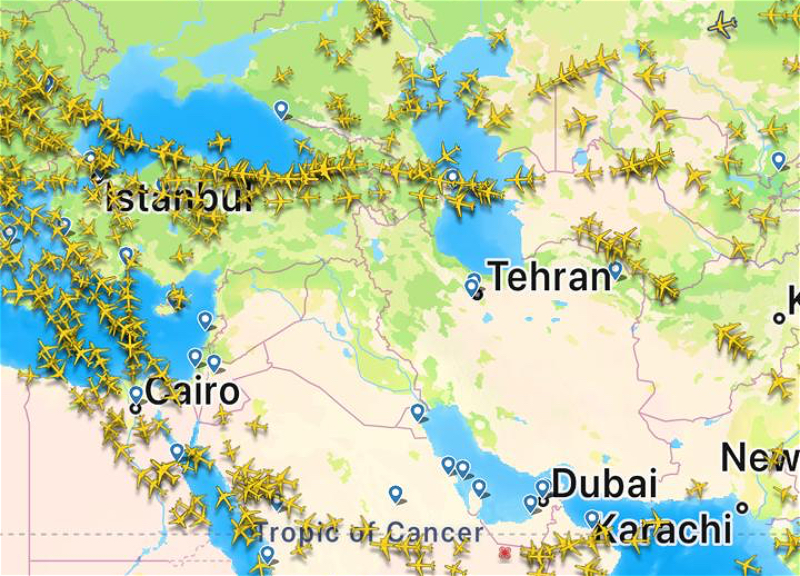
The airspace over vast areas of the Middle East was closed on Saturday, February 28, following coordinated strikes by the U.S. and Israel on military targets in Iran. Tehran responded with a missile barrage, leading to widespread disruptions in civilian air traffic across the region.
According to data from Flightradar24, the skies over Iran and Iraq were nearly empty on the morning of February 28. Iran closed its airspace to civilian aviation immediately after the strikes began. Iraq also suspended civilian air traffic and evacuated aircraft from its airspace as a precautionary measure.
Several Persian Gulf countries introduced additional restrictions. Kuwait, Qatar, and Bahrain suspended or limited air traffic amid reports of missile activity. The UAE announced a "partial and temporary" closure of its airspace as a precaution. Israel and Jordan also closed their skies to flights.
Airlines Massively Cancel Flights
According to Reuters, major global carriers quickly reacted to the escalation. Germany's Lufthansa suspended flights to Dubai for Saturday and Sunday, while routes to Tel Aviv, Beirut, and Oman are frozen until March 7. The airline also stated it would not use the airspace of Israel, Lebanon, Jordan, Iraq, and Iran until the same date.
Budget carrier Wizz Air suspended flights to Israel, Dubai, Abu Dhabi, and Amman with immediate effect until March 7. Air France canceled flights to Tel Aviv and Beirut. KLM moved the suspension of its Amsterdam-Tel Aviv flight from Sunday to Saturday. Virgin Atlantic announced a temporary suspension of using Iraqi airspace and the rerouting of flights.
Qatar Airways temporarily suspended air traffic as a precautionary measure. According to Flightradar24, several Qatar Airways flights that departed on Saturday morning circled over Kuwait or Saudi Arabia before returning to Qatari airspace. The Russian Ministry of Transport reported that Russian airlines have suspended flights to Iran and Israel.
Spain's Iberia canceled flights to Tel Aviv. Japan Airlines canceled flights to Doha. Flydubai reported that the situation has impacted some of its flights.
Impact on Global Aviation
The closure of airspace in several countries disrupted one of the world's busiest air corridors, connecting Europe, the Persian Gulf, and Asia. Long-haul flights are being rerouted south through Saudi Arabia or north through Central Asia, increasing flight times, fuel consumption, and complicating crew scheduling.
The situation is exacerbated by the fact that Russian and Ukrainian airspace has been closed to most airlines for several years due to the ongoing conflict. This makes Middle Eastern routes even more critical for transcontinental flights—and their simultaneous closure puts carriers in an extremely difficult position.
In Abu Dhabi airport, thousands of passengers were stranded due to mass flight cancellations. Etihad Airways and several international carriers suspended flights, leaving travelers without clear information on when services might resume.
Aviation authorities and airlines continue to monitor the situation. According to carriers, flight suspensions and route diversions will remain in place until the security situation stabilizes.
Sources: Reuters, Flightradar24, Skift, Focus on Travel News