The Price of a Fake - Five Million Euros, or the Story of a Failed Blackmail Attempt
Sometimes, high-profile scandals that at first glance appear to be just another wave of internet sensations turn out, upon closer examination, to be part of a much uglier story.
This seems to be the case with an attempted blackmail of the family of Azerbaijan's President Ilham Aliyev, as reported by the country's State Security Service (SGB).
The investigation presented by the SGB reveals a scheme in which an information attack and blackmail act as complementary elements. First, a wave of defamatory materials is launched, then artificial resonance is created on social media, followed by an attempt at monetization—in this case, a demand for five million euros in exchange for not releasing alleged compromising material. In such a configuration, it is hard to speak of spontaneous internet activity. What we see is a deliberate logic of pressure, where informational noise is used as a tool to prepare the ground for extortion.
According to the investigation, the story began with the online dissemination of claims concerning Alena Aliyeva, the daughter-in-law of the President of Azerbaijan. Publications started appearing on the pages and platforms of bloggers located outside the country, after which the information began to circulate actively across various segments of the internet. The criminal case materials state that, in parallel, an individual attempted to contact high-ranking Azerbaijani officials and members of the President's family through social media, email, and a mobile phone number registered abroad.
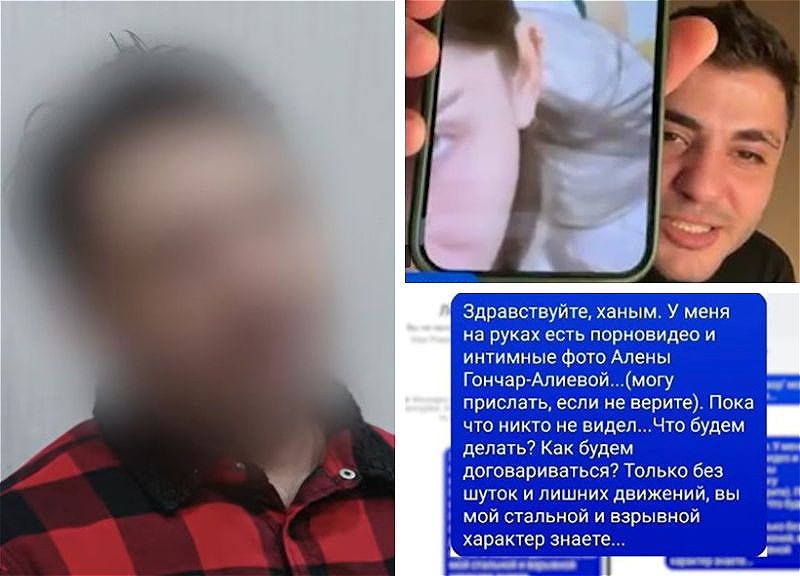
This person claimed to possess a video recording allegedly featuring Alena Aliyeva and threatened to make it public. In exchange for withholding the material, they demanded 5 million euros. Investigative authorities classified the incident as an attempted blackmail. During operational measures, a citizen of Azerbaijan, identified in the case materials as F.S., was detained. Their identity has not yet been disclosed due to ongoing investigative actions.
During interrogation, the suspect provided a confession and described the circumstances of the incident in detail. According to them, on February 11, they attempted to contact blogger Mehman Huseynov via the social network Facebook and asked him to send the video materials already being discussed online. Some time later, the files were sent by two other individuals—Elman Aliyev and Zaki Salimov. According to the detainee, one of them provided two video clips. After viewing the materials, the suspect claims they did not believe in their authenticity.
This point is of fundamental importance for understanding the entire story. It indicates that the person who later attempted to use the recordings for coercion had doubts about their veracity. Nevertheless, the received files became a tool for further actions. According to the detainee's testimony, they sent messages to the Facebook pages of family members of the President—Mehriban, Arzu, and Leyla Aliyeva—stating that they possessed information about Alena Khanum's personal life and wished to establish contact.
There was no response to these messages. Following this, the suspect made another attempt to establish contact. On February 15, they sent a letter through the official website of the Heydar Aliyev Foundation, leaving an email address and mobile phone number. The letter contained a warning: if they were not contacted, they would disseminate the information they had worldwide.
The SGB investigation shows that the informational wave preceding these actions did not arise spontaneously. According to the investigation, the initial dissemination of defamatory claims was linked to the activities of several individuals residing abroad. Among them are bloggers Emin Huseynov and Gabil Mammadov, whose publications became one of the sources for the proliferation of these claims online.
Such a temporal coincidence between informational publications and the subsequent extortion attempt inevitably raises questions about the nature of the events. When the dissemination of dubious materials is accompanied by attempts to gain financial benefit, the line between expressing an opinion and participating in a smear campaign becomes glaringly obvious.
The suspect's method of operation also indicates a certain sequence. First, there were attempts to establish contact via social media, followed by targeted messages, and then an attempt to reach out through the official website of the foundation. This pattern suggests a deliberate testing of various communication channels.
A separate aspect of this story relates to the geography of its participants. A significant portion of the informational activity took place outside Azerbaijan. The use of foreign platforms and accounts registered abroad creates an additional layer of distance and often gives participants in such campaigns a sense of protection from legal consequences.
In essence, this situation involves informational leaks, pressure through online publications, and an attempt at financial blackmail as links in a single chain. Such a model is well-known in the modern digital environment. First, sensational information is disseminated, then resonance is built around it, after which an attempt is made to profit from the created informational noise.
In this context, appeals to the rhetoric of "freedom of speech" appear highly questionable. The dissemination of knowingly false materials and their use to make financial demands falls under entirely different legal evaluations.
An important outcome of this story is the swift response of law enforcement agencies. The measures taken by the SGB allowed for the identification of the suspect and the obtaining of their confession. Thus, an attempt to exert pressure on the family of the head of state, based on the use of dubious materials and the threat of their dissemination, was thwarted.
At the same time, the significance of this case extends beyond the specific episode. It vividly demonstrates how rumors, defamatory publications, and attempts at financial pressure can intertwine in the modern information space. Such situations show how quickly information spread online can become a tool for manipulation.
The story of the blackmail attempt also serves as a reminder that the line between internet provocation and criminal offense can be very thin. When the dissemination of fake materials is accompanied by threats and financial demands, it becomes a matter of legal violation requiring a state response.
Judging by the actions of the investigative authorities, in this case, such a response followed quite quickly. The investigation continues, with all circumstances of the incident and possible connections between the participants being established. Final conclusions will be drawn after the investigation is completed. However, it is already clear that the attempt to exert pressure through informational manipulation and extortion has not gone unnoticed by law enforcement structures.