A man of knowledge and firm principles: marking the 36th anniversary of Ajdar Khanbabayev’s death
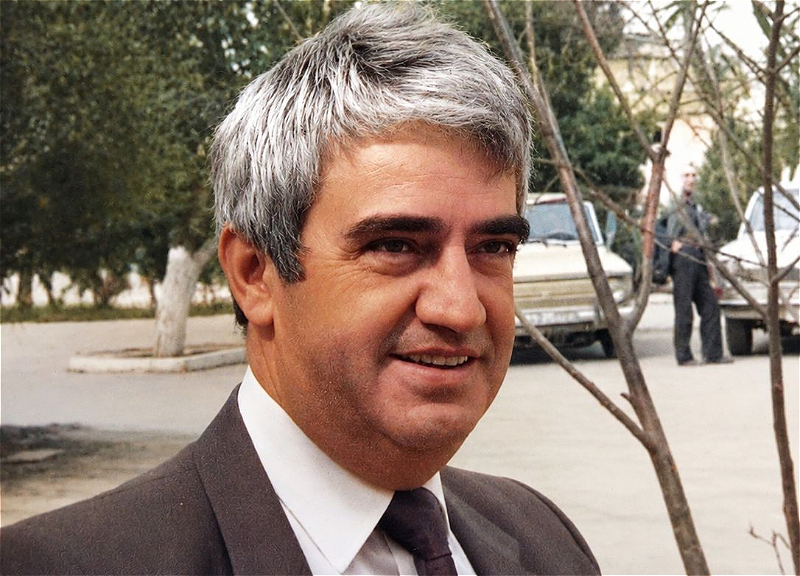
His murder shocked all of Baku…
Today marks 36 years since the tragic death of Ajdar Khanbabayev, a prominent organizer of the book industry in Azerbaijan, director of the Azerneshr publishing house, who was shot on May 30, 1990…
His death was a heavy loss not only for the literary and publishing community of Azerbaijan. A man who made a major contribution to the development of national book publishing and the implementation of large-scale cultural and educational projects, the significance of which is difficult to overestimate, has passed away.
It was under his leadership that the 10-volume “Azerbaijani Encyclopedia,” the 50-volume series “Children’s World Literature,” the first 30 volumes of the “Library of World Literature” in the Azerbaijani language, the 20-volume collection of classical Azerbaijani literature in Azerbaijani and Russian, as well as translations of the works of Nizami Ganjavi and other great poets into foreign languages were published.
But the memory of Ajdar Khanbabayev is preserved not only thanks to these large-scale works. Many who had the chance to know him personally remember him as a man of firm principles, high culture, and selfless dedication to his work.
People who worked and were friends with him tell about what he was like in life and why his name continues to occupy a special place in the memory of his contemporaries.
From the memoirs of People’s Writer of Azerbaijan Elmira Akhundova:
“An entire era of domestic book publishing is associated with the name of Ajdar Khanbabayev. The secret of Ajdar Khanbabayev’s professional success lay in the rare combination of the qualities of a good printer, who mastered the entire “kitchen” of publishing from the basics and in practice, and a man of great erudition, deep knowledge of literature, especially classical. Among his close friends were famous writers, philologists, Arabists, and historians.
It is impossible to list all the publications that saw the light thanks to Ajdar Khanbabayev’s tireless diligence, talent, and, at times, courage. For example, the story of the famous book “Black January,” the publication of which was carried out under the leadership of Ajdar Khanbabayev in record time. Ajdar muallim managed to release this accusatory book under a state of emergency and under the watchful eye of Russian troops. His office, as well as the printing house, were searched more than once. The military were looking for the manuscript of the future book to destroy it, but each time they left empty-handed. And Ajdar muallim carried this manuscript with him, not parting with it for a single day. After the murder of Ajdar muallim, among the possible versions, many Baku residents put forward the version that he was avenged precisely for the publication of the book “Black January,” which showed the true face of Gorbachev’s “democracy.”
This man had a great many good deeds to his credit. Khanbabayev’s attitude toward creative youth is a special topic altogether. He had very warm relations with young Azerbaijani writers. He remembered the birthdays of all living writers and tried to time the release of one or another book to that day. He loved to give gifts to both acquaintances and strangers.
After Ajdar Khanbabayev’s death, many poems were found in his personal archive. Their author was Ajdar muallim himself. No one knew that he wrote poetry — neither relatives nor friends. And he, with his capabilities, did not even allow the thought of publishing a collection of his own poems… Ajdar Khanbabayev lived a short life, but he fulfilled the main task of this life to the end.”
After the trial of the perpetrators of Ajdar Khanbabayev’s murder, Elmira Akhundova had the opportunity to familiarize herself with six volumes of the criminal case and talk with persons directly involved in solving this crime: “Later, Isa Najafov and I wrote the book “The Murder of the Publisher” based on the materials of the criminal case. After excerpts from the novel were published at my initiative in “Literaturnaya Gazeta,” the late Heydar Aliyev told me: “I am very glad that your work was published in the newspaper that attacks me.” Everyone knew that Ajdar Khanbabayev was killed to prevent Heydar Aliyev from coming to Baku.
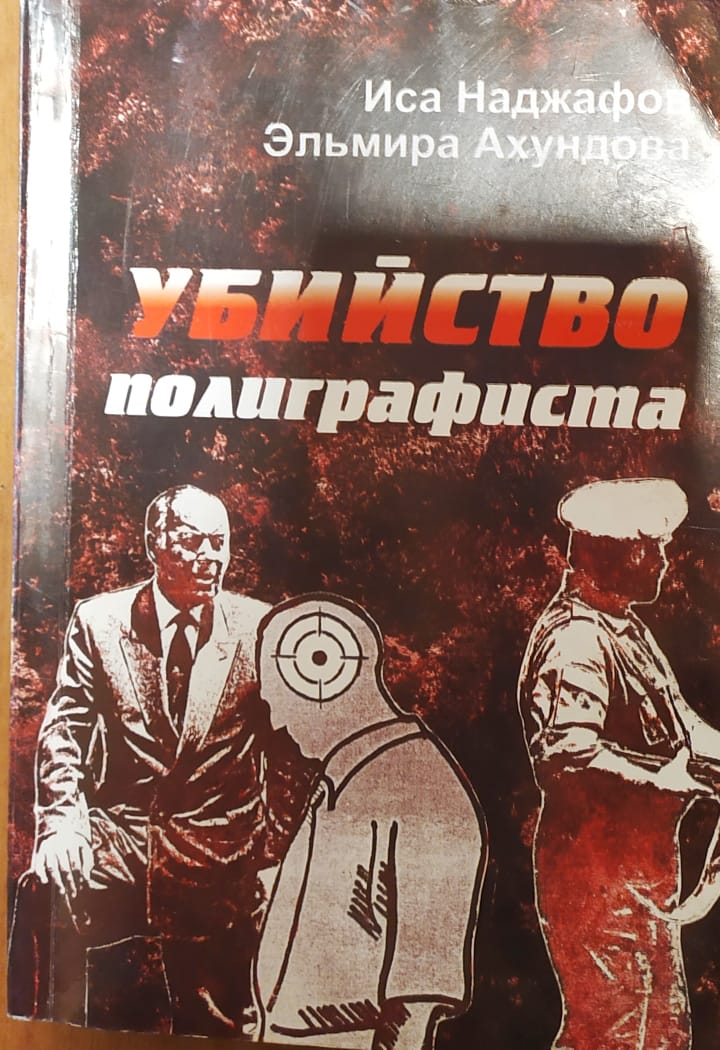
This work has two lines: one — criminal, the other — political. It describes Heydar Aliyev’s Moscow period of life, his relations with members of the Politburo, the reason for his resignation, sudden illness, etc. By the way, it was because of the Khanbabayev case that Aliyev was interrogated as a witness for the first and only time in his life. His interrogation lasted several hours and amounted to 15 pages.
Ajdar Khanbabayev was killed to intimidate Aliyev and prevent his arrival in Baku. It was Khanbabayev who in June 1990 was preparing Heydar Aliyev’s arrival in the capital and insisted on his participation in the XXXII Congress of the Communist Party of the republic, where the question of power was being decided. If Aliyev had appeared at that congress — and he was elected deputy from Nakhchivan — then, quite possibly, the “old guard” would have elected Aliyev, not Mutalibov, as First Secretary of the Central Committee. And then the entire history of modern Azerbaijan would have gone differently.”
From the memoirs of People’s Writer of Azerbaijan Chingiz Abdullayev:
“You always especially respect people who are ready to die for their convictions. For their principles. There cannot be too many such people. But they are like peculiar “beacons,” showing people how one can and should live.
Ajdar Khanbabayev remained that way in my memory. He was considered the recognized aksakal of our printing industry, our publishing business.
I saw how Khanbabayev worked. As if sensing how little time he had, he hardly rested. He visited the pavilions of foreign publishing houses, offered them books by Azerbaijani authors, and conducted negotiations. He was a true ascetic and patriot of our literature. And a few months later, “Black January” happened (it would be called exactly that, after the title of our book), when troops entered the city, and there were hundreds killed and wounded.
All information about the events in Baku was dosed out by the center. In fairness, I will say that even now many in the world do not quite understand what exactly happened then. But it was necessary to somehow convey this information to the world community. At such moments in life, you understand who is a true patriot and who is just a demagogue and windbag. Ajdar muallim secretly printed it in the printing house and took copies out in his car, perfectly understanding exactly what he was risking.
A curfew was imposed in the city, all printing houses were under special control. But “manuscripts do not burn.” The book was ready in two and a half days. And it was taken to Moscow, handed over to all the leaders of the Supreme Soviet of the USSR.
It was then that our national leader Heydar Aliyev came to the representation of Azerbaijan and expressed his decisive protest. He came with his son, also perfectly understanding what he was risking.
This was already a challenge to the then leadership of the Union. It was perfectly understood in Moscow as well. Such a person had to be feared, because millions of his supporters lived in Azerbaijan. Among them was Ajdar Khanbabayev. It is important to emphasize that he did not hold any special posts and was never at any “feeding trough.” Forgive me for this word. There are people who devote their lives to enriching themselves and plundering their own people. And there are people ready to do something for their people, convinced that this is precisely the main goal of their life. It is they who remain in grateful popular memory.
Ajdar muallim did not hide his attitude toward Heydar Aliyev. He was convinced that it was precisely such a person who could save us from the impending catastrophe. Khanbabayev did not hide either his views or his principles. He openly called Moscow, openly spoke his mind. And on May 30, 1990, he was killed. His death shocked everyone. But in the general atmosphere of fear, uncertainty, discord, and disintegration, many remained silent. Although even then everyone understood why Ajdar Khanbabayev was killed.
We remember this man, commemorate him with a kind word, and speak of his services to the people.
May his memory be eternal!”
In August of this year, Ajdar Khanbabayev would have turned 95. Decades later, his name still occupies a special place in the memory of his contemporaries. For many, he remained a talented organizer of publishing, a man of firm principles, and a true patriot of Azerbaijan.
For his family, he was first and foremost a caring husband and loving father, a man whose life was inextricably linked with service to books and culture.
His daughter Afet khanum Khanbabayeva recalls her father, his work, and the events preceding the tragedy of May 30, 1990, in an interview with 1news.az.
“Of course, it is very difficult for me to talk about this… May 30, 1990, became the hardest day of my life. Of the life of our entire family.
My father headed the largest publishing houses of the republic from the age of 28. He started at the publishing house of the National Academy of Sciences of Azerbaijan, then there were Azerneshr and the Yazychy publishing house. He was a printer in the broadest sense of the word. Publishing books was the work and meaning of his entire life.
My father was born in 1931 in Ordubad. He graduated from the Oriental faculty of Azerbaijan State University (now Baku State University) and was a Stalin scholar.
Many knew and loved him. He enjoyed great respect among the Azerbaijani intelligentsia and was a very interesting conversationalist. His mere presence created an atmosphere of warmth and spiritual comfort around him.
It is hard to find a book by his contemporaries in our house without an author’s inscription. It was my father who initiated the publication of the Holy Quran in the Azerbaijani language. He personally went to Moscow and insisted that the Quran be published in the Azerbaijani language as well.
After the tragedy of January 20, my father took the events in the country very hard. He was one of four people who prepared and released the book “Black January” in the shortest possible time.
At the same time, with firm conviction, he joined the work of preparing for Heydar Aliyev’s arrival in Azerbaijan.
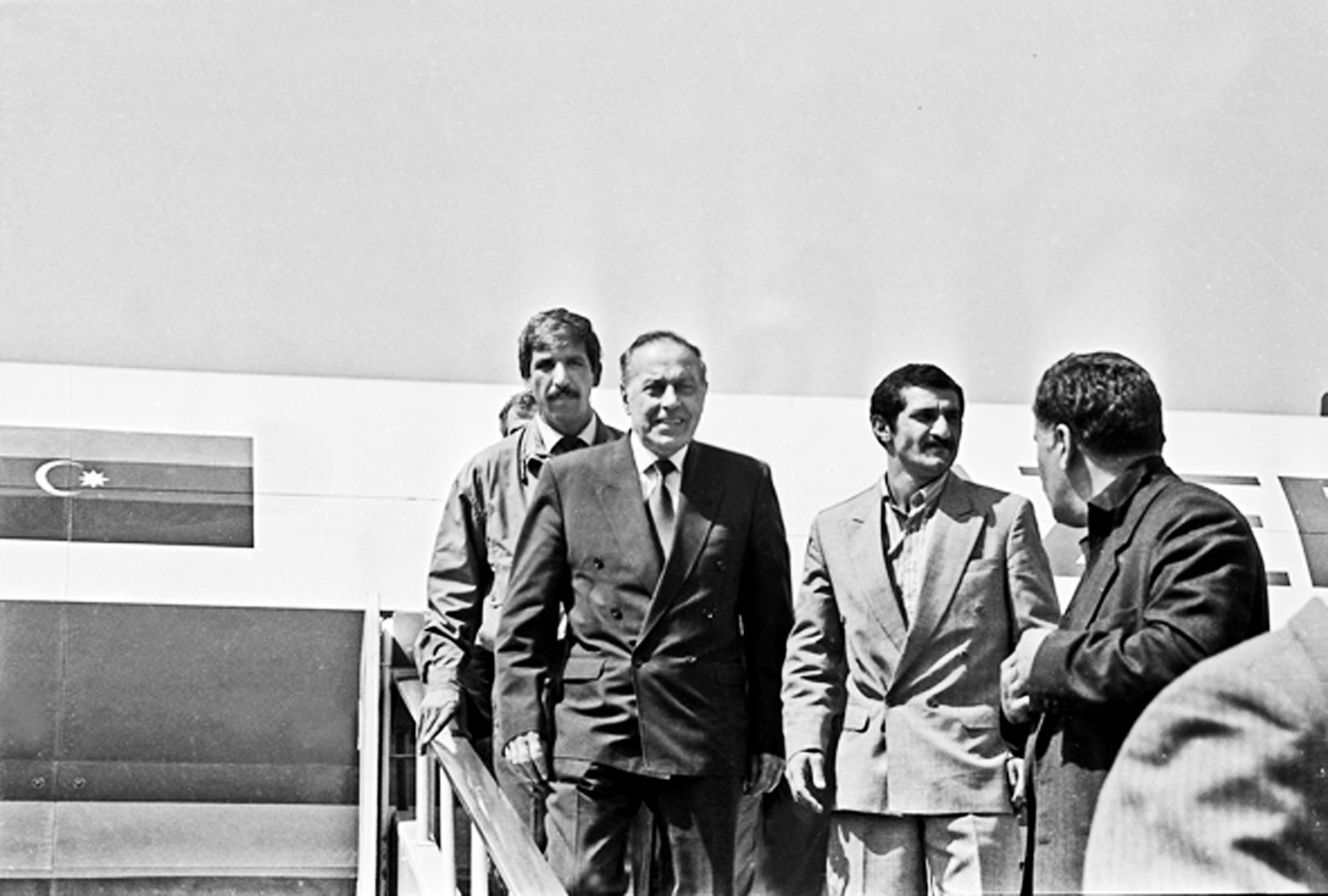
In 1990, openly supporting Heydar Aliyev was a truly bold act. It was a very difficult time. My father and several other patriots with great difficulty achieved that Heydar Aliyev’s arrival took place. And to prevent this arrival, on May 30, 1990, my father was killed… That’s how it all was.”
***
Ajdar Khanbabayev lived a life in which the book was not just a profession, but a true calling. He left behind not only dozens of major publishing projects, but also the memory of a man who remained faithful to his convictions, his work, and his country to the end.
Today, 36 years after his tragic death, people continue to speak of him with respect and gratitude. This means that the memory of him is still alive.
Political department of 1news.az