War around Iran and the South Caucasus: How Azerbaijan maintains balance
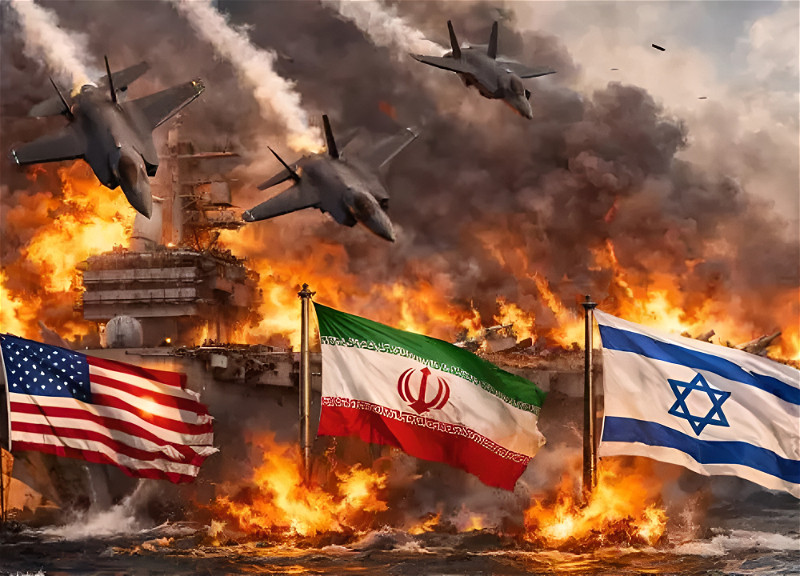
The second month of the war between the American-Israeli tandem and Iran is underway—a military conflict that was initially, at least by U.S. President Donald Trump, conceived as a "quick" operation lasting 4-6 weeks.
Although the campaign has not yet exceeded the six-week mark, with the current level of Iranian resistance, it is unlikely that the Americans will meet their designated deadline.
Meanwhile, this war has, from its very first days, extended far beyond the borders of the directly involved states. Practically the entire Middle East region is ablaze, as Iran, lacking the ability to strike back directly on U.S. territory, has been launching fairly successful attacks on American military bases in neighboring Middle Eastern countries. And there are plenty of such bases in the region.
When an armed conflict between major powers and one of the key Middle Eastern states erupts in such a sensitive region, its consequences inevitably affect the entire security architecture of adjacent areas, including the South Caucasus.
For the South Caucasus, this situation holds particular significance. The region’s geographical position makes it a natural crossroads of political interests, transport routes, and energy communications. Under these conditions, any escalation in the Middle East automatically gains an additional dimension, as it may impact the security of states located in close proximity to the potential escalation zone. Azerbaijan, which shares a long border with Iran while actively engaging with a wide range of international partners, finds itself in a unique position. On one hand, it is objectively involved in regional processes; on the other, its strategic interest lies in maintaining stability and preventing the transfer of conflicts onto its own territory.
Baku’s official stance in this situation remains consistent and crystal clear. Azerbaijan has repeatedly emphasized that its territory has not been and will not be used for aggression against neighboring states. This principle has been articulated at the highest level and has become a crucial element of the country’s foreign policy. Amid the growing confrontation around Iran, such a position takes on special importance, as it demonstrates Azerbaijan’s desire to maintain balance and avoid being drawn into conflicts that originate outside the region.
This approach is often described as pragmatic neutrality, but in essence, it reflects a much more complex diplomatic strategy, through which Azerbaijan seeks to simultaneously maintain constructive relations with various centers of power—both within and beyond the region. This requires delicate political calculation, as any abrupt move could disrupt the existing balance and create new security risks.
In this context, the dynamics of Azerbaijani-Iranian relations take on particular importance. Over recent years, these relations have gone through various stages, including periods of tension. However, recent events indicate a noticeable softening of rhetoric and a gradual return to pragmatic dialogue. Regular contacts between official representatives of the two countries, telephone conversations, and consultations demonstrate the desire of Baku and Tehran to move past episodes of misunderstanding and focus on areas of cooperation that serve the interests of both sides.
This logic is largely explained by objective factors. Azerbaijan and Iran are connected not only by a shared border exceeding 700 kilometers in length but also by deep historical, cultural, and religious ties. Millions of people on both sides of the border share a common historical memory and family connections. These circumstances create a natural foundation for maintaining stable relations and serve as a kind of safeguard against sharp confrontation.
Moreover, a key principle for Azerbaijan remains respect for the sovereignty and territorial integrity of all states in the region. A stable and unified Iran aligns with the security interests of the South Caucasus, as any internal upheavals or military actions on its territory would inevitably trigger a chain reaction, the consequences of which could affect neighboring countries. In a context where the Middle East is already experiencing a period of heightened turbulence, maintaining stability along the Azerbaijani-Iranian border takes on strategic significance.
The economic dimension of relations between Baku and Tehran deserves separate attention. In recent years, it has gradually become one of the key factors shaping bilateral interaction. A central role here is played by the international transport corridor "North-South," which connects India, Iran, Azerbaijan, Russia, and European countries. This project is seen as one of the most important elements of the new logistical architecture of Eurasia.
The route passing through Iranian and Azerbaijani territories significantly reduces the delivery time of goods between South Asia and Europe. While the traditional sea route through the Suez Canal takes about 40 days, the use of land and railway sections of the "North-South" corridor can cut this time nearly in half. Under these conditions, Azerbaijan and Iran become important transit partners with largely aligned interests.
Economic cooperation is also evident in the implementation of specific infrastructure projects. One of the most notable examples is the joint use of water resources from the Araz River. The hydroelectric facilities "Khudaferin" and "Gyz Galasy," built on this river, have become a symbol of cross-border interaction that brings tangible benefits to both sides. The realization of these projects demonstrates that even in complex geopolitical conditions, countries can find common ground and jointly utilize natural resources.
In recent years, the development of transport communications linking mainland Azerbaijan with the Nakhchivan Autonomous Republic has also been actively discussed. One of the options under consideration is a route through Iranian territory along the Araz River, which could serve as an additional secure communication channel. Such a project is viewed as a pragmatic solution to a transport challenge, capable of strengthening economic ties and reducing risks associated with political disagreements in the region.
At the same time, Azerbaijan’s geopolitical role amid the current crisis extends far beyond mere participation in economic projects. Baku has long pursued a multi-vector foreign policy, which involves developing partnerships with various countries and international organizations. Azerbaijan maintains a strategic alliance with Turkey, cooperates with Israel in technical and defense spheres, fosters ties with the European Union and the United States, and simultaneously preserves good-neighborly relations with Iran.
Such a combination of connections often requires complex diplomatic decisions. However, it is precisely this ability to maintain working contacts with diverse political centers that makes Azerbaijan an important player in regional diplomacy. Amid escalating tensions between the West and Iran, such a position can play a stabilizing role, as Baku is interested in reducing tensions and preserving channels of dialogue.
It should also be noted that any military actions near Azerbaijan, especially in close proximity to its borders, inevitably create serious risks. This primarily concerns humanitarian consequences and potential environmental threats that could arise from strikes on industrial infrastructure or energy facilities. For this reason, Baku advocates for the diplomatic resolution of international disputes and supports efforts aimed at reducing the level of confrontation.
The current international situation demonstrates how fragile stability can be when it depends solely on external factors. This is why strengthening its own sovereignty and developing internal resources remain strategic priorities for Azerbaijan. Economic resilience, the development of transport infrastructure, and the expansion of international trade routes are becoming crucial elements of national security.
The history of recent decades shows that wars eventually end, but geography remains. Azerbaijan and Iran have been and will continue to be neighbors, connected by a shared border, economic interests, and human ties. Therefore, strengthening pragmatic cooperation between Baku and Tehran today is not just an element of bilateral policy but a vital factor for the stability of the entire South Caucasus—a region that knows all too well the cost of major geopolitical games.