From New York to Karabakh: When a mayor becomes a propagandist
In modern politics, a dangerous trend is increasingly evident: the most complex international conflicts are being turned into tools for domestic positioning, where accuracy gives way to sensationalism, and facts are replaced by ideological clichés.
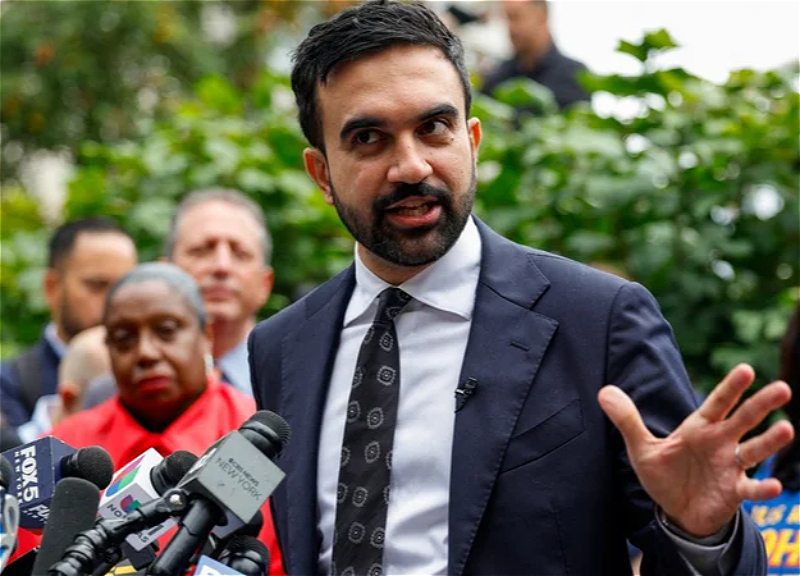
Public figures with significant influence often allow themselves to make categorical judgments on events beyond their direct competence, without delving into historical or legal nuances. It is within this logic that we should consider the rhetoric of New York City Mayor Zohran Kwame Mamdani on the Karabakh issue.
His recent statements, far from the truth, about the so-called 'Armenian genocide' of 1915, as well as Azerbaijan’s efforts to restore its territorial integrity and sovereignty in 2020–2023, appear particularly striking against the backdrop of criticism already directed at him on the domestic political stage in the United States. A politician accused by opponents of populism, one-sided assessments, and ideologically charged rhetoric effectively confirms these accusations by stepping onto the international stage with statements that are far removed from factual and legal reality. The use of loud and legally loaded terms without proper argumentation, the disregard for alternative perspectives, and the complex historical context all fit into the already established image of a politician for whom political effect often takes precedence over accuracy and responsibility.
For instance, Mamdani’s statement about a 'genocidal campaign' by Azerbaijan does not withstand either legal or factual scrutiny. The term 'genocide' has a clear definition in international law and cannot be applied arbitrarily in political rhetoric. Its use in this context appears as a deliberate attempt to emotionally color events that have a different nature. In 2020, Azerbaijan acted within its internationally recognized territory, restoring territorial integrity, which was also confirmed by UN Security Council resolutions. Ignoring this fundamental fact undermines the very logic of a legal approach to assessing the conflict.
Equally telling is the complete absence in the mayor’s statements of any mention of nearly three decades of occupation of Azerbaijani territories, which resulted in hundreds of thousands of people becoming internally displaced. This is not merely an omission—it is a selective interpretation that ignores inconvenient facts.
Particular concern arises from the portrayal of the counter-terrorism measures of 2023 as the 'expulsion' of the Armenian population of Karabakh, while the Armenian residents of Azerbaijan’s Karabakh region were offered mechanisms for reintegration, security guarantees, and equal rights. Ignoring these circumstances, replacing them with the term 'ethnic cleansing,' and disregarding the fact of the voluntary departure of part of the Armenian population indicate a desire not to understand the situation but to fit it into a pre-determined political narrative.
This logic of selective perception and substitution of concepts is not an isolated incident but rather fits into a broader pattern of his public behavior and political rhetoric.
Criticism of Mamdani has long transcended ordinary political debate and has taken on a systemic character, reflecting a deep crisis of trust in his rhetoric and managerial style. His opponents increasingly point out that behind loud statements and ideologically polished formulations, there often lies a lack of practical responsibility and a tendency to oversimplify complex issues to the level of slogans. The right sees him as a threat to economic stability and security, accusing him of radicalism and antagonism toward business; centrists criticize his lack of managerial experience and inability to make balanced decisions; even part of his own left-wing base is growing louder in expressing disappointment, considering his policies either declarative or half-hearted. Against this backdrop, criticism from Jewish organizations and Israeli circles, pointing to the one-sidedness and conflict-provoking nature of his approach to Middle Eastern issues, has taken on particular sharpness. Collectively, this forms the image of a politician in constant contradiction not only with opponents but also with his own supporters, inevitably raising questions about his ability to act as a responsible and unifying public leader.
Against this background, his statements on the South Caucasus appear not as a random slip but as a logical continuation of the same behavioral model—a model in which complex international issues are replaced by ideological clichés. This is particularly dangerous when it comes to a region that has experienced prolonged conflict and is in the stage of post-conflict recovery. Any irresponsible statement from outside can not only distort the perception of events but also complicate normalization processes.
The reaction from the Azerbaijani side, including statements by the official representative of the Ministry of Foreign Affairs (MFA) of Azerbaijan Aikhan Gadzhizade and an appeal from representatives of civil society, appears entirely justified in this context. This is not merely about defending a national position but about attempting to bring the discussion back within the framework of facts and international law.
Ultimately, the situation surrounding Mamdani’s statements is a symptom of a broader problem. When politicians begin to use international conflicts as a platform for ideological self-expression, it is not only the quality of public discourse that suffers but also the very prospects for peace. The responsibility for words in such conditions increases manifold. And it is precisely this responsibility that, judging by his latest statements, the mayor of New York clearly lacks today.