AFB Bank: Diagnosis and Three Scenarios for the Future of a ‘Bank-Experiment’
Five years of contraction, a dividend vacuum — and a sudden credit sprint. What is behind the sharpest reversal in Azerbaijan’s banking market?
In February 2026, the Central Bank of Azerbaijan (CBA) published its complaint index, in which AFB Bank ranked third from the bottom with an index of 2.95 — the red zone. A month earlier, the bank had been second (3.83). For a bank that was recently a quiet mid-table player with an index of 1.49, two consecutive months in the critical zone is a systemic signal. In March, the index declined to 1.45 (7th place, yellow zone) — an improvement, but still above the 2025 annual average.
But the complaint index is merely an external symptom. Behind it lies a story without precedent in Azerbaijan’s banking market: an institution that spent five years losing assets, extracting capital through dividends, and depleting its liquidity cushion, in 2025 suddenly became the fastest-growing bank in the country — expanding its loan portfolio by 60% while the sector grew just 2–3%.
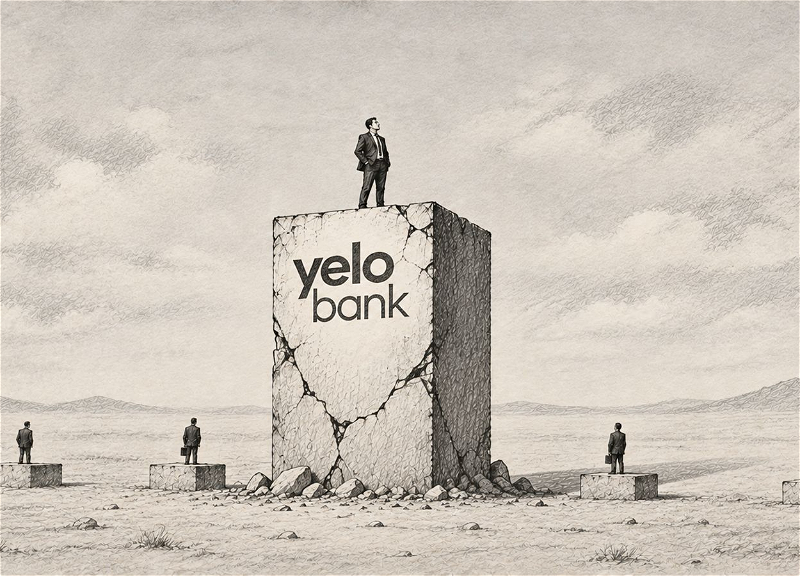
First News Intelligence Unit conducted a comprehensive analysis of AFB Bank’s audited financial statements for 2019–2024, CBA prudential data for 2023–2025, Fitch Ratings’ rating action (August 2025), and open sources. The result: this is neither a bank in crisis nor a bank in renaissance. This is a bank-experiment — an institution that changed its operating mode without changing its fundamental risks.
Act I. Five Years of Contraction (2019–2024)
Terminal contraction: the bank that was melting away
At the end of 2019, AFB Bank’s total assets stood at AZN 576.7 million. By the end of 2024 — AZN 292.3 million. In five years, the bank lost nearly half its balance sheet. The contraction was monotonic — every single year without exception.
Table 1. AFB Bank dynamics, 2019–2024 (audited IFRS data, AZN million)
|
|
2019 |
2020 |
2021 |
2022 |
2023 |
2024 |
Δ |
Δ % |
|
Assets |
576.7 |
511.3 |
465.1 |
280.5 |
328.7 |
292.3 |
−284 |
−49% |
|
Loans (net) |
328.3 |
254.8 |
215.4 |
151.1 |
162.4 |
174.2 |
−154 |
−47% |
|
Deposits |
402.8 |
358.1 |
301.2 |
124.8 |
169.4 |
130.4 |
−272 |
−68% |
|
Equity |
81.3 |
75.3 |
77.2 |
83.6 |
80.5 |
77.0 |
−4.3 |
−5% |
|
Net profit |
10.3 |
6.4 |
4.8 |
10.7 |
7.6 |
4.1 |
−6.2 |
−60% |
|
Dividends |
— |
— |
5.5 |
9.3 |
10.7 |
7.6 |
|
|
Source: AFB Bank audited reports (IFRS), Baker Tilly Azerbaijan. Dividends from statements of changes in equity.
This is not a reflection of a market trend. Over the same period, total assets of Azerbaijan’s banking sector grew from approximately AZN 44 billion to AZN 55.7 billion — an increase of roughly 25%. AFB Bank was moving in the opposite direction.
The dividend vacuum: profits leave, capital erodes
An analysis of the statements of changes in equity for 2022–2024 reveals a persistent pattern: dividends systematically exceed net profit. In 2023, with net profit of AZN 7.57 million, shareholders were paid AZN 10.68 million — 41% more than the bank earned. In 2024, with profit of AZN 4.1 million, AZN 7.57 million was paid out. Over two years, AZN 6.6 million more was extracted than the bank earned.
Fitch Ratings in August 2025 stated directly: the 2023 net income was fully distributed as dividends, leading to a decline in the FCC ratio from 39% to 36%. Equity eroded steadily: 83.6 → 80.5 → 77.0 million AZN. Shareholders were withdrawing capital at the very moment the safety cushion was thinning: reserve coverage of impaired loans (Stage 3), according to Fitch, fell from 86% to 60% over the same period.
From paralysis to depletion
AFB Bank’s liquidity story breaks into two phases. In 2020–2022, instant liquidity exceeded 97–106%: the bank accumulated vast cash reserves but failed to convert them into loans. This was investment paralysis.
By 2023–2025, the picture reversed. According to CBA prudential reports (Form A-13), instant liquid assets declined steadily: from AZN 42.1 million (end of 2023) to 32.1 million (2024) and 28.5 million (2025). The cash position fell from 66 to 49 and then to 19.3 million. Nostro accounts collapsed from 13.4 to 2.8 million AZN in a single year (2024).
If in 2020 AFB Bank was ‘a giant safe that stopped lending,’ by 2024 the safe was gradually emptying. The first diagnosis: paralysis. The second: depletion.
Ownership context: continuity of connections
Until 2019, AFB Bank was part of Gilan Holding’s structure. In February 2019, 99.64% of shares were acquired by Hikmat Ismayilov for AZN 70.14 million. According to open sources, the former and current shareholders are connected, which explains the continuity of the business model: six years after the formal change of ownership, Gabala — the district of the holding’s historic investments — still accounted for 10% of the bank’s loan portfolio (AZN 29.4 million per 2025 prudential data), exceeding the combined lending volumes of Sumgait, Ganja, and Absheron.
Hikmat Ismayilov is simultaneously a shareholder of Bank of Baku (31.11%). This fact will acquire key significance in the next act of this story.
Turning Point: The New Team
In early 2025, AFB Bank underwent a radical management overhaul. In February, Orkhan Khubanli, who had led the bank since 2011, stepped down as Chairman of the Management Board. In May, Amid Ganbarov was appointed to the position — a manager who had spent over 19 years at Bank of Baku, including as Director of Partner Relations and Alternative Sales Channels.
Simultaneously, Vusal Shahverdiyev — formerly of ABB (the country’s largest bank) and an INSEAD graduate — became Chairman of the Supervisory Board. Rufat Manafov, from PMD Group — a company that absorbed several former Gilan Holding assets — was appointed Deputy Chairman of the Management Board.
The critical detail: Ganbarov came from another bank owned by the same shareholder. This was not a market hire — it was an intra-group transfer. The shareholder moved a retail specialist from one of his banks to the other with a clear mandate: to pivot AFB Bank from a liquidation-dividend mode into aggressive growth. Previously, First News Intelligence Unit analyzed the ‘hidden cost of growth’ at Bank of Baku — the bank where Ganbarov built his career. Whether the new team will bring the same risks to AFB Bank remains an open question.
Related reading:
Bank of Baku and the Hidden Cost of Growth: What the Reports Reveal
Act II. The Credit Sprint (2025)
60% growth in a stagnating sector
The 2025 results overturned the five-year trend. AFB Bank’s loan portfolio grew by 59.8% — from 183 to 292.5 million AZN (+109.5 million in one year). The bank became the absolute leader in growth among all 22 banks. The sector’s total loan portfolio in 2025 grew by just 2–3%. AFB Bank was an outlier.
Table 2. AFB Bank loan portfolio structure, 2025
|
Segment |
End of 2024 |
End of 2025 |
Growth |
|
Consumer loans |
~21,800 |
65,000 |
+198.6% |
|
Business loans |
~90,000 |
158,900 |
+76.4% |
|
Mortgage |
~71,300 |
68,600 |
−3.7% |
Source: Marja.az citing AFB Bank financial data. Thousands AZN.
Consumer loans tripled. Business loans grew by 76%. Meanwhile, the bank operates through just 7 branches and 4 offices and conducted no major marketing campaigns.
Funding sources: the state drip
Where did AFB Bank find the money to grow its portfolio by AZN 109 million in one year? Fitch Ratings in August 2025 provided the answer: wholesale borrowings account for 36% of the bank’s liabilities and primarily consist of low-cost, long-term loans from state development institutions.
The deposit base accounts for 61% of liabilities, but Fitch characterizes it as ‘highly concentrated by name, including related parties and companies affiliated with a conglomerate.’
According to open sources, none of the international development institutions (EBRD, IFC, FMO, DEG) have projects with AFB Bank — unlike competitors that actively attract international credit lines. The funding is exclusively domestic: state development institutions, three bond issues (5, 10, and 5 million AZN — the first in the bank’s history), and concentrated deposits.
Red flags from Fitch: 70% of the portfolio on 25 borrowers
In August 2025, Fitch Ratings assigned AFB Bank a B rating (Stable Outlook) while simultaneously noting: underwriting standards are weak. According to Fitch, the top 25 borrower groups account for over 70% of the corporate and SME portfolio, the bulk comprising relationship-based exposures.
Formally, loans to related parties under CBA regulations amount to just AZN 1.9 million (less than 1% of the portfolio). However, Fitch assesses the real concentration differently: over 70% of the corporate and SME portfolio consists of relationship-based exposures, and the deposit base includes funds from companies affiliated with a conglomerate.
Impaired loans (Stage 3 under IFRS 9) stood at 14.4% of gross loans at end-2024. Reserve coverage was 60% (down from 86% a year earlier). Fitch explicitly named the downgrade triggers: material weakening of capitalization due to loss-making performance or rapid loan growth, as well as substantial deposit outflows from the largest corporate customers.
‘Başdan Başa’: a digital platform with limited impact
In September 2025, AFB Bank launched ‘Başdan Başa’ — a fully digital lending platform. Limit up to AZN 50,000, rates from 14.5%, zero commission. By the third quarter, online lending exceeded 50% of the retail portfolio.
However, the platform operated for at most 3.5 months out of 12. A threefold increase in the consumer portfolio over the full year cannot be explained by a single digital channel. For the first 8 months, growth came through traditional mechanisms — with no visible marketing campaigns.
Regulatory actions and the complaint index
Against the backdrop of aggressive growth, the CBA took two supervisory actions against AFB Bank in 2025: a mandatory injunction for violations of foreign exchange reporting (February) and a court fine for AML/CFT violations (September). Two regulatory actions in a single year is unusual for a bank of this size.
The CBA complaint index confirms operational overheating: January 2026 — 3.83 (2nd place, red zone), February — 2.95 (3rd place). The 2025 annual average was 1.49. A 2.5x spike is a direct consequence of aggressive client base expansion without commensurate investment in infrastructure.
First News Intelligence Unit research consistently demonstrates a correlation between a bank’s financial health and its complaint index. Bank BTB, which consistently led the anti-ranking in 2025, was converted by the CBA into a non-bank credit organization in March 2026 — seven weeks after our analytical forecast.
Related reading:
Diagnosis: A Bank-Experiment
AFB Bank is an institution that has passed through three operating regimes in six years — none of which was sustainable.
2019–2022: Captive banking — serving a narrow circle of interests within a holding structure, investment paralysis, excess liquidity.
2023–2024: Liquidation dividend — systematic capital extraction through dividends exceeding profits. Depletion of the liquidity cushion. Declining profitability, deteriorating portfolio quality.
2025: Credit sprint — deployment of a new management team, funding from state development institutions, aggressive 60% portfolio growth in a stagnating sector. Over 70% of the corporate portfolio concentrated on 25 borrowers. AML fine. Complaint index in the red zone. Fitch warning of a possible downgrade.
Three Scenarios: What Comes Next
The key question is not whether AFB Bank can grow. It already has. The question is at what cost and with what outcome.
Scenario 1: Managed Transformation
This scenario is possible if the new team truly knows what it is doing. Ganbarov spent 19 years building retail at Bank of Baku; Shahverdiyev brought corporate governance of ABB caliber. The strategy: inject cheap state resources into a ‘drained’ bank, build the portfolio, establish a sustainable retail model through ‘Başdan Başa,’ and diversify the client base. In 2–3 years — a bank with 2–3% market share and normal economics. Bond issuances are the first step toward market-based funding. Growth in retail deposits is the second.
Precondition: the quality of the new portfolio must be acceptable (NPL on new originations below 5%), and dividend policy must be restrained. Neither condition has been confirmed yet.
Scenario 2: Stagnation at the New Level
Under this scenario, the bank that grew cannot sustain the pace. The consumer portfolio begins to deteriorate (early signs should appear in the 2025 audit, expected within a month or two), business lending remains concentrated on a narrow group of borrowers, and the deposit base fails to diversify.
AFB Bank stabilizes at AZN 250–300 million in assets, but without a breakthrough: neither growth nor contraction. The bank remains a niche instrument serving the shareholder’s group — as before, only at a larger scale.
Indicators: stable B rating, dividends at profit level, complaint index returns to the yellow zone but not green.
Scenario 3: Overheating and Retreat
As noted, 70% of the corporate portfolio rests on 25 borrowers. If even 2–3 of them face difficulties — and with relationship-based lending, one borrower’s trouble often means the group’s trouble — the portfolio will start deteriorating. Reserves will be insufficient (Stage 3 coverage at 60% and falling). Capital is thin (AZN 77 million against a portfolio of 293 million). Fitch will downgrade. Related-party deposits may exit — and liquidity, already strained, will become critical.
The Bank BTB precedent shows that the CBA responds — but responds late. BTB’s conversion into an NBCO came after months of agony that First News Intelligence Unit documented well before the regulator intervened.
Three indicators we will be watching
The 2025 audit (Baker Tilly, expected May–June 2026). It will reveal the true quality of AZN 109 million in new loans. If Stage 3 on new originations is already in the 10%+ zone, the model is in question.
2025 dividends. If the shareholder once again takes all profits — the strategy has not changed, only the scale. If dividends are minimal — this is a sign of serious intent.
The complaint index for April–June 2026. If the bank exits the red zone, the operational infrastructure has adapted to growth. If it stays — the overheating is chronic.
Until the audit is published, AFB Bank remains what it has become: an experiment — with an open ending.
***
First News Intelligence Unit (FNIU) is the analytical division of the 1news.az editorial team, specializing in research on Azerbaijan’s financial sector and economy.
Read in other languages:
AFB Bank: diaqnoz və “bank-eksperiment” üçün 3 ssenari
AFB Bank: диагноз и 3 сценария будущего «банка-эксперимента»