Mikhail Gusman on Heydar Aliyev: the people of Azerbaijan never betrayed him
June 15 in Azerbaijan marks National Salvation Day, a date that became a turning point in the history of the independent state. The return of national leader Heydar Aliyev to the leadership of the country in 1993 halted the processes of political chaos and laid the foundation for the stable development of Azerbaijan.
The significance of this historical date, the role of Heydar Aliyev in the formation of the modern Azerbaijani state, the continuity of his political course and the achievements of Azerbaijan at the present stage were discussed in an interview with 1news.az by well-known international journalist, professor Mikhail Gusman, who personally knew the national leader and met with him repeatedly over the years.
- June 15 in Azerbaijan marks National Salvation Day. This date is associated with Heydar Aliyev's return to power in 1993 and is considered a turning point in the country's modern history. How do you assess the significance of these events decades later?
- The more time separates us from that memorable historical day - June 15, 1993 - the clearer its significance for the fate of Azerbaijan becomes. Today, one especially clearly understands the scale of that event - Heydar Aliyev's return to the leadership of the republic.
It is enough to recall the extremely difficult condition the country was in at that time. The wounds of the First Karabakh War had not yet healed, hundreds of thousands of people had become refugees and internally displaced persons, and the economy was practically destroyed. Azerbaijan was experiencing a deep political and social crisis, and external forces and various political opponents watched the events with undisguised interest, hoping to take advantage of the weakness of the young state. The country was in fact falling apart before our eyes.
I remember that time well. And I remember that Heydar Aliyev's return was conditioned above all by the will of the people of Azerbaijan. Heydar Aliyev himself once spoke very wise words: in his political life there were people, including former associates, who betrayed him or tried to do so. But, as he emphasized, the people of Azerbaijan never betrayed him.
This is where the special significance of those events lies. At a critical moment for the state, the people saw the only chance to save their homeland - to appeal to Heydar Aliyev with a request to return from Nakhchivan to Baku and take responsibility for the country's future. This step became a turning point in the history of independent Azerbaijan and laid the foundation for subsequent stabilization, development and strengthening of statehood.
- Heydar Aliyev's political legacy covers two key historical periods, as you know, in Soviet times and later in independent Azerbaijan. In your opinion, what is the historical uniqueness of each of these stages?
- In world politics and world history it is difficult to find another example when one person, one individual, one political leader twice returned to the pinnacle of power in his country and both times played a decisive role in its fate. Of course, these periods cannot be compared directly - they were different eras, different political systems and different historical circumstances. However, the indisputable fact remains: both in the Soviet period and in the years of independence, Heydar Aliyev managed to achieve results that had a decisive influence on the development of Azerbaijan.
It is enough to recall that after his coming to the leadership of the Azerbaijan SSR in 1969, the republic in a relatively short time became one of the leaders of the Soviet Union in terms of socio-economic development rates. By the mid-1970s, Azerbaijan occupied leading positions among the fifteen union republics. These achievements were repeatedly noted at the highest state level. High recognition of his services was the awarding of the title of Hero of Socialist Labor to Heydar Aliyev twice, his election as a candidate member of the Politburo of the Central Committee of the CPSU and the exceptional level of political trust he enjoyed in the leadership of the Soviet Union.
It is no coincidence that the then leader of the USSR, Leonid Ilyich Brezhnev, uttered the now-famous phrase: "Azerbaijan is striding widely." These words were addressed precisely to Azerbaijan, which, thanks to effective leadership, demonstrated impressive development results.
Then a new stage began. Heydar Aliyev held high positions in the union leadership, worked in the highest echelons of Soviet power, but later fell into political disgrace. He survived a serious illness and the most difficult period of his life. But it was strength of character, political will and a sense of responsibility to his people that allowed him to return to the historical arena once again.
In 1993, responding to the call of the people, Heydar Aliyev returned to Azerbaijan and in a short time managed to stop the processes that threatened the very existence of the state. He in fact saved the country from chaos, civil confrontation and disintegration, laying a solid foundation for modern Azerbaijani statehood.
If Heydar Aliyev is rightly called the savior of Azerbaijan, then it is no less fair to call him the builder of the modern Azerbaijani state. It was the foundation he created that ensured the country's sustainable development for decades to come. And the successes of today's Azerbaijan, its international authority, economic power, restoration of territorial integrity and strengthening of positions on the world stage became possible thanks to the consistent continuation of this political course under the leadership of President Ilham Aliyev.
- In the early 90s, Azerbaijan faced external military aggression and an internal political and economic crisis simultaneously. Which decisions of Heydar Aliyev in that period would you call decisive for preserving Azerbaijani state nationality?
- You know, like any outstanding politician and wise statesman, Heydar Aliyev in that period solved many complex tasks. They can be listed for a long time. These were issues of strengthening the armed forces, restoring the economy, stabilizing the socio-political situation, creating conditions for the country's development and improving the well-being of citizens.
However, in my opinion, Heydar Aliyev's main achievement lay elsewhere. He managed to unite the Azerbaijani people around the idea of building a new independent state, strengthen people's faith in the future of their country and mobilize society to confront external challenges and aggression. The people trusted their leader and saw in him a man capable of leading the state out of the deepest crisis.
That is why today we can rightfully speak of Heydar Aliyev as the National Leader of Azerbaijan - a politician who managed to unite the nation in one of the most difficult periods of its history and lay the foundations of the modern Azerbaijani state.
- How would you characterize the historical interconnection of the Victory in the Patriotic War with the foundations laid by Heydar Aliyev, including the increase in the country's international authority, economic development, and army building?
- It must be understood that in the period when Heydar Aliyev headed independent Azerbaijan, he faced a huge number of complex tasks. He had to simultaneously restore state institutions, strengthen the economy, ensure political stability and lay the foundations of the modern Azerbaijani army - those Armed Forces that later became one of the key factors in strengthening statehood and ensuring the country's national security.
I think that one of the main testaments Heydar Aliyev left to his worthy successor, President Ilham Aliyev, was the task of liberating the native lands and restoring the territorial integrity of Azerbaijan.
We were all witnesses to how, step by step, year by year, starting from the 2000s, under the leadership of Supreme Commander-in-Chief Ilham Aliyev, the power of the Azerbaijani army was strengthened. Military construction was consistently carried out, the Armed Forces were modernized, and their professionalism and combat readiness were increased. At the same time, Azerbaijan invariably gave preference to a peaceful settlement of the conflict and for many years sought to achieve a just solution through diplomatic means.
However, when all possibilities of the peaceful process were exhausted, Azerbaijan, relying on the norms of international law and the relevant resolutions of the UN Security Council, managed to restore its territorial integrity, liberate the occupied lands and achieve historical justice. This became not only a military victory, but also the restoration of the national dignity of the Azerbaijani people.
That is why the Victory in the 44-day Patriotic War became one of the brightest embodiments of that strategic course, the foundations of which were laid by Heydar Aliyev. This is the best monument to his statesmanship, his foresight and his enormous contribution to the building of independent Azerbaijan.
It is no coincidence that on November 8, 2020, on Victory Day, Supreme Commander-in-Chief Ilham Aliyev first of all visited the Alley of Honor and paid tribute to the memory of the National Leader and with full right reported to him that his Great Testament had been fulfilled. The Karabakh land is free.
- Over the past decades, a significant change in the world order has been observed. What features of the Azerbaijani model of state governance, in your view, allow the country to maintain stability in conditions of global turbulence?
- You know, I have already spoken about this more than once and today I can only confirm my thought with full conviction: before our eyes a truly unique phenomenon of political leadership of President Ilham Aliyev is unfolding. In conditions of a rapidly changing world, against the backdrop of geopolitical upheavals, conflicts, wars and confrontations, he manages to confidently steer the ship of Azerbaijan along a complex and turbulent international course, consistently strengthening the country's economy, developing the social sphere and building up the state's defense potential.
Today we see many examples of how Azerbaijan strengthens its positions on the international arena. The country manages not only to maintain good-neighborly relations, expand the circle of strategic partners and build new formats of cooperation, but also step by step to form a fundamentally new atmosphere in relations with Armenia - a state that until recently was a military adversary of Azerbaijan.
In this regard, I recall the words of President Ilham Aliyev himself that living in conditions of peace with someone who was your enemy only yesterday is a special and very valuable feeling. These words reflect the philosophy of modern Azerbaijani policy: after restoring justice and ensuring national interests, the country bets on peace, cooperation and development.
It is precisely the combination of multi-vector policy, balance, pragmatism and firm adherence to national interests that makes Ilham Aliyev's foreign policy course unique. This policy demonstrates that even in conditions of global instability it is possible not only to preserve sovereignty and independence, but also to strengthen the international authority of the state, turning it into one of the most influential and respected participants in regional and world politics.
- You have witnessed many key political processes in the post-Soviet space. How do you remember Heydar Aliyev as a person outside official protocol? What, in your opinion, especially distinguished him among other political leaders?
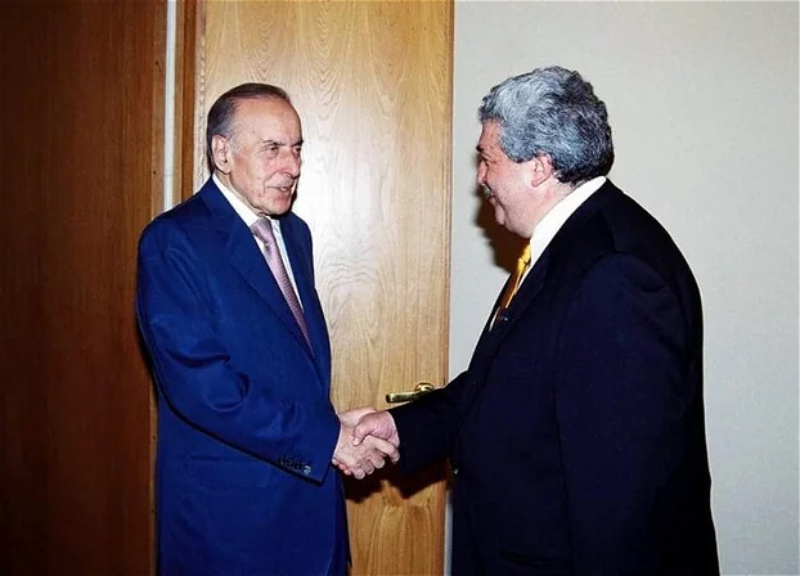
- Heydar Aliyev's personality was so multifaceted and large-scale that one could talk about it endlessly. I was fortunate to communicate with him personally and interview him in 2001. Even during his visit to Moscow, he visited the TASS agency, where I worked at the time, held a press conference and met with the heads of leading Russian mass media.
Later I had the opportunity to meet with him in Azerbaijan, at his residence in Zagulba. These three long meetings remained forever in my memory and, I am sure, became significant for everyone who had the chance to participate in them.
Heydar Aliyev with amazing depth and attention revealed the most important issues of the political and public life of Azerbaijan, analyzed international processes in detail, and shared his vision of current events. At the same time, his stories were always distinguished by an amazing combination of wisdom, subtle humor, benevolence and sincerity. He knew how to win over his interlocutor and create an atmosphere of confidential and meaningful conversation.
I especially want to note his attitude toward the mass media. Heydar Aliyev perfectly understood the importance of the press and always treated journalists with great respect. He considered it necessary to answer questions in detail and thoroughly, and strove to explain his position in detail on those topics that interested his interlocutors.
Heydar Aliyev will undoubtedly be remembered as a man who could bring the truth to people. There was no political opportunism or desire to please the audience in his words - he was sincere and frank in communicating with people, regardless of circumstances.
In this regard, I recall the famous interview of Heydar Aliyev, published in 1979 in "Literaturnaya Gazeta" under the headline "Qoy ədalət zəfər çalsın!" ("Let justice triumph!"). In it, with his characteristic directness and depth, he spoke about the problems that existed in society, about shortcomings that needed to be corrected, about phenomena that needed to be fought. He did not avoid sharp topics and was not afraid to raise issues that required an honest and principled conversation.
I well remember what a huge resonance this interview caused throughout the Soviet Union. Many saw in these words a rare example for that time of openness, adherence to principles and responsibility of a statesman before society.
In this, perhaps, one of the most important traits of Heydar Aliyev's personality was manifested. He always remained true to his convictions, stood for truth and justice, considered honesty a necessary condition for effective state governance and was never afraid to speak openly about problems.
- Thank you for the interview!