Ilham Aliyev in Munich: A Policy Without Ambiguities
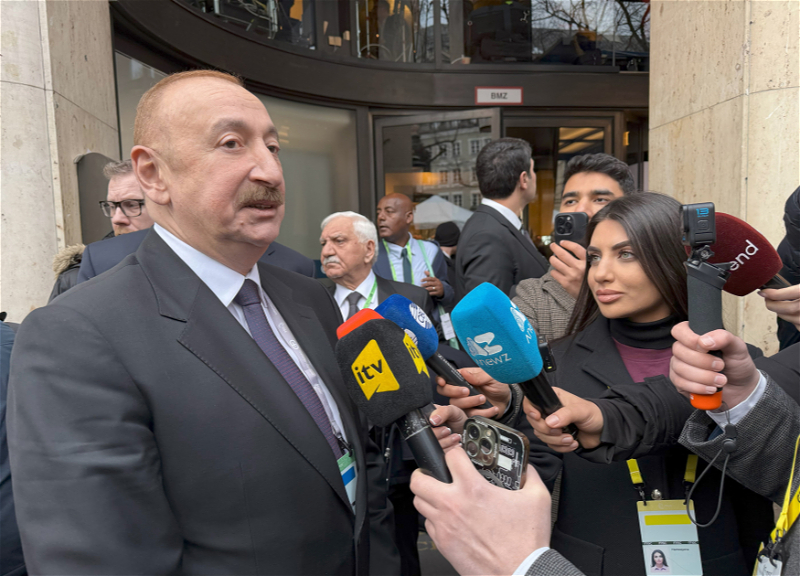
The visit of Azerbaijan's President Ilham Aliyev to Germany for the Munich Security Conference was marked by a comprehensive and unequivocally clear articulation of Baku's stance on the current international agenda.
Right at the outset of his visit, the head of state gave insightful interviews rich with meaningful highlights: one to Azerbaijani television channels and another to France 24. These interviews can essentially be viewed as the conceptual framework of the entire visit. They outlined Azerbaijan's approaches to the normalization process with Armenia, the conditions for concluding a peace treaty, and the tentative timeline for its signing. They also characterized the new parameters of strategic partnership with the United States, provided assessments of Vice President J.D. Vance's visit, prospects for defense cooperation with the U.S., and the TRIPP project. Additionally, Baku's position on the judicial process against the leaders of the former separatist regime was thoroughly explained, as was the logic and background of the complex but restartable relations with France. In this format, Azerbaijan's foreign policy line was presented in its most concentrated and unambiguous form, clearly setting the context for all subsequent meetings and interactions in Munich.
In his conversation with Azerbaijani media, Ilham Aliyev immediately highlighted a key point that lends special significance to his participation in the Munich Security Conference. "For the first time, I am participating in this event as the head of a state that has achieved peace," he stated. This fact largely defines the content of Azerbaijan's messages. These messages are traditionally open and clear: cooperation, peace, partnership, and the growing role of the country in matters of security, economy, energy, transport, connectivity, and artificial intelligence. Ilham Aliyev directly linked Azerbaijan's agenda to the foundations of global politics today, emphasizing that Baku is not lagging behind global processes and participates in them as an equal.
A central theme of his statements was the normalization of relations with Armenia. Responding to a question about the prospects of signing a peace treaty, the President of Azerbaijan outlined Baku's conditions with utmost clarity: "You know that this does not depend on us. Our position has been conveyed to the Armenian side for many years: necessary amendments must be made to the Constitution of Armenia. As soon as these amendments are made, we can sign the peace treaty the very next day." At the same time, in his assessment, peace has already been achieved de facto. The agreements reached at the Washington Summit, the signing of the Joint Declaration, and the initialing of the peace treaty signify the establishment of peace in practical terms, while the formal aspect of the issue now entirely depends on Yerevan.
This idea was further elaborated in the interview with France 24, where Ilham Aliyev dwelt in detail on the outcomes of the trilateral summit at the White House involving Armenian Prime Minister Nikol Pashinyan and U.S. President Donald Trump. He emphasized that the signing of a historic document in the presence of the American leader marked the end of the conflict and the beginning of a period of peace. "More than six months have passed since then, and the situation on the border with Armenia is very calm. There are no more shootings, no casualties, no injuries," noted the Azerbaijani leader. He reminded that Azerbaijan unilaterally lifted restrictions on the transit of goods to Armenia and began supplying critically important petroleum products, effectively marking the start of trade relations. According to him, the normalization process is already underway, and the legal formalities remain the final stage, which could be completed this year provided the Armenian constitution is amended. When directly asked if this was possible within the current year, Ilham Aliyev responded without hesitation: "Absolutely."
In the same interview, the issue of the so-called "red line" for Azerbaijan was thoroughly discussed. The President recalled that the Armenian constitution, adopted during the occupation of Azerbaijani territories, contains a reference to the Declaration of Independence of Armenia with a provision on the so-called "unification" of "Nagorno-Karabakh" and Armenia. "So, this is a territorial claim against Azerbaijan," he stressed, adding that Baku's position on this remains unchanged.
Special attention in the France 24 interview was given to relations with the United States and the visit of U.S. Vice President J.D. Vance to Baku. Ilham Aliyev described this visit as extremely important, noting that the very fact of a U.S. Vice President's visit holds great significance for any country. In this case, it was marked by the signing of the Charter on Strategic Partnership between the governments of the U.S. and Azerbaijan. "Thus, we have become an official strategic partner of the most powerful country in the world, and we consider this a great success for our country," the President stated. He highlighted that the Charter covers a wide range of areas: energy, connectivity, artificial intelligence, investments, trade, and defense cooperation, with all restrictions on arms supplies to Azerbaijan lifted.
In this context, the topic of the TRIPP project—"Trump Route for International Peace and Prosperity"—was also addressed. The project envisages road and rail connections through Armenian territory to link the main part of Azerbaijan with its exclave, Nakhchivan. Ilham Aliyev expressed confidence in the project's implementation, underscoring the decisive role of the U.S. in this process.
A resonant part of the interview was the responses to questions about the judicial process against the leaders of the Armenian separatist regime that operated in Karabakh. The head of state confirmed that this issue was raised during the meeting with the U.S. Vice President, and he presented Azerbaijan's position, after which the discussion concluded. The President emphasized that these individuals were the masterminds behind war crimes against Azerbaijanis and Azerbaijan for many years, acted illegally on the territory of a sovereign state, and were brought to justice. He particularly noted the transparency of the judicial process, the presence of lawyers, and the proven nature of the crimes. When asked about the possibility of pardon, Ilham Aliyev responded firmly, drawing a comparison with the Nuremberg Trials: "Imagine the Nuremberg Trials after World War II, and two months after all those Nazi leaders are sentenced to death, someone comes and asks for their release." When pressed on whether he considers these war crimes comparable, the President replied: "Yes, absolutely. Even worse, much worse."
The topic of the humanitarian consequences of the conflict was also addressed without softening the rhetoric. "We offered all Armenians living in Karabakh to apply for Azerbaijani citizenship or work permits. We had several rounds of interaction with representatives of the Karabakh Armenians, but they chose to leave for Armenia," the Azerbaijani leader stated. At the same time, he pointed to hundreds of thousands of Azerbaijanis deported from the territory of modern-day Armenia, emphasizing the principle of reciprocity in the right to return. "We have hundreds of thousands of Azerbaijanis who were deported from the territory of modern Armenia and subjected to ethnic cleansing, but the Armenian government has never made any proposals for their return. I think we should consider this issue from the perspective of reciprocity. The right to return is a universal right, and of course, Azerbaijan will definitely respect this right if we receive a corresponding request. But at the same time, considering that we fought with Armenia for 30 years and they occupied our territory for 30 years, we expect a similar attitude toward the hundreds of thousands of Azerbaijanis we call Western Azerbaijanis, and the provision of an opportunity for them to return to the territory of present-day Armenia," the President noted.
A significant portion of the interview was devoted to relations with France. Ilham Aliyev detailed the background of the deterioration of bilateral ties, recalling that before the Second Karabakh War, relations were good, with official visits and active economic interaction. "But with the start of the Second Karabakh War and the restoration of our territorial integrity, unfortunately, France's position became completely incomprehensible. France defends the territorial integrity of countries: it tries to protect its own territorial integrity, now defends the territorial integrity of Denmark, Ukraine. But back then, unfortunately, France supported the separatists: more than ten resolutions of the National Assembly and the Senate were aimed at supporting the separatists. And even the parliament recognized the so-called Nagorno-Karabakh, although even Armenia did not recognize it. Moreover, we had tense relations with the government. But again, we were not the source of this tension. We only wanted our sovereignty to be respected," said Ilham Aliyev. Meanwhile, as the head of state emphasized, all harsh statements from Baku were retaliatory in nature. Nevertheless, he noted the positive nature of the meeting with Emmanuel Macron and the agreement to reset relations, stressing Azerbaijan's readiness for normalization on the condition of mutual respect for sovereignty and non-interference: "We are ready for this. The last thing we need is problems with any country, including France. Again, this was not our initiative. But now I think both sides are more ready for normalization of relations, especially after Armenia and Azerbaijan have already achieved peace."
Against this backdrop, the meetings held by the President of Azerbaijan in Munich appear as a logical continuation of Baku's policy to expand its international influence. The contact with the head of the Iraqi Kurdistan region, Nechirvan Barzani, who accepted Ilham Aliyev's invitation to visit Baku, confirmed Azerbaijan's growing authority in the Middle Eastern context.
The meeting with Slovakia's Deputy Prime Minister and Defense Minister Robert Kaliňák recorded the steady development of military-technical cooperation with European partners. Meanwhile, discussions with Oracle Corporation's Executive Vice President Mike Sicilia underscored that digital transformation, artificial intelligence, and collaboration with global technology players hold a firm place in Baku's foreign economic strategy.
Collectively, the statements and meetings that took place during the first day of the Munich visit portrayed Azerbaijan as a state that speaks openly and honestly with the world, relying on achieved results. The peace process, strategic partnership with the world's leading state, infrastructure projects, technological agenda, and readiness for pragmatic dialogue with those who are prepared for mutual respect formed a coherent image of a foreign policy course that cannot be ignored. What the President said requires no further clarification and leaves no room for double interpretations, which in itself is a rare phenomenon in international politics.
It is precisely in this—directness, reliance on achieved facts, and readiness to speak without regard for conjecture—that Baku's main foreign policy advantage lies today.