The Case of the Catholicos: Law, Power, and the Limits of Sacred Authority in Modern Armenia
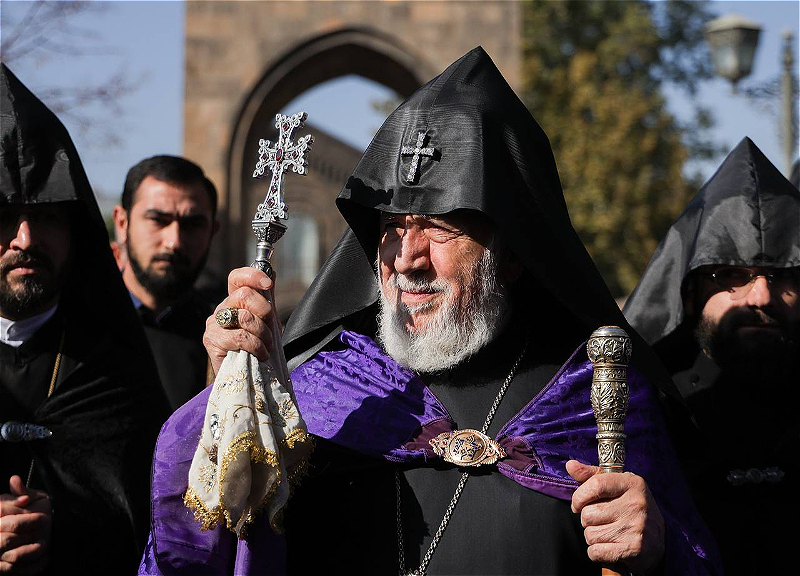
On February 14, 2026, a criminal case was initiated against the Catholicos of All Armenians, Garegin II. According to his lawyer, Ara Zohrabyan, Garegin II has been barred from leaving the country.
The initiation of a criminal case against Garegin II is not only a legal event but also a deeply symbolic one. This is not merely about the procedural status of an individual—under investigation is the head of the Armenian Church, an institution that has served as a pillar of Armenian identity for centuries, though in recent years it has been repeatedly renamed.
This story intertwines law and politics, the secular nature of the state and the special status of the church, legal procedures, and public perceptions of sacred authority.
Legal Framework: The Formula of the Accusation and Its Significance
According to available information, the criminal case has been opened under an article related to obstructing the enforcement of a judicial act. Formally, it concerns the alleged failure to comply with or obstruction of a court decision related to the case of former clergyman Arman (Gevorg) Saroyan, who challenged the actions of church authorities. There are also mentions of potential investigations into other episodes related to financial or administrative matters within the Church.
From a legal perspective, this is significant for several reasons: 1) it does not pertain to theological issues; 2) the case involves the enforcement of a secular court decision; and 3) the legal qualification falls within the realm of the binding nature of judicial acts.
Thus, the state demonstrates that no institution—even one with historical and spiritual authority—is beyond the reach of the judicial system.
At the same time, Garegin II has been prohibited from leaving the country—a measure traditionally applied to suspects or accused individuals to ensure their participation in investigative actions. Formally, his status has not been publicly detailed, but the very fact of procedural restrictions indicates an active stage of the investigation.
Constitutional and Institutional Context
Modern Armenia is a secular state. However, the Armenian Church holds a special role in the Armenian constitutional and public sphere as the national church, historically tied to the formation of Armenian statehood and identity.
This creates a unique duality: on one hand, there is a secular legal regime, and on the other, recognition of the church’s special historical mission in the absence of statehood.
In ordinary circumstances, this balance does not provoke a crisis. But when criminal prosecution targets the Catholicos himself, the balance becomes a point of tension.
Political Background: Transformation of Power After 2018
Following the political changes of 2018 and the rise to power of a government led by Nikol Pashinyan, the configuration of relations between the state and traditional institutions shifted. The new government declared a strengthening of the rule of law, a fight against corruption, and institutional renewal.
Simultaneously, discussions about the role of the church in public life intensified. After Armenia’s defeat in the 44-day war of 2020, the church’s active public stance became more visible and less veiled. Media outlets published photographs of priests holding firearms on occupied Azerbaijani territories. Certain statements by church hierarchs openly criticized the government. This further widened the distance between the government and the spiritual center in Etchmiadzin.
In 2022–2023, institutional distancing grew even stronger: debates emerged about the status of church property and tax issues. The information space saw disputes over the church’s powers and its socio-political role. The authorities emphasized the principle of a secular state and non-interference of the church in state affairs, while the church underscored its unique historical role in shaping national identity.
In 2024, localized conflicts arose: individual lawsuits emerged related to decisions by the church administration; in one episode, a former clergyman challenged the actions of church leadership in court, and the subsequent development of this case became the legal basis for law enforcement intervention.
In 2025, the confrontation intensified. An investigation began into the alleged failure to comply with a court decision. In public statements, the parties effectively moved to open polemics. Defenders of the Catholicos describe the events as pressure on the church, while government representatives stress that this is a legal process, not a conflict with the church. The Catholicos’s residence in Etchmiadzin remains a focal point of public attention.
Thus, by the time the criminal case was initiated, the conflict already had a built-up political and psychological backdrop.
The information environment consists of the following: The initiation of the case and the travel ban have been confirmed by several sources, including international agencies and Armenian media. However, the official stance of investigative bodies remains restrained, limited to confirming the fact of the investigation.
Such an information landscape creates a situation where the state speaks the language of procedure, the defense speaks the language of pressure, and society interprets the events through the prism of political context.
Law Versus Symbol: What Is Really at Stake?
From a legal standpoint, the case may be “technical”—limited to the specific episode of non-compliance with a court decision. However, from an institutional perspective, the stakes are significantly higher:
First, a precedent of equality before the law may be established. If the case reaches court, it will be an extremely rare example of holding the head of a national church accountable. Second, the limits of church autonomy will be defined: the question of whether secular jurisdiction extends to administrative decisions within the church structure will be answered. Third, the issue of trust is on the agenda: society will evaluate not only the legal aspects but also the motives—whether they are legal or political.
Possible Scenarios and the Answer to the Main Question
The development of events could follow three scenarios. The first is purely legal. The case remains within the narrow framework of the article on non-compliance with a court decision. The process concludes without systemic consequences for church-state relations.
The second scenario involves the emergence of an institutional crisis. Discussions arise about revising the status of the church, its property situation, and administrative autonomy.
The third scenario unfolds along the path of politicization of the conflict. The situation becomes an element of internal political struggle, mobilizing supporters and critics of the government.
At the center of the events is not only Garegin II as a figure but also a fundamental question facing Armenian society: Where does the boundary lie between sacred authority and secular law?
If the state demonstrates equality of all before the law, it naturally strengthens the principle of the rule of law. However, if the process is perceived as politically motivated, it could deepen societal divisions.
In Conclusion…
The situation surrounding Garegin II is a test of the maturity of Armenia’s state institutions.
For the state, it is about the ability to ensure legal procedure without political excess. For the church, it is about the ability to operate within the framework of secular legal order while preserving spiritual authority and not interfering in state affairs. For society, it is about the ability to distinguish between law, politics, and religion.
Regardless of how this case concludes, it has already become one of the most significant episodes in the modern history of relations between the state and the Armenian Church.
Namik Aliyev
Doctor of Legal Sciences, Professor, Ambassador Extraordinary and Plenipotentiary, Head of Department at the Academy of Public Administration under the President of the Republic of Azerbaijan