Altar of Revanchism: Armenia Continues Attempts to Revive the Myth of the 'Karabakh Movement'
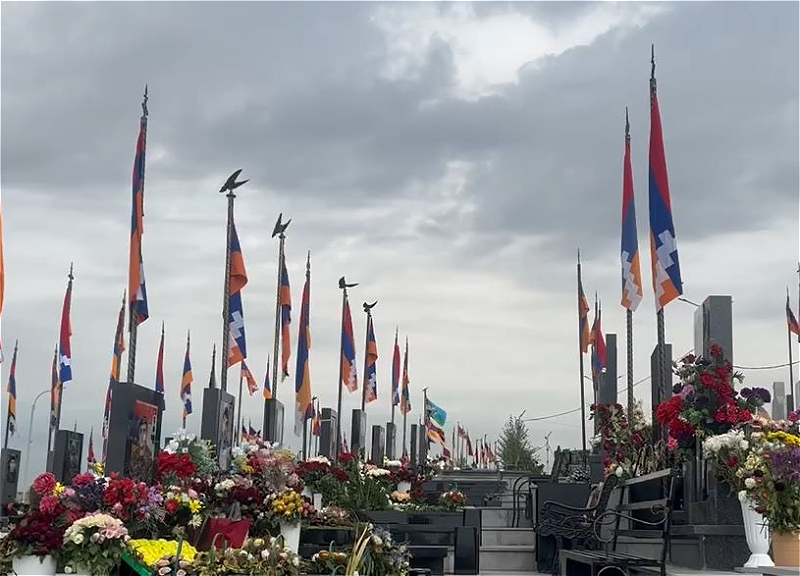
On Friday morning, the political remnants of the former separatist regime and representatives of the Armenian establishment once again gathered at the Yerablur military pantheon to mark the 38th anniversary of the so-called 'Karabakh movement.'
Formally, it is a 'day of remembrance.' In essence, it is yet another attempt to breathe life into an ideology that has already led the region to wars, occupation, ethnic cleansing, and Armenia's strategic collapse.
It is no secret that the 'Karabakh movement,' which began in the late 1980s, was never about a 'struggle for rights' or an act of 'self-determination.' It was a nationalist project launched during the collapse of the USSR amidst geopolitical chaos and an institutional vacuum. This project was built on the revision of borders, the logic of force, and the deliberate disregard for international law. Its real outcomes are long known and beyond interpretation: hundreds of thousands of displaced Azerbaijanis, destroyed cities and villages, the militarization of Armenian society, and decades of artificially sustained conflict.
For many years, this myth was fueled by state institutions, the education system, and Armenia's political elites. Any attempt at a sober analysis of the Karabakh venture was branded as 'treason,' and any doubt was deemed a 'blow to the nation.' Karabakh was elevated to the status of a sacred dogma, beyond discussion. It is within this framework that Yerablur ceased to be a cemetery and became an ideological altar—a place where the cult of death replaced conversations about life, and the past deliberately overshadowed the future.
Today's visits to Yerablur are not about mourning or memory. They are a political demonstration that a significant portion of the Armenian establishment still refuses to accept reality. Society is repeatedly fed the mythology of a 'lost victory' instead of an honest discussion about the causes of the catastrophic defeats of 2020 and 2023. Instead of acknowledging strategic mistakes, there is romanticization of failure. Instead of accountability, there are wreaths and rituals. Instead of a future, there is cemetery symbolism.
It is particularly cynical that the very forces who have monopolized the Karabakh issue for decades and used it as a tool to retain power are the ones gathering at these gravestones. It is they who led the country to military defeat, international isolation, and economic deadlock. It is they who discredited the very concept of statehood, turning the 'Karabakh idea' into a cover for corruption, authoritarianism, and political irresponsibility. And it is they who are now once again trying to convince society that the catastrophe was 'inevitable' or 'temporary.'
But reality is far more prosaic and harsh: the Karabakh project has ended definitively and irrevocably. Not due to someone's 'malice' or 'conspiracy,' but because of its own logic of adventurism, detachment from real resources, and disregard for international law. Refusing to acknowledge this is not a political stance but a form of escaping responsibility.
When politicians head not to universities, research centers, technology parks, or industrial zones, but to cemeteries, it always signals a crisis of ideas. When the primary political language becomes gravestones, wreaths, and memorized slogans of the past, it means the country lacks a vision for the future. This is not 'respect for history.' It is capitulation to it.
The attempt to sacralize the 'Karabakh movement' in 2026 is a signal not of strength, but of weakness. When politics has nothing to offer society, it turns to graves. When there is no development strategy, no economic vision, and no foreign policy agency, all that remains is the symbolism of defeat disguised as 'memory.'
Armenian society will sooner or later have to make a choice. Either continue living in the shadow of Yerablur, captive to myths that have already led to catastrophe, or acknowledge the outcomes of history and start building relations with neighbors and reality without revanchist fantasies and cemetery ideology. For now, each such procession to the pantheon looks not like an act of remembrance, but like a desperate attempt to delay the inevitable—the final and irrevocable farewell to revanchism.