Thought Infarction: Why Robert Kocharyan is Attacking the Peace Process in the South Caucasus
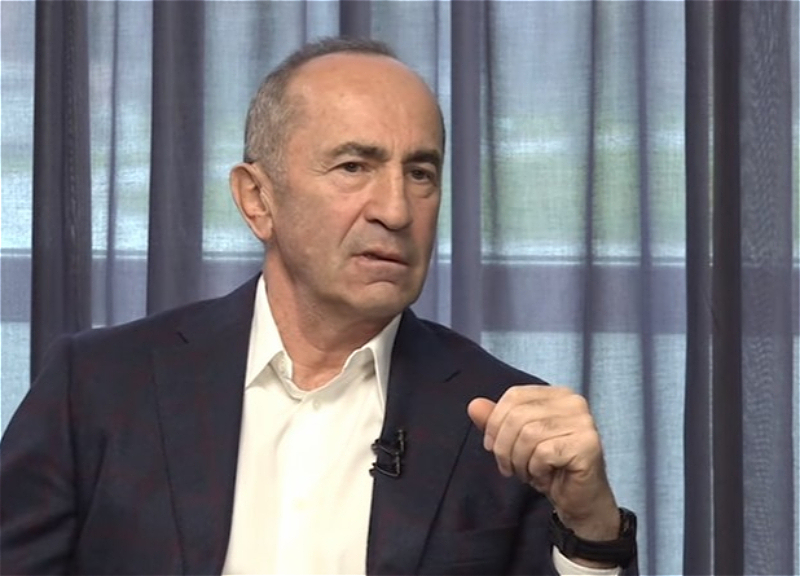
The recent activism of former Armenian President Robert Kocharyan appears symptomatic.
His speeches and podcasts, filled with criticism of the peace process between Armenia and Azerbaijan, resemble less an analytical discussion and more a desperate attempt to revive the long-played-out card of revanchism in the political agenda.
In his statements, Kocharyan claims that the peace process "lacks a legal basis," accuses the current Armenian leadership of "surrendering Karabakh," and asserts that it was Nikol Pashinyan’s policies that led to war and defeat.
However, a closer examination of these claims reveals not analysis, but political rhetoric built on the substitution of causes and effects.
Listening to such arguments, it’s hard to shake off the feeling of a peculiar "thought infarction": logical connections break down, arguments contradict each other, and reality is replaced by political fantasies.
The Illusion of "Legal Emptiness"
In one of his speeches, Kocharyan claims that the initialed peace declaration between Armenia and Azerbaijan supposedly "lacks a legal basis" and contains no international guarantees.
But such argumentation collapses at the first reference to diplomatic practice.
The very fact of initialing the document, which took place on August 8, 2025, in Washington between the leaders of Azerbaijan and Armenia in the presence of the U.S. President, means that the parties have agreed on its text and confirmed their readiness to move toward final signing and ratification. This is a standard procedure for preparing an international treaty.
Moreover, this is not a mere "declaration," as Kocharyan tries to portray it, but an agreed text of a peace and interstate relations agreement, which is set to become a full-fledged international treaty after signing and ratification.
Thus, the thesis of the "legal emptiness" of the peace document is nothing more than political manipulation.
The Myth of "Surrendering Karabakh"
One of Kocharyan’s central claims is the accusation against Pashinyan that his policies allegedly led to the loss of Karabakh.
However, this assertion deliberately ignores a key fact: the strategic preconditions for defeat were laid long before 2018—during the rule of Kocharyan himself and his political ally Serzh Sargsyan.
For nearly twenty years, the Armenian political elite adhered to a strategy of freezing the conflict, effectively rejecting compromise solutions for settlement.
At the same time, Armenian leadership operated under the illusion that the status quo could be maintained indefinitely.
But over those years, fundamental changes occurred. First, Azerbaijan significantly strengthened its economic and military capabilities, preparing for two decades to liberate its territories. Second, the Armenian army, resting on its laurels, remained technologically and structurally unprepared for modern warfare, relying on the very "guarantees" Kocharyan now recalls. Finally, diplomatic opportunities for settlement gradually narrowed until it became clear that, short of invoking Article 51 of the UN Charter, an aggressor and occupier could not be brought to reason.
It was this strategic error—betting on the indefinite preservation of the status quo—that became the main factor in the catastrophe.
The Paradox of the "Peace Agenda"
Kocharyan also claims that Pashinyan "brought war" and then tried to present himself as the author of a peace agenda that emerged after the deaths of thousands of people.
But here again, there is an obvious substitution of causes and effects.
The peace agenda emerged not because someone wanted to "monopolize" it, but because the balance of power in the region changed after the war.
The reality is that it was the military defeat that finally shattered the illusion of indefinitely maintaining the previous status quo—an illusion on which Kocharyan’s policies were built.
In other words, the war was the result of a twenty-year political deadlock, not decisions made in recent years.
The Paradox of Guarantees
Another of Kocharyan’s arguments is the assertion that peace is impossible without external guarantors and international sponsors.
But this raises a logical question: where were these guarantees during his own tenure?
During the years when Kocharyan was in power, Armenian forces held Azerbaijani territories under occupation, and the negotiation process remained deadlocked for decades. No sustainable mechanisms for peace were created at that time.
Moreover, the logic of "external guarantees" has repeatedly shown its limitations in practice. No international mediator over three decades was able to create a functioning settlement mechanism.
Today, Kocharyan himself acknowledges that the previous security architecture has effectively collapsed. He states that after Armenia’s withdrawal from earlier formats, "the entire peace structure has disintegrated."
Thus, the ex-president’s logic becomes paradoxical: on the one hand, when he was in power, no real guarantees of peace were established. On the other hand, when the parties finally approached a peace treaty, he declares the process as "lacking a legal basis."
Therefore, the current peace process is built on a far more realistic principle—mutual recognition of territorial integrity and the normalization of interstate relations.
Politics of Fear Instead of Politics of Peace
Another argument from Kocharyan is the claim that the current peace process is supposedly centered around the personality of Armenian Prime Minister Nikol Pashinyan and carries a "propagandistic character." Kocharyan asserts that the current peace process is propagandistic and serves domestic political goals.
However, such statements primarily reflect the crisis of Kocharyan’s own political model.
In reality, peace negotiations are conducted based on the fundamental principles of international law and international relations, including the recognition of territorial integrity and the opening of regional communications.
For decades, his model was built on three key principles: 1) maintaining the conflict in a "frozen" state; 2) mobilizing society through the rhetoric of the threat of "eternal war"; 3) preserving political power through the logic of military confrontation.
Today, as the region approaches the possibility of a full-fledged peace treaty for the first time in decades, this political model has been completely discredited.
The South Caucasus is entering a period where peace, economic ties, and transport communications are becoming the main drivers of regional development.
Why Kocharyan Has Become Active
Kocharyan’s activation is no coincidence.
In the geopolitical context of the South Caucasus, it looks like an attempt to once again play the old "Kocharyan card"—the card of revanchism, instability, and managed conflicts.
Such rhetoric benefits those forces that have used the unresolved conflict as a tool of influence over the region for decades. A peace treaty between Baku and Yerevan automatically deprives them of this tool.
Therefore, it is unsurprising that figures from the past—politicians from the era of conflict—are reappearing in the public space.
A Political Past That Refuses to Leave
Today, Robert Kocharyan acts as a kind of voice of a bygone era—an era when conflict was a political tool.
But the region is changing.
The South Caucasus is gradually moving away from the logic of endless confrontation.
This is precisely why the arguments of the former president sound increasingly unconvincing. They resemble not political analysis, but nostalgia for an era of conflict in which his political model made sense.
The peace process between Azerbaijan and Armenia is not the whim of individual politicians, but a historical necessity dictated by the new geopolitical reality.
Instead of an Epilogue
History knows many examples of politicians from the past trying to halt progress toward peace by appealing to fears, grievances, and revanchist sentiments.
But peace processes rarely reverse course.
And the louder the criticism from those whose political careers were built on the ideology of nationalism and conflict, the clearer one thing becomes:
The South Caucasus is entering a new era—an era in which the politics of war finally gives way to the politics of peace.
Author: Namik Aliyev,
Doctor of Legal Sciences, Professor,
Extraordinary and Plenipotentiary Ambassador,
Head of Department at the Academy of Public Administration under the President of the Republic of Azerbaijan