Memory That Does Not Fade: 34 Years Since the Khojaly Genocide
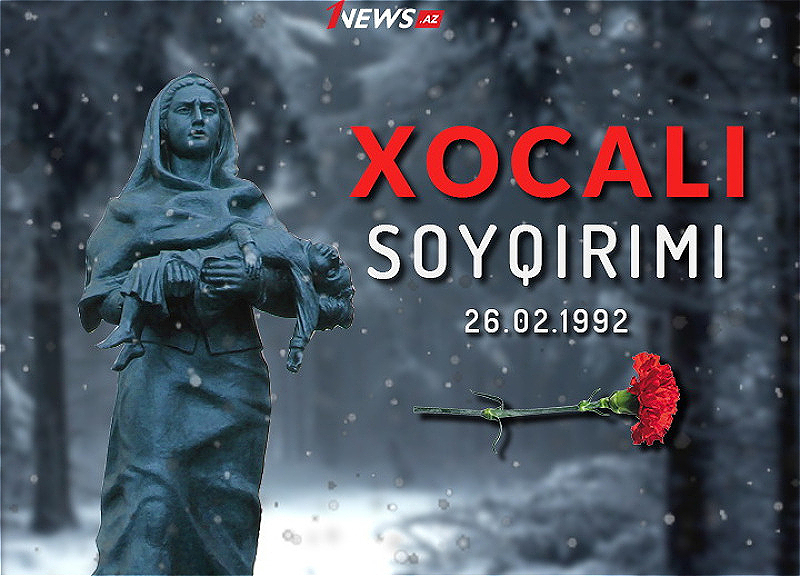
Today marks 34 years since one of the most tragic dates in modern Azerbaijani history - the day when a mass massacre of civilians took place in Khojaly.
The events of February 1992 were not just an episode of the First Karabakh War, but a symbol of inhumanity and extreme cruelty directed against civilians. This was a crime that, by its nature and consequences, went far beyond ordinary military actions and has forever remained in the national memory as an act of deliberate destruction of peaceful Azerbaijanis.
What happened in Khojaly was not a spontaneous tragedy or a random casualty of military chaos. It was part of a broader pattern of aggression against Azerbaijan, accompanied by ethnic hatred and systemic discrimination. People were deprived of their lives because of their nationality. The fact that the victims included women, children, and the elderly indicates that the goal was not military superiority, but intimidation and displacement of the population.
By the beginning of 1992, Khojaly was completely isolated. Since the fall of 1991, the town had been surrounded, communication routes were cut off, and the only connection to the outside world was through rare helicopter flights. After a civilian helicopter was shot down in January 1992, killing dozens of Azerbaijanis, air communication effectively ceased. The town was under blockade, deprived of normal supplies and the possibility of evacuating civilians.
In the second half of February, the encirclement of Khojaly tightened completely. The settlement was subjected to daily artillery shelling, attacks with heavy equipment, and armed units. Despite extremely limited resources, the residents tried to defend themselves. The defense was held by local police officers, a small unit of the National Army, and self-defense groups, mostly armed with hunting rifles. Their resistance was an act of desperate self-sacrifice, but the forces were incomparable.
On the evening of February 25, the active phase of the operation to capture the town began. Military equipment of the 366th Motorized Rifle Regiment of the Soviet Army, stationed in the region, was deployed to firing positions.
After prolonged shelling from tanks and anti-aircraft guns, the assault began. The attack was carried out from several directions, depriving the population of the opportunity to leave the town in an organized manner. People, trying to escape, headed towards Askeran, hoping to break through a supposed corridor. However, the path was blocked, and on the plain near Nakhchivanly, the refugees came under fire. Many were killed there, having already left the burning town.
Some residents attempted to escape through snow-covered mountain passes and forest areas. Among them were many women and children. Not everyone could withstand the frost and the exhausting journey - people died from frostbite and exhaustion. Only a few managed to reach Agdam and tell of what had happened.
On the night of February 26, 1992, the town finally came under the control of Armenian armed formations with the support of units of the Soviet 366th Regiment. What followed was a mass massacre. A total of 613 people were killed, including 63 children, 106 women, and 70 elderly individuals. 1,275 people were taken captive, subjected to abuse and torture. 487 sustained injuries of varying severity.
The fate of 150 people remains unknown to this day, including dozens of women and children. Eight families were completely wiped out. Hundreds of children were left orphaned. Over five thousand residents were forced to leave their hometown.
Responsibility for these events lies with the political and military leadership of Armenia at the time. The crime was not committed in secret, but under conditions where information gradually became available to the international community. One indirect confirmation of the deliberate nature of the actions was a statement by Serzh Sargsyan, who in the early 1990s was one of the commanders of Armenian armed formations. In an interview with British journalist Thomas de Waal, he stated that before Khojaly, Azerbaijanis believed Armenians would not raise a hand against civilians, and that this stereotype was 'broken.' These words became a de facto admission that intimidating civilians was seen as a tool of war.
A few days after the tragedy, journalists managed to reach the site of the mass killing. What they saw shocked even experienced reporters. The bodies of the dead lay in open terrain, many disfigured. Attempts to evacuate the remains were met with shelling. Nevertheless, information about what had happened began to spread beyond the region.
From the perspective of international law, the events in Khojaly fall under the definition of grave violations of humanitarian norms. This pertains to genocide, war crimes, and crimes against humanity. Such actions contradict the provisions of the Convention on the Prevention and Punishment of the Crime of Genocide, the Convention Against Torture, the Convention on the Elimination of All Forms of Racial Discrimination, and other international documents. The European Court of Human Rights, in its decision of April 22, 2010, classified what happened as acts comparable to war crimes or crimes against humanity.
Those who planned and carried out the attack on Khojaly counted on demoralizing Azerbaijani society, hoping that fear would break the will to resist and force acceptance of the occupation of territories. However, this did not happen. The memory of the victims became not a factor of oppression, but a source of internal mobilization. Over the past decades, a generation has grown up in the country, raised with an awareness of the tragic pages of history and ready to defend state sovereignty.
Every year on February 26, mourning events are held in Azerbaijan. People come to the 'Cry of the Mother' memorial to honor the memory of the fallen. In recent years, these ceremonies have taken place in a different historical context - after the liberation of our lands from occupation. This does not erase the pain of loss, but it adds a new dimension to the memory - as the memory of a people who managed to overcome the consequences of tragedy and restore the territorial integrity of the country.
On the Day of Remembrance of the Khojaly Victims, Azerbaijan bows its head to the fallen - to the children, women, and elderly, to all those who became victims of those February events. Their fate remains part of the national history and collective responsibility to ensure that such tragedies never happen again.