Nigar Akhundova: 'Television Should Not Follow the Viewer—It Should Shape Their Taste'
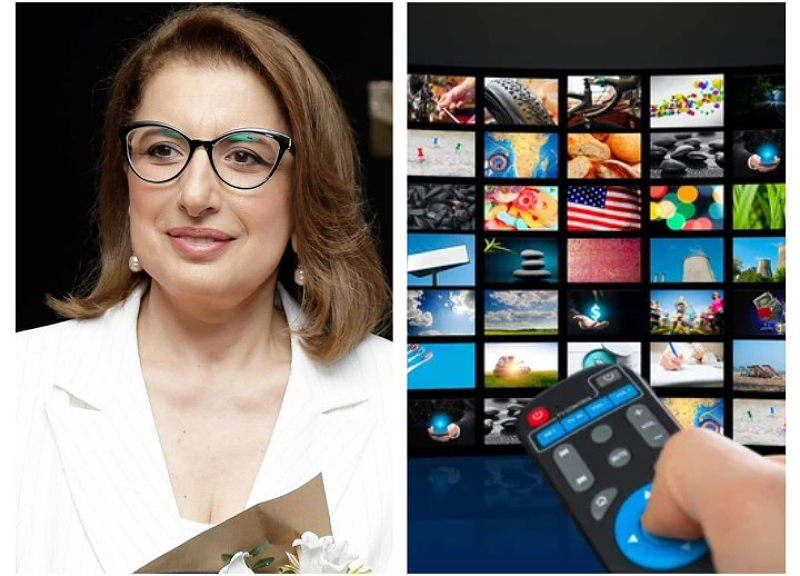
Interview by 1news.az with Doctor of Philosophy in Art Studies, Nigar Akhundova.
Azerbaijani television has recently undergone noticeable changes: several programs, previously criticized by viewers, have been taken off the air. These steps have elicited a largely positive reaction from the public and have sparked broader discussions about the quality of content and the role of television today. Against this backdrop, 1news.az decided to speak with Doctor of Philosophy in Art Studies, Nigar Akhundova, about the cultural mission of television, its impact on audiences, and what it should be like in modern realities.
- Nigar Khanum, your comment on the closure of controversial programs—“Finally! The voice of the people has been heard! Many thanks to those who were not afraid to take this step and assume responsibility!”—has generated some interest. How do you assess this situation from the perspective of television’s cultural mission? And to what extent, in your opinion, is television today capable of shaping aesthetic taste and cultural awareness in society?
- The cultural mission of television today is not just significant—it is critically important. That is why it is particularly alarming to observe what it is turning into. Against the backdrop of a sharp decline in interest in reading, television has effectively taken the place of books. But taking that place does not mean it has adequately replaced them. Instead of fostering critical thinking, taste, and cultural depth, viewers are increasingly offered simplified, aggressively intrusive, and often outright primitive content.
Yes, if you ask young people which screen they prefer—television, computer, or phone—television will likely be at the bottom of the list. But this is only an illusion of its weak influence. The reality is much harsher. Television continues to play in homes—it is watched by the older generation. And along with them, children and teenagers inevitably absorb this stream of low-quality content. They may not consciously choose it, but they hear it, see it, and internalize it. Day after day, hour after hour. This is how taste is formed—or rather, how it is distorted. This is how superficiality, aggression, vulgarity, and intellectual laziness become normalized.
Television today does not influence directly but subtly—and this makes its impact even more dangerous. It operates as background noise that gradually becomes the norm. If this process is not recognized and controlled, we risk raising a generation for whom cultural standards are inherently lowered. And this is no longer just a matter of taste—it is a question of the future of society.
- Can the closure of controversial programs be seen as an example of “the voice of the people being heard,” or is it more a result of internal editorial policy?
- I believe that the closure of these programs is not an initiative of the editorial teams. And it is certainly not their desire. It is the result of public pressure. Dissatisfaction reached a critical point—it could no longer be ignored. This was discussed on social media, voiced by representatives of the intelligentsia, and written about by ordinary viewers. Just look at the comments—pure negativity. And yet, for years, we were told about “high ratings” and the “necessity of such content.”
We must not forget that at the core of these programs were blatantly commercial interests, for which good taste, professionalism, basic ethical standards, and much more were sacrificed.
- In your opinion, what principles should guide television in selecting content to balance aesthetic value with cultural and educational significance for the audience?
- I am convinced that after such significant changes, our television needs not just renewal but thoughtful and systematic development. First and foremost, it is important to strengthen the educational direction. But this is not about dry formats—it should be lively, engaging programs like quizzes, competitions, interactive projects, and social surveys. Education presented in an interesting way is especially necessary today for both youth and adult audiences. Such programs set the overall tone and standard.
Equally important are informative projects: travel shows, science programs, and popular science broadcasts. They broaden horizons and foster a sustained interest in knowledge.
Culture, of course, must occupy a special place. And I’m not talking about its presence on a single specialized channel, but about making the cultural component a natural part of the general television landscape.
Entertainment programs are undoubtedly necessary. But their quality must be oriented toward high professional standards and good taste. And perhaps it’s worth considering the introduction of certain professional standards. For example, limiting the use of pre-recorded tracks on television—a practice that already exists in several countries and could help raise the level of musical content.
- In your view, are there universal criteria for “good taste” on television, or is it always subjective and dependent on the audience?
- Universal criteria for artistic taste, of course, do not exist. But there is a certain range within which different preferences are possible—on one important condition: it must be genuine professional art. Some may prefer Rashid Behbudov, others Muslim Magomayev; some may favor Shovket Alakbarova, others Sara Gadimova. Some like mugham, others classical music, and some jazz. Tastes may differ, but the level must remain high.
Television, in this regard, should not follow the viewer—it should shape their taste. This is one of its key tasks. Through constant exposure to quality art, a sense of “visual and auditory familiarity” develops, and even without specialized education, a person begins to distinguish what is truly valuable.
- What role do viewers, social media, and public opinion play in shaping the cultural agenda of television?
- I would say that today, the viewer has almost no influence on shaping the television agenda. Channel executives often cite “audience demand” to justify lightweight content. But in reality, it’s more often about commerce: viewer attention is captured by appealing to the simplest and sometimes lowest instincts—for the sake of basic profit.
If we truly want to understand what viewers want, serious sociological research is needed—across different age groups, social strata, and interests. Without this, talk of “audience taste” remains speculative. But even that is not the main point. Television should not merely adapt to demand—it should elevate the level and shape taste.
- If you could offer recommendations to television editors to ensure their programs foster aesthetic sensibility and culture, what would they be?
- I believe that television strategy should not be shaped by individual editors but by artistic councils. Today, channels need not just to make isolated changes but to rethink their strategy as a whole. Such councils should include high-level professionals. When professionals like Ramiz Mirishli and Nadir Akhundov worked on air, the quality of content served as a natural filter—random material simply did not make it to broadcast.
One personal wish—I would very much like each channel to employ a professional stylist. Remember the scene from the American film “Up Close & Personal,” where the character played by Michelle Pfeiffer, a provincial journalist, is sent to the channel’s stylist before going on air, who completely transforms her image? Such a stylist is absolutely necessary for our channels as well!
Overall, the guiding principles should remain professionalism, talent, and good taste. And it is precisely this approach that can gradually improve the television landscape.
Finally, I recently came across a photograph of our outstanding announcers from the 1960s, 1970s, and 1980s. Some are no longer with us, but many, fortunately, are still alive and remain bearers of the high professional culture that is so lacking today. Now, more than ever, it is important to turn to their experience, their mastery, their impeccable speech culture, and stage presence. I believe it would be both appropriate and timely if they shared their knowledge with the younger generation—teaching, guiding, and passing on the standards that were once the norm. Because culture does not emerge anew—it continues.