Legal constant: why disputes over 'primacy' in recognizing Karabakh are meaningless
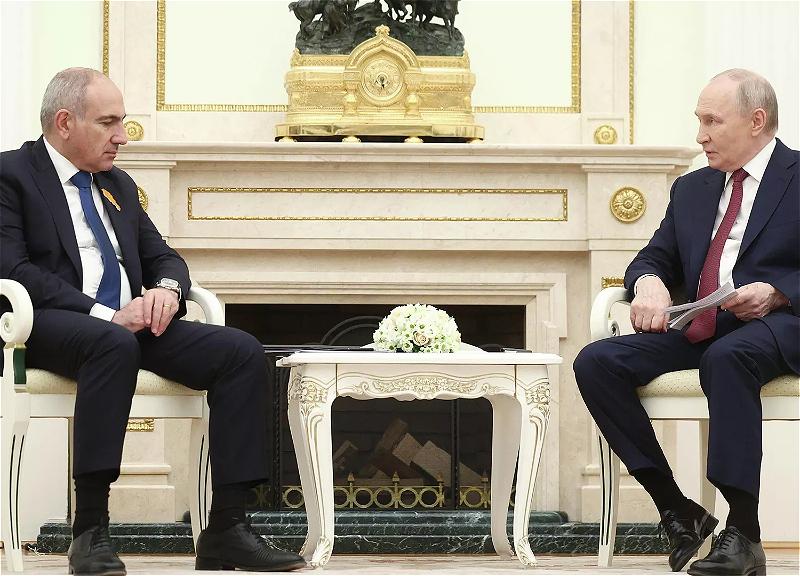
The issue of recognizing Azerbaijan's territorial integrity and the affiliation of the Karabakh region has become a subject of heated discussions in the media spaces of Armenia and Russia following the recent meeting between Armenian Prime Minister Nikol Pashinyan and Russian President Vladimir Putin.
During the talks held in Moscow on April 1, 2026, the Russian leader noted that Armenia's recognition of Karabakh as part of Azerbaijan in Prague in 2022 shifted the process into an 'intra-Azerbaijani dimension,' excluding the legitimacy of external interference. In response, Pashinyan argued that Yerevan took this step only after corresponding public statements by Russia's top leadership.
This exchange of remarks triggered a wave of mutual accusations in the information field, centered around the rhetorical question of who exactly and at what moment 'first' acknowledged this political reality. However, from the perspective of international law, such disputes are devoid of legal significance, as Azerbaijan's status as a unified state was established by the international community long before the current political upheavals.
A fundamental fact is the republic's admission to the UN in 1992 within the borders of the former Azerbaijani SSR. According to the principle of uti possidetis juris, the administrative boundaries of former Soviet republics automatically transformed into protected state borders at the moment of gaining sovereignty. Thus, Azerbaijan's acceptance into the UN became an act of final collective recognition of its territorial integrity, including the Karabakh region, which does not require additional confirmations from individual leaders to suit the current political climate.
This legal foundation was definitively закреплен in 1993 by four UN Security Council resolutions. These documents not only called for a ceasefire but also unequivocally affirmed Azerbaijan's sovereignty, demanding the immediate withdrawal of occupying forces. The unshakeable legal framework established at that time remained unchanged for decades, regardless of the course of negotiations or the personal positions of politicians. In this regard, attempts to portray the recognition of Karabakh as some 'recent concession' are a manipulation of facts. Any contemporary statements in Prague, Sochi, or Moscow are merely a reiteration of an already existing reality, not the creation of a new one.
From this, it can be concluded that the politicization of the issue in Russian and Armenian segments is aimed at domestic audiences with the purpose of shifting responsibility for the conflict's outcomes. At the same time, the fact that the legitimacy of Azerbaijan's borders is based on the UN Charter and the Alma-Ata Declaration of 1991 is completely ignored. International law does not operate on the principle of personal permissions; sovereignty over the entire territory of the country was effectively resolved more than thirty years ago. The current situation is merely a practical restoration of the legal order that was violated by decades of occupation. Ignoring this aspect leads to a false perception of reality, in which a state's integrity supposedly depends on the moods of specific players.
Understanding these legal constants is critically important for the logic of regional settlement. The peace process must be based not on the search for 'new' recognitions, but on respect for the obligations accepted by all republics during the dissolution of the USSR. Azerbaijan's position on this issue has always remained consistent: territorial integrity is not a subject of bargaining but a starting point for negotiations. All contemporary diplomatic maneuvers merely return the discourse to the framework of international law, from which attempts were made to divert it.
Summarizing the media disputes over 'primacy,' it can be said that the inflamed polemic is nothing more than an artificial construct designed to obscure the obvious fact: Baku's sovereignty has never been questioned by any significant international organization, which forms the only true basis for long-term peace.