The factor of absolute victory: how Azerbaijan created a model army of the 21st century
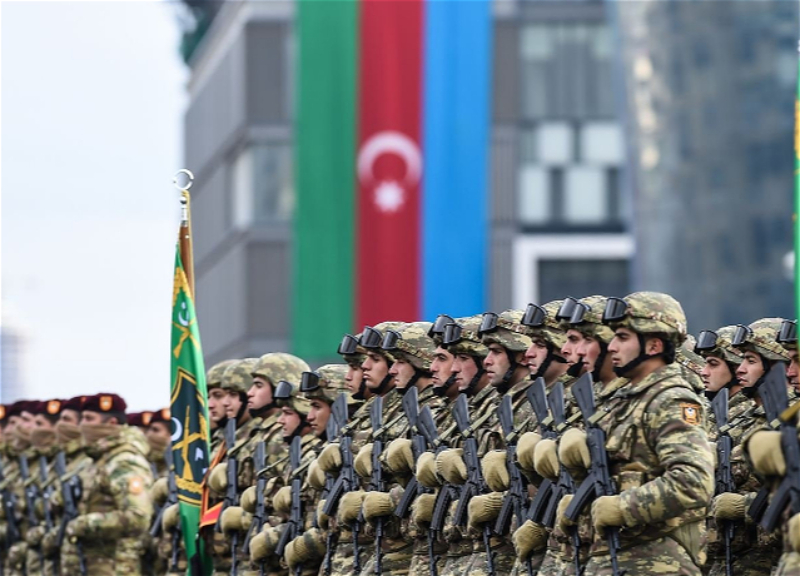
Armed Forces Day, celebrated in Azerbaijan today, serves as a natural confirmation of the correctness of the sovereign foreign policy course that the republic has consistently and independently pursued for decades.
For the country, this date has special significance; it is a day of triumph of national will, sovereignty, and the indomitable power that the country has forged over decades. Every sovereign state relies on its institutions, but for Azerbaijan, which has gone through the most difficult trials at the turn of the century, it is the national army that has become the main guarantor of historical justice.
Army - the process of forming this powerful institution required colossal time and strict strategic consistency. Its foundations were laid by national leader Heydar Aliyev, whose foresight made it possible to create the foundation of the modern military school of Azerbaijan - starting with the landmark opening, still in the Soviet era, in distant 1971, of the Military School (now the Military Lyceum) named after Jamshid Nakhchivanski, which gave the country its first professional military personnel. The legacy of the national leader proved its viability in the First Karabakh War. Heydar Aliyev's return to the leadership of the country in 1993 came during a period of the deepest military-political crisis, when the lack of unified command and the dominance of disparate politicized detachments led to catastrophic consequences at the front. The first fundamental step of the new government was the elimination of anarchy: disparate volunteer battalions were disbanded, and on their basis the urgent creation of regular military units with strict centralized discipline and a single chain of command began.
The results of this titanic work manifested themselves immediately during the winter campaign of 1993–1994. The successful Goradiz operation became the first major strategic victory of the reviving regular Azerbaijani army. Having broken through the enemy's defensive lines, Azerbaijani troops in harsh winter conditions liberated more than 20 settlements in the Fizuli district and the most important railway junction of Goradiz, returning under state control a huge strategic bridgehead. This triumph had colossal psychological and practical significance. The Goradiz operation clearly demonstrated that coordinated actions of regular formations, backed by state will and professional planning, are capable of breaking the aggressor's strategic plans. It was this success that forced the opposing side to sign a ceasefire agreement in May 1994, which gave Baku the necessary respite to deploy long-term, systemic military construction.

After the establishment of the ceasefire regime, Heydar Aliyev faced the task of a radical transformation of the defense sector - transferring troops from the rails of emergency mobilization to the rails of creating a professional state institution. The key emphasis was placed on the formation of a full-fledged national higher military school. The Higher Combined Arms, Naval and Military Aviation Schools underwent deep reform and transition to international training standards, and in 1999 the creation of the Military Academy of the Armed Forces laid the foundation for the training of senior and higher officer personnel capable of carrying out operational-strategic planning.
At the same time, Baku began to actively bring the army out of international isolation. Accession to NATO's Partnership for Peace framework program in May 1994 opened access for Azerbaijani officers to modern methods of staff management, and subsequent participation in international peacekeeping operations in Kosovo, Iraq and Afghanistan gave Azerbaijani military personnel invaluable practical experience in performing combat and security tasks as part of international coalitions, securing Baku's status as a reliable and predictable geopolitical partner.
During the same period, Heydar Aliyev laid the foundation for strategic cooperation with the Armed Forces of Turkey. Along with institutional reforms, hard work was carried out to centralize logistics, eradicate corruption schemes in supply and restore the prestige of military service.
The symbol of this new era was the presidential decree of May 22, 1998, which established June 26 as the official Day of the Armed Forces. It is important to understand that the Oil Strategy and the "Contract of the Century" implemented by Heydar Aliyev were viewed by him as a geopolitical and financial basis for future modernization - it was this economic platform that subsequently allowed the state to multiply defense allocations.
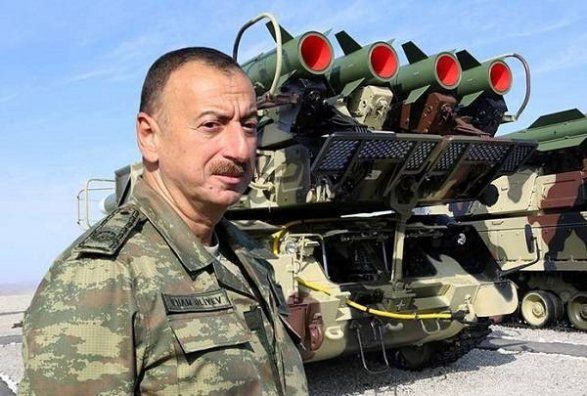
In the subsequent period, this doctrine received its logical, systemic completion.
President Ilham Aliyev transferred army building to the plane of creating a super-equipped military machine of the 21st century, where advanced technical thought was combined with absolute operational readiness. Years of systematic technical and tactical training were aimed at solving the main national task. Azerbaijan never created sham troops, pursuing the goal of breaking the stereotype of an "army of parades" and building a real combat force capable of functioning in the conditions of modern non-contact-contact warfare. The Patriotic War of 2020 removed all questions, clearly demonstrating how in a matter of days it is possible to completely eliminate the enemy's deeply echeloned defensive system. The vaunted "Oganyan line," which the enemy considered impregnable, was broken in the very first days of the operation, which predetermined the collapse of the entire thirty-year occupation infrastructure.
The uniqueness of this success becomes obvious when comparing the actions of the largest military powers on the planet in recent years. While the recognized strongest world armies - the armed forces of the United States and Russia - in their latest campaigns and conflicts regularly face strategic viscosity, protracted positional battles and colossal difficulties in achieving final goals, Azerbaijan demonstrated filigree precision in implementing geopolitical tasks. Acting under conditions of severe time pressure and under the harshest diplomatic pressure from outside, Baku achieved a one-hundred-percent result. The army won a clean, absolute military and political victory, creating a rare precedent in modern military history.
The technological core of this blitzkrieg was the world's first systematic use of unmanned aviation. Baku combined the strike and reconnaissance capabilities of Turkish and Israeli UAVs into a single operational fist. The Azerbaijani command linked the actions of drones, loitering munitions, electronic warfare assets and traditional artillery in real time. This network-centric model of combat overturned classical ideas about the art of war. Leading countries of the West and East were forced to urgently rewrite their defense doctrines, recognizing Azerbaijan's experience as a "drone revolution." The new tactics made it possible to completely paralyze the enemy's air defense and logistics, destroy his armored vehicles on distant approaches and radically reduce losses among their own personnel.

However, technology alone does not win wars. This has been repeatedly stated by the President, Supreme Commander-in-Chief Ilham Aliyev: "Our Victory was not won by technical means; it was won by our soldiers and officers. They went into battle, sacrificing their lives, breaking through fortifications, and raised our flag on the liberated lands."
Advanced weapons are only a tool in the hands of man. Over the years of independence, Azerbaijan has formed a completely new generation of young people motivated by the idea of uncompromising restoration of historical justice. Their patriotism, iron discipline and loyalty to the oath turned out to be more powerful than any most advanced weaponry.
The pinnacle of this human factor and the professionalism of special forces was the storming of the city of Shusha. The operation entered the annals of world military science as a unique example of urban warfare in highland conditions. A detailed analysis of these battles formed the basis of a special study by John Spencer, head of the Urban Warfare Project at the U.S. Military Academy (Modern War Institute). The American analyst in his work emphasizes that the liberation of Shusha by fighters who climbed sheer cliffs almost manually, having only light small arms and cold weapons, refuted all existing tactical canons. Spencer emphasizes that Azerbaijani units completely outplayed the superior forces of the defenders due to surprise and jewelry work in dense urban development. The city was taken with minimal losses and without the use of heavy artillery, which made it possible to preserve its historical appearance.
Special attention should be paid to the impeccable moral character of the Azerbaijani army throughout the campaign. The troops fired exclusively at legitimate military targets of the enemy, and the norms of international humanitarian law were observed unswervingly. The Azerbaijani soldier fundamentally did not fight with the civilian population. On this score, President Ilham Aliyev spoke unambiguously: "We take revenge on the battlefield. I have said this before and I say it today: we have never fought and will not fight against the civilian population."
Baku demonstrated an example of civilized conduct of hostilities, which sharply contrasted with the behavior of the opposing side, which out of impotence launched vile missile strikes on the sleeping residential quarters of Ganja, Barda and Mingachevir. This humanity of the Azerbaijani army stems from the national and moral guidelines of society and strict internal control by the command.
It was this colossal combat experience and demonstrated effectiveness that brought the defense potential of Azerbaijan to the level of official recognition by the leading analytical centers of the planet. In current reports of the influential global ranking Global Firepower, which evaluates the combined military power of states according to more than 60 factors, the Azerbaijani army consistently holds undisputed leadership in its region, leaving far behind countries with greater demographic resources. Similar conclusions are conveyed by regular reports of the Stockholm International Peace Research Institute (SIPRI), whose experts emphasize the highest efficiency of Baku's defense spending and the competent structure of imports of high-tech systems.
The completion of the Patriotic War and subsequent local successes did not become a reason for weakening vigilance. On the contrary, the process of reforming and modernizing the Armed Forces of Azerbaijan received a new powerful impetus aimed at consolidating the achieved geopolitical results. The head of state Ilham Aliyev unambiguously defined the current state of the defense sector: "Today the Azerbaijani army is even stronger than the army that won the 44-day war."
In accordance with this vector, the structure of the troops was deeply modernized according to the advanced Turkish model. The country saw the emergence of fundamentally new mobile formations - "Commando" brigades, designed for conducting autonomous operations in any physical and geographical conditions. The system of military education also underwent a radical transformation. The creation of the National Defense University made it possible to unite all specialized educational institutions under a single command and introduce the latest educational standards for the officer corps.
At the same time, the country is increasing purchases of heavy weapons, long-range missile systems and robotic complexes, which is clearly demonstrated by the latest military parades. An important factor of national security has been the deep integration of the army with the domestic military-industrial complex. The Ministry of Defense Industry of Azerbaijan, together with leading foreign partners, has reached the level of serial production of high-tech products. The country independently produces unmanned aerial vehicles and loitering munitions of a new generation, including the "Zərbə" and "Arkan" systems, which fully meet the needs of the troops in conducting modern network-centric wars. Baku's international cooperation has long outgrown the format of simple purchases and transformed into joint scientific and technical developments with leaders of the global market. The Armed Forces of Azerbaijan today are not just a shield of the state, but a dynamic, high-tech and extremely dangerous organism for any potential aggressor, capable of guaranteeing stability, sovereignty and inviolability of the borders of the Republic of Azerbaijan under any development of the geopolitical situation.