
"Weapons of mass disinformation": CNN to answer to Baku in an American court
In the golden age of journalism, the logos on the facades of the CNN or The New York Times buildings were perceived as standards of truth.
Editorial filters, the institution of fact-checking and the rule of balance seemed to be an unshakable foundation. Today, all that remains of that foundation is a dusty facade.
The oldest institutions of the Western press are going through their deepest systemic crisis. The information age has laid bare an unpleasant fact: media giants with big names have turned into an instrument of geopolitical pressure, where journalistic ethics is sacrificed to political expediency, and objectivity gives way to banal paid-for hackwork.
A fresh and perhaps the most telling example of this is the lawsuit filed by Azerbaijan against the American television channel CNN in a U.S. federal court. This event marks an important milestone: a sovereign state is moving the fight against media disinformers from the plane of diplomatic notes to the plane of the legal field of the defendant's country. The battlefield becomes that very jurisdiction behind whose shield the authors of commissioned materials have been hiding for decades.
The anatomy of a provocation
On June 5, 2026, the CNN World website posted material containing provocative accusations against Azerbaijan. The article claimed that the country's territory is being used by Israel to conduct military and intelligence operations against Iran, and that Israeli special forces have been deployed and espionage equipment installed in the south of Azerbaijan, near the Iranian border.
Accepted investigative practice requires elementary things from a journalist — verification of facts, work with objective evidence and consideration of the other side's position. So how did CNN act?
Baku officially informed the channel's editorial office even before publication. In response to the preliminary inquiry, the Azerbaijani side gave an exhaustive answer: the use of the country's territory by third states for military or intelligence purposes against neighboring Iran is completely ruled out.
CNN chose to ignore Baku's official position. Azerbaijan's response was not adequately reflected in the material, while the key theses were built on "anonymous sources."
After the article was published, Baku demanded an official retraction. The head of the press service department of Azerbaijan's Ministry of Foreign Affairs, Aykhan Hajizada, stated: "The claims contained in the article published on June 5 on the website of the CNN World news channel about the alleged use of Azerbaijan's territory for military or intelligence operations against Iran and the deployment of Israeli forces on the territory of Azerbaijan are completely groundless and we resolutely reject them." The publication of claims based on anonymous sources, without any solid evidence and without taking into account Azerbaijan's official position, contradicts the principles of objectivity, impartiality and journalistic ethics. As has been repeatedly stated, there are no grounds for claims that Azerbaijan's territory is being used for military operations, intelligence activities or other hostile purposes against any third country. Our country has never allowed and will never allow such actions. Azerbaijan is committed to the cause of promoting peace, stability and good-neighborly relations in the region. Such groundless and unsubstantiated claims are yet another attempt at disinformation. We expect CNN to retract this publication, which contains unfounded claims, he emphasized.
CNN's editorial office ignored repeated official letters dated June 6, June 23 and July 2, 2026, demanding a retraction of the claims contained in the material and the making of corresponding corrections. The lie remained posted on the site, serving the interests of third forces.
When a media resource with a multimillion audience publishes anonymous fakes contrary to official facts, this is no longer erroneous journalism. This is a deliberate disinformation operation.
As can be seen, the chronology of this media attack and Baku's response unfolded along the following chain — first, CNN's editorial office sent an inquiry, to which it received an official and unambiguous response from Azerbaijan. Ignoring the fact it had received, on June 5, 2026, the channel published fake material. Between June 6 and July 2, Baku sent three repeated notes demanding a retraction, and, having received no adequate response, initiated the filing of a federal lawsuit in a U.S. court.
The geopolitical subtext
Rumors about "secret Israeli bases" in Azerbaijan are not appearing for the first time. This is a systemic narrative injected into the information field. The goal is clear — to drive a wedge into Baku's relations with its neighbors.
The assistant to the president of Azerbaijan and head of the foreign policy affairs department of the Presidential Administration, Hikmet Hajiyev, in a recent interview with Turkish media directly pointed to those who commission such materials: "The black propaganda about the 'presence of Israeli bases' in Azerbaijan and about Baku allegedly being a 'lifeline' for Israel is a lie concocted by the enemies of Turkey and Azerbaijan. We issue a challenge! Let's walk together over every meter here: is there anything here at all that belongs to Israel? We will grant the authors of these claims the right to conduct an inspection anywhere they wish."
The ban on conducting military operations against third countries from the territory of Azerbaijan is not just a declaration, but a basic principle of Baku's foreign policy. However, outlets of CNN's level are not interested in the actual state of affairs. What matters to them is informational noise capable of destabilizing the situation across a vast geographical space.
Baku breaks the scripts
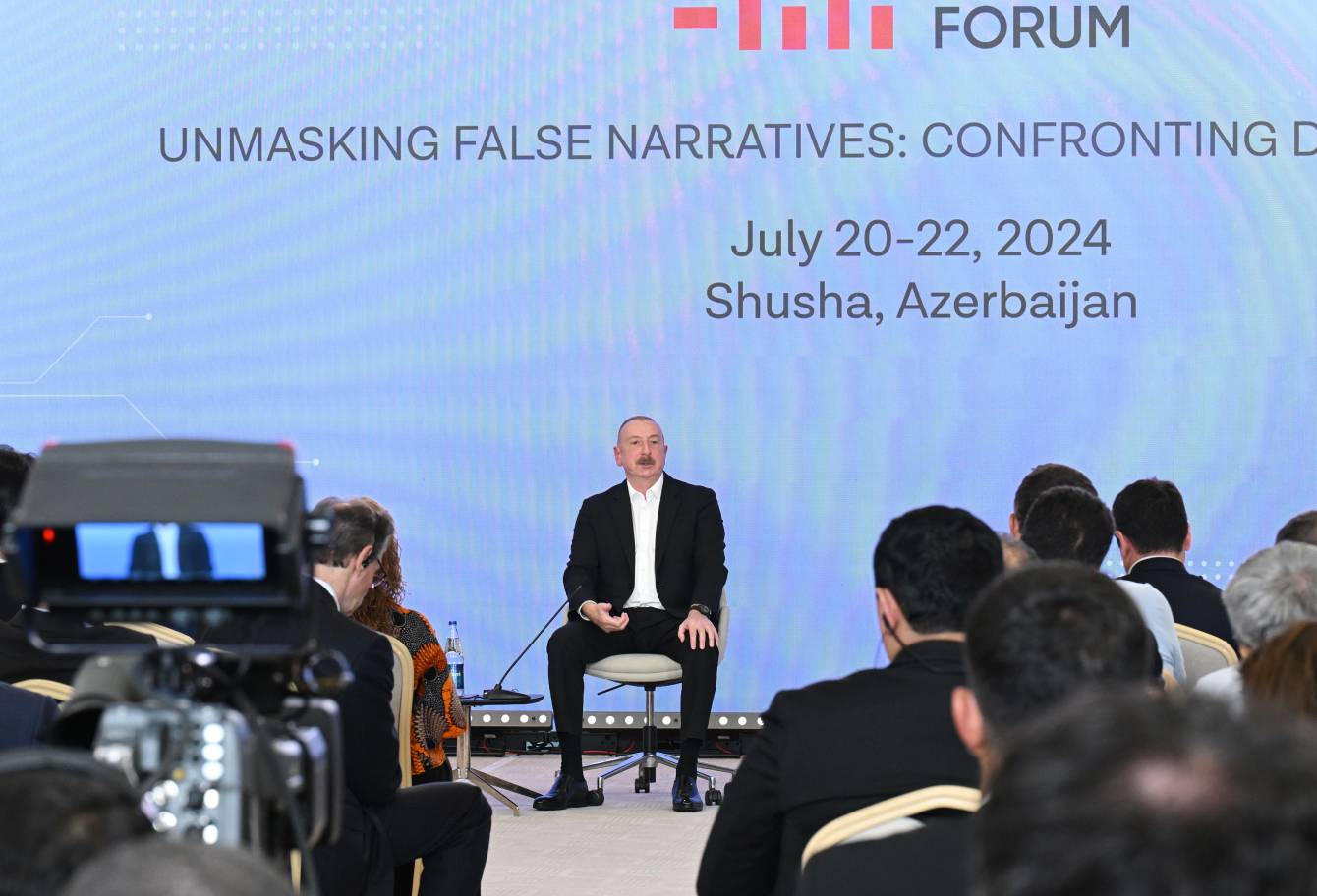
The president of Azerbaijan, Ilham Aliyev, characterized the phenomenon of the transformation of the modern Western press profoundly and precisely. "It is important that the narrative be truthful, that it reflect reality. And it must not be biased. Otherwise, it means that everything was arranged in advance, especially if the narrative is part of a coordinated campaign. We call this a media attack. That's one thing. But if the reason is a lack of information, then that's another matter," the head of state stated at the II Shusha Global Media Forum in 2024.
He noted that Azerbaijan has for many years been a victim of the manipulation of facts and false narratives: "What Azerbaijan has faced and continues to face is a coordinated media attack. This attack accompanies important geopolitical events. The organizers of this media attack cannot achieve their goals related to us, because their goals contradict our interests. That is why they use this mechanism. There are many other mechanisms of influence. For example, non-governmental organizations, funding and various other forms of interference in the internal affairs of sovereign states. But the most noticeable and sensitive is the influence of the media, especially if it comes from large and well-known outlets." "The media must not be used as a weapon. Opinions should be different. Today in many countries the media reflect only one opinion on various issues. In Europe there is one narrative, in some Asian countries another, in Russia a third, in Azerbaijan its own. This shows that the media have become highly politicized," the Azerbaijani leader emphasized.
President Ilham Aliyev focused attention on the social responsibility of journalism: "Of course, we would like the media to be objective. Everyone is subjective, but media representatives bear a special responsibility, since their messages and the way they cover events in many cases affect people's lives."
As can be seen, when the media space turns into a theater of military operations, and articles into "shells" of information-psychological operations, the concept of "freedom of speech" becomes a convenient cover for legal lawlessness.
A global crisis: From Trump to multimillion-dollar fines
It should be noted that Azerbaijan is far from the only victim of disinformation campaigns. The Western political system itself and its leaders regularly face the same problem.
The head of the Azerbaijani state also pointed to this: "Today we see that even the president of the United States is facing what we have faced for many years. President Trump called the Washington Post and the New York Times sources of fake news. And I fully agree with him — not only with this, but with other statements as well."
Donald Trump's verbal skirmishes with CNN journalists have long become a classic of world politics. Just the other day, the former U.S. president publicly rebuked a correspondent of the channel: "Fake news. You're fake news. You're a loud, noisy person. You're fake news. Shut up!… You're a fake journalist and you spread fake news!"
The White House's official account on the X network picked up this discussion, publishing a video recording with the comment that the journalist's behavior was a "shameful, humiliating disgrace to her profession."
Trump's regular criticism of NBC, The New York Times and CNN is not just personal antipathy, but a reflection of the total collapse of trust of American and global society in the leading media corporations.
Examples of lawsuits and reputational catastrophes of the largest Western media outlets vividly show the scale of the problem:
- in 2019, the $275 million lawsuit by Kentucky schoolboy Nicholas Sandmann against CNN and for distortion of facts and organized harassment,
- in the same year, Nicholas Sandmann's lawyers filed a $250 million lawsuit against the Washington Post,
- in 2023, the Fox News television channel was forced to agree to pay $787.5 million under an out-of-court settlement for spreading false information about election fraud through Dominion machines,
- in 2018, the German magazine Der Spiegel faced a most severe reputational blow after the disclosure of years of falsifications and the complete fabrication of reports by its "star reporter" Claas Relotius, who received prestigious awards for these fakes.
These stories show that one has to pay for deliberate lies; moreover, the myth of the impeccability of the Western press has been destroyed.
The end of the era of impunity
Finally, the fresh case of the CNN World division with the publication of false information about Israel's military presence in Azerbaijan in the summer of 2026 led to the filing of a large-scale federal lawsuit by Azerbaijan in a U.S. court.
Azerbaijan's lawsuit against CNN in an American federal court is an important precedent for international practice. For decades, Western editorial offices have proceeded from the logic of their complete unreachability. They could publish an uncut fake about any sovereign country in an effort to destroy its reputation, provoke a diplomatic scandal, and then hide behind the formulation "we were only quoting anonymous sources."
This conveyor belt has broken down. When state institutions begin to prosecute media killers within their own legal system, the rules of the game change.
Now CNN will have to answer in a U.S. court, present those very "anonymous sources" and explain why the state's official retraction demands were ignored.
The age of unpunished "journalism of anonymous leaks" is coming to an end. If legacy media have decided to definitively trade their name for the status of an instrument of information warfare, they will have to pay for it — with reputation, money and court verdicts.