Alpha Capricornids meteor shower can be observed in the sky over Azerbaijan
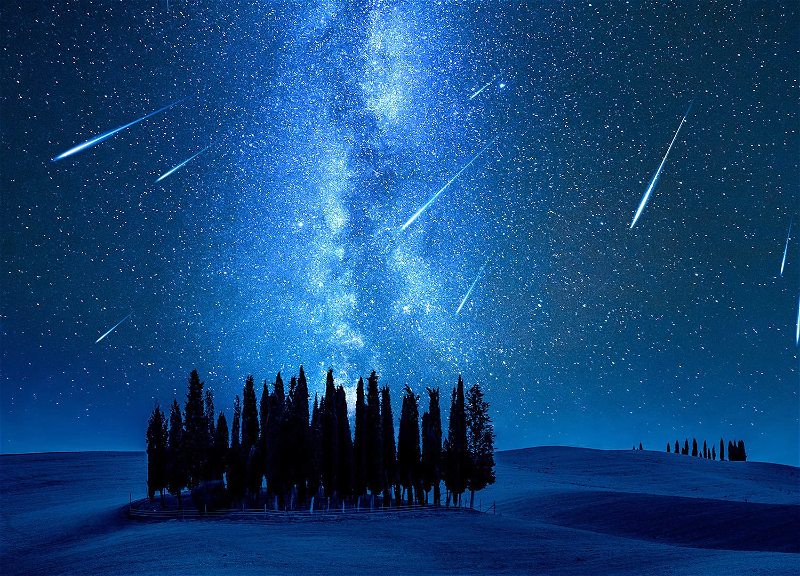
In late July, residents of Azerbaijan will be able to observe the Alpha Capricornids meteor shower (Alpha Capricornids).
As reported by 1news.az citing the Department of Astrophysics at the Faculty of Physics of Baku State University, the meteor shower will be active from the beginning of July to August 15, reaching peak activity on July 30 at 17:00 Baku time. The most favorable conditions for observation in Azerbaijan are expected on the evening of July 30 and the night of July 31.
The radiant of the Alpha Capricornids stream is located in the constellation Capricornus. From Baku it remains above the horizon throughout the night, so meteors can be observed at any time during the night. However, the most favorable time is considered to be around 01:00, when the radiant rises to its maximum height and the observer’s position relative to the direction of the meteor stream becomes most optimal.
During peak activity under ideal conditions, the zenithal hourly rate (ZHR) will be about 5 meteors per hour. However, because the radiant rises only 39° above the horizon over Baku, in real conditions an average of about three meteors per hour can be seen.
One of the main factors complicating observations this year will be the phase of the Moon. At the time of the meteor shower’s peak, only two days will have passed since the full moon, so bright moonlight will significantly hinder the observation of faint meteors. Nevertheless, Alpha Capricornids are known to occasionally produce very bright meteors of the “fireball” type, leaving a long glowing trail, so the chance of seeing the brightest objects will remain.
Another distinctive feature of the Alpha Capricornids is their relatively low speed. These meteors enter Earth’s atmosphere at a speed of about 23 km/s (approximately 82,800 km/h).
Meteor showers occur when Earth, in its orbit around the Sun, passes through clouds of dust and small rocky particles left by comets or asteroids along their orbits. Entering the atmosphere at speeds of tens of kilometers per second, these particles burn up at altitudes of 70–100 km, forming glowing trails popularly known as “shooting stars.”
The source of the Alpha Capricornids meteor shower is believed to be periodic comet 169P/NEAT, which completes a full orbit around the Sun in about 4.2 years and belongs to the Jupiter-family comets. Despite its relatively weak gas-and-dust activity, particles left by the comet in the past continue to cross Earth’s orbit each year, causing this meteor shower.
No telescope or binoculars are required to observe the Alpha Capricornids. It is best to observe away from city lights, in locations with an open horizon and dark skies. It is also recommended to look not directly at the radiant but about 30–40° to the side of it — this method allows more meteors to be seen.