The Caspian has ceased to be a 'sea of peace' - who is to blame and what to do?
7 October 2015, lights rose over the Caspian: from the Russian ships Dagestan, Grad Sviyazhsk, Uglich and Veliky Ustyug, twenty-six Kalibr-NK cruise missiles were launched.
They flew low, almost skimming the water, crossed the airspace of Iran and Iraq — the route had been pre-coordinated with Tehran and Baghdad — and struck eleven targets in Syria. Russia’s Defense Ministry reported accuracy of no more than three meters.
Video recordings of those launches spread across social networks as a technical curiosity: a missile flying over Caspian waters was a rare sight. And it was. But that night the closed sea, which the five littoral states in their declarations call a sea of peace, was used for the first time as a firing position.
Almost eleven years have passed. In the night of 25 July 2026, a vessel exploded in the same sea and one person died aboard.
What happened
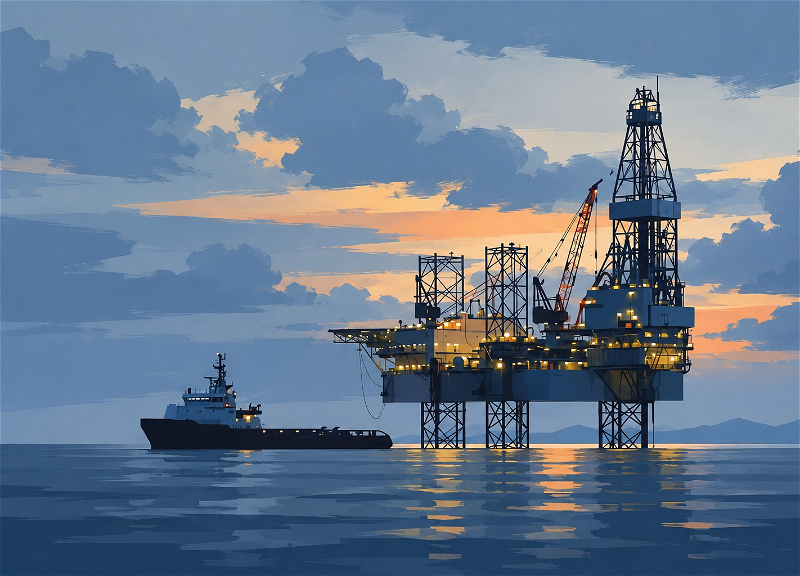
Ukraine’s Security Service reported drone strikes on targets in the Caspian: the Filanovsky field oil platform, the cargo ship Port Olya 2, the dry-cargo vessel Begey and the Project 12418 Molniya missile boat. Both vessels, according to the Ukrainian agency, are under international sanctions and were used to transport military cargo between Iran and Russia. Volodymyr Zelenskyy the same day reported “very good results” from long-range strikes in the Caspian Sea.
Iran’s Foreign Ministry stated that the strike hit an Iranian commercial vessel: an explosion occurred on board, one sailor was killed and another wounded. Tehran called the incident an act of aggression and a violation of Article 2(4) of the UN Charter, summoned Ukraine’s chargé d’affaires and said the event posed a threat to the security of all Caspian states. Abbas Araghchi, speaking with EU foreign-policy chief Kaja Kallas, demanded a strong reaction from the UN Security Council.
The final formulation was addressed in part to Caspian neighbors — and it does merit a response. Only that response is broader than Tehran would like.
Two versions and one unnamed vessel
The sides’ accounts do not coincide on any point. Kyiv named two vessels, both Russian-owned or Russian-flagged (though it later edited the post). Tehran speaks of an Iranian commercial vessel but gave neither name, flag nor IMO number. The most concrete claim about the cargo came not from the agency that carried out the operation: Ukraine’s ambassador to Israel, Yevhen Korniychuk, told Israel’s N12 channel that the vessel was carrying drone and missile components.
Let us separate what is established from what is not. The route is documented independently of Kyiv: Port Olya 2 is on the U.S. Treasury sanctions list; Britain and Canada imposed sanctions on Begey; and the U.S. Treasury has previously noted that the Caspian corridor is used for shipments between Iran and Russia. According to a Sky News source, as early as January 2023 two Russian-flagged vessels, Musa Jalil and Begey, left Iran’s Amirabad port with roughly two hundred containers holding about one hundred million rounds of ammunition and three hundred thousand shells. A caveat is required: sanctions designation is an administrative decision, not a judicial finding of fact.
Yet none of the parties reported the cargo that was aboard in the night of 25 July. Iran denies involvement in the Russia-Ukraine war but does not name the vessel that would allow that denial to be verified. Ukraine names vessels but does not present the cargo.
This is not a journalistic failure; it is a diagnosis — five states spent thirty years negotiating the sea’s status and never created a single instrument allowing independent and objective verification of what occurs in these waters. The Caspian has neither international monitoring, nor inspection procedures, nor an arbiter. Any incident here therefore instantly becomes a clash of unverifiable claims — and each side gains the ability to say whatever it wishes.
Who brought war to this sea?
Tehran’s appeal to the security of the Caspian states would have carried more weight had it been made earlier — several years before the strike on its own vessel.
The Caspian ceased to be a non-military space not on 25 July 2026 but on that October night in 2015. Launches from the Caspian have been repeated since: first against Syria, then against Ukraine. Among the targets of the latest strike was a Project Molniya missile boat; in May a Project 22800 Karakurt small missile ship, also a Kalibr carrier, was struck in the Caspian. At the same time, U.S., British and Canadian sanctions agencies assess that a logistics corridor bypassing controls has been built across the Caspian.
Precision in characterization is needed here. Russia and Iran are signatories of the 2018 Convention on the Legal Status of the Caspian Sea and participants in the regime they invoke when it suits them. Turning the waters into a launch pad for cruise missiles and a military-transport corridor is the destruction of that regime from within by those who created it. A state that uses the common sea as the rear of its war loses the right to speak of the security of that sea.
The demand addressed to them is therefore entirely concrete: there must be neither missile launches from the Caspian nor military shipments. Until this is fulfilled, the sea risks truly losing its status as a secure space.
Does the current situation give Kyiv the right to strike?
Kyiv’s position has internal logic, and pretending otherwise is pointless. Over Ukrainian cities, Kyiv reports, more than forty-four thousand Iranian-designed drones have been shot down. Striking an adversary’s military logistics is a task for a warring army, and vessels placed on sanctions lists precisely for weapons transport are, in Kyiv’s view, legitimate targets.
Yet this reasoning is not carried to the conclusion drawn from it.
The Caspian is not the high seas and not a theater of military operations. It is a closed basin with a special legal regime created by five states, under which issues are to be resolved by peaceful means among the Caspian countries. No mechanism granting an external party the right to enforce the law by force in these waters exists — neither for Ukraine nor for anyone else.
The nature of the cargo is exactly the question that in any maritime space is established by procedure: inspection, detention, port control, sanctions enforcement. A drone strike establishes nothing. It replaces the establishment of fact with force and makes verification impossible forever: a vessel lying on the seabed will present neither manifest nor hold. If the sanctions regime has not worked for years — and it evidently has not — that is a failure of enforcement, and it must be remedied by restoring control, not by drones. Illegal cargo must be intercepted by legal means; both are equally important here.
A sea with no outlet and a potential ecological catastrophe
There is a second aspect. Ukraine is not a party to the 2018 Convention, the Framework Convention for the Protection of the Marine Environment of the Caspian Sea, or the Aktau Protocol. It has no obligations for oil-spill cleanup, no share in compensation mechanisms and no seat at the table where the consequences will have to be addressed. An external party has introduced combat operations into a closed body of water whose ecological consequences it does not bear. The bill will be presented to those who are not participants in this war.
Here begins precisely the part usually omitted from political commentary — the physics.
The Caspian is the planet’s largest closed body of water, an endorheic lake with no exchange with the world ocean. There is no strait or current capable of carrying pollution out of the basin. Oil that enters the Caspian does not leave. It remains, settles on the bottom and accumulates. Comparison with the Black Sea, where Ukraine has operated until now, is physically incorrect: the Black Sea has the Bosporus; the Caspian has nothing.
And here it is appropriate to recall what even a spill where an outlet exists can produce.
On 15 December 2024, in a force-seven storm off the Kerch Strait, two tankers — Volgoneft-212 and Volgoneft-239 — were wrecked, vessels that had exceeded their service life: the first broke in two and sank, the second lost power and ran aground. More than eight and a half thousand tons of fuel oil were aboard; part of the cargo entered the water. One sailor died. What followed is what everyone remembers: the black line of surf, birds volunteers washed by hand, dead dolphins on the Anapa shore. Rosprirodnadzor filed a claim of 49.5 billion rubles against the owner and charterer of Volgoneft-212 and more than 35 billion against the owner of Volgoneft-239; the court upheld the claims.
A year and a half later the story is still not closed. In spring 2026 part of Anapa’s pebble beaches were declared cleaned; Deputy Prime Minister Vitaly Savelyev reported that more than ninety percent of the fuel oil had been removed and the water met sanitary standards. Scientists are more cautious: concentrations in soil and bottom water have declined, but heavy fractions decompose slowly, their residues are still found on the seabed, and brown stains remain on boots after a walk along the shore.
Recall that this was an accident, not a strike. It occurred in the open sea with a strait, and the disaster had an identified culprit, a court and a payer. Even so, a year and a half, billions and thousands of volunteers were required — and a full stop has still not been placed on the story.
Now imagine the same accident in the Caspian, where there are no straits or currents. Where, in the event of combat operations, there will also be no clearly identified culprit who could be held liable under the Tehran Convention, because that party simply did not sign it. There will be no court, because jurisdiction does not exist. Only fuel oil and the closed waters will remain, waters inhabited by sturgeon, the Caspian seal and the fisheries of five countries.
The line that must not be crossed
From this follows a conclusion that should be stated without diplomatic softening.
A strike on oil-and-gas infrastructure in an endorheic body of water is impermissible. Not “undesirable,” not “fraught with complications” — impermissible, and no considerations of military necessity justify it. A transport vessel can be sunk, and the consequences, however grave, remain finite.
A stationary platform, however, means a guaranteed spill that in the Caspian no one is in a position either to carry beyond the basin, to localize promptly, or, in the absence of jurisdiction, to present to anyone. The damage here is irreversible and is addressed not to a party to the conflict but to the littoral peoples who live by this sea.
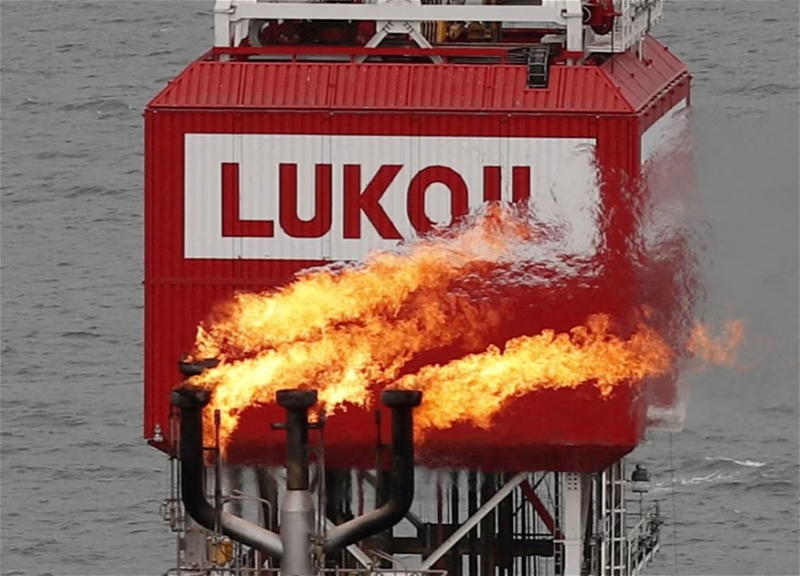
The Filanovsky field platform, Lukoil’s largest asset in the Russian sector of the Caspian, has already been struck. The scale of the consequences has not been publicly determined — and that very silence is alarming.
The same demand, in the same tone, must be addressed in the opposite direction: the placement of military facilities and military logistics next to extraction infrastructure is impermissible, because it creates a formal pretext for a strike on that infrastructure. Whoever hides war behind an oil platform bears responsibility for a spill on equal terms with whoever fires at it.
For Azerbaijan all of this is a matter of first-order importance.
Not long ago, speaking at the 80th session of the UN General Assembly, President Ilham Aliyev described what is happening to the Caspian as an ecological catastrophe with unpredictable consequences and stressed that one of the main causes of the sea’s rapid shallowing is not climate change.
On 17 July in Moscow, Foreign Minister Jeyhun Bayramov and Russian Foreign Minister Sergey Lavrov stated that solving the shallowing problem requires the combined efforts of all Caspian states. That is, the Caspian agenda has been in an active phase literally in recent weeks. And into it, like a nail, enters the strike on the platform.
The sea that is shallowing is simultaneously becoming a space of combat operations. The combination of these two processes is the essence of the problem for the littoral countries — everything else is derivative.
There is also a quite earthly bill. Military risk in the waters raises insurance premiums for all shipping, not only for vessels that become targets. The Middle Corridor, linking Europe with Central Asia, passes through the Caspian; Caspian infrastructure for hydrocarbon exports is used by Kazakhstan, Turkmenistan and Azerbaijan. The rise in freight and insurance costs is the mechanism by which those who are not parties to the war are the first to pay for it.
And there is a direct risk. The precedent created in one sector of the sea operates throughout the entire sea. The oil fields of other Caspian states that supply energy resources to Europe lie in the same waters and within the same reach as the struck platform. A threshold once removed does not remain with the party that removed it.
What must be said
A call on all sides to show restraint will remain scenery unless it is translated into requirements that can be addressed by name.
First. The Caspian must be removed from the theater of combat operations completely and in both directions: no launches and no military logistics from inside, no strikes from outside. This is one principle, not two different ones, and it must be applied to all without exception — even though the responsibility of the signatories of the Convention who are destroying their own regime is heavier than that of the external party that did not sign it.
Second. Civilian shipping and energy infrastructure of the Caspian are declared inviolable without qualification. Suspicion regarding the nature of cargo is verified by procedure, not by ammunition.
Third. The Aktau Protocol, adopted on 12 August 2011 and designed for accidents, must be supplemented with a norm on pollution caused by military actions: procedures for access, financing of cleanup, allocation of responsibility, including the case when the polluter is not a party to the Convention. This is work inside the existing treaty, not requiring a new negotiating cycle — and its absence is precisely the hole through which war entered the sea.
And until these questions find their solution, one will have to state with regret that the Caspian has ceased to be a sea of peace.
Simply until 25 July of this year no one paid for it.
Analytical Department, First News Media
Read in other languages:
Каспий перестал быть «морем мира» — кто виноват и что делать?
Xəzər “sülh dənizi” statusunu itirib – günahkar kimdir və nə etmək lazımdır?