European Parliament Against Facts: Separatism Under the Guise of 'Human Rights'
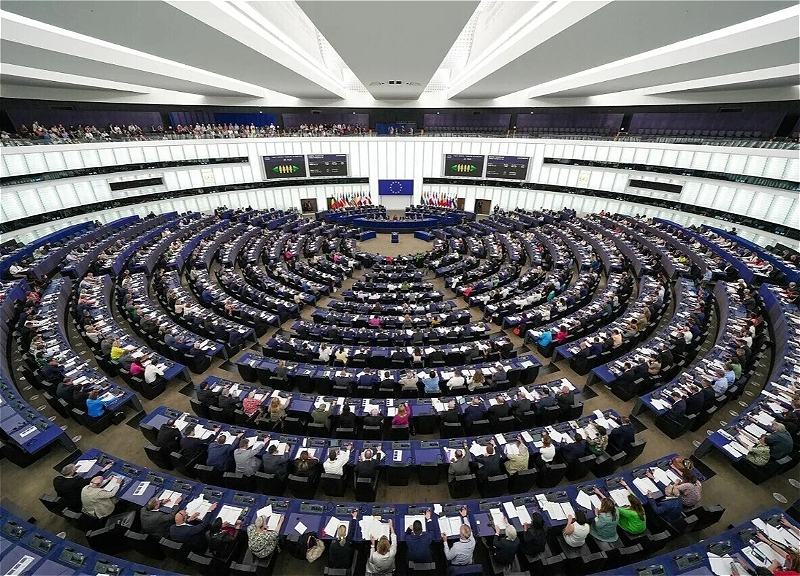
The European Parliament has once again confirmed its persistent reputation as an institution that increasingly acts not as a neutral arbiter, but as a politically biased platform, convenient for promoting narrow lobbying interests.
A joint statement by a group of MEPs—Chair of the Subcommittee on Human Rights Munir Satouri, Head of the Delegation for Relations with the South Caucasus Nils Ušakovs, and Standing Rapporteurs on Armenia and Azerbaijan Miriam Lexmann and Danuša Barna—has become yet another confirmation of the systemic crisis of objectivity within the European Parliament.
The reason for the statement was a decision by the Baku Military Court regarding cases of Armenian citizens accused of war crimes, crimes against peace, and humanity as a result of Armenia's military aggression against Azerbaijan. The MEPs were quick to condemn the decision while simultaneously calling on Baku to 'release all Armenian prisoners.'
At the same time, the authors of the document attempted to present their interference as concern for the 'fragile but positive atmosphere of peace' in the South Caucasus, although, in essence, this is a direct attempt to pressure a sovereign state and its judicial system.
A central role in this campaign is once again played by French politician Munir Satouri, whose activities have long gone beyond the classic human rights mandate. Under the slogans of defending human rights, he consistently promotes a one-sided and politically motivated agenda, closely intertwined with the narratives of the Armenian lobby in European institutions.
Satouri, as one of the initiators of the statement on 'Armenian prisoners,' deliberately ignores the obvious fact: these are war criminals.
Moreover, this is far from the first such step. In the summer of 2025, Satouri openly called for EU sanctions against Azerbaijani officials, effectively proposing to use the sanctions mechanism as a tool of pressure and political blackmail. At the same time, he repeatedly linked the prospects of a future partnership agreement between the EU and Azerbaijan to the fulfillment of imposed conditions, including the release of so-called 'political prisoners.' Such an approach not only undermines the idea of equal dialogue but also demonstrates the desire of part of the European Parliament to maintain a confrontational model of relations with Baku, ignoring new geopolitical realities.
Against this backdrop, it is no coincidence that several other MEPs who signed the anti-Azerbaijan statement expressed irritation over the visit of EU foreign policy chief Kaja Kallas to Baku last year. For instance, Miriam Lexmann publicly questioned the appropriateness of this visit, once again resorting to the usual set of accusations against Azerbaijan. Meanwhile, Lexmann herself had previously advocated for the deployment of an international 'peacekeeping mission' and the provision of 'humanitarian aid' to the separatist regime in Karabakh, while consistently promoting claims of 'staged trials' and 'inhumane conditions of detention' in Baku, without providing any objective evidence.
Such selectivity and distortion of facts have long become the signature style of a certain group of MEPs. The European Parliament is consistently turning into a tool of pressure, where resolutions and statements increasingly resemble political orders. After Azerbaijan's historic victory over aggression, occupation, and separatism, and after the full restoration of territorial integrity and state sovereignty, the country has become the target of a coordinated campaign of discredit. This campaign aims to distort reality and question Azerbaijan's achievements in restoring justice, which the Azerbaijani people were denied for decades.
This logic appears particularly cynical against the backdrop of the fact that it was neither the UN nor the EU, but Azerbaijan itself that ensured the resolution of a decades-long conflict and the formation of a new post-conflict reality in the region.
The latest call by the European Parliament to release 'all Armenian prisoners' is seen as ignoring and effectively encouraging Armenia's occupation of Azerbaijani territories, ethnic cleansing, and numerous war crimes. Under the guise of routine rhetoric about 'human rights,' MEPs are effectively demanding that Azerbaijan abandon its sovereign right to justice and 'release' individuals involved in illegal armed formations and separatist structures that operated in the previously occupied territories of our country.
A key feature of such documents is the deliberate distortion of facts and selective omission. MEPs do not bother to analyze specific criminal cases, court decisions, or the nature of the crimes. For example, in demanding the release of individuals associated with the former illegal regime, they effectively ignore the fact that its very existence was a gross violation of international law. The attempt to portray these individuals as 'political prisoners' is not just a substitution of concepts but a direct attempt to legitimize separatism retroactively.
In doing so, the European Parliament proposes an extremely dangerous interpretation: participation in illegal armed structures is presented as a form of political activity, and the management of quasi-entities as an acceptable 'alternative' to state sovereignty. Such an approach goes far beyond the Azerbaijani agenda and undermines the very foundations of international law.
It is particularly telling that in their statements, MEPs prefer to completely ignore Baku's real humanitarian steps. Let us recall that, in accordance with bilateral agreements between Azerbaijan and Armenia and guided by principles of humanism, on January 14, Baku handed over to the Armenian side Gevorg Sujyan, David Davtyan, Vigen Euljekjian, and Vagif Khachatryan, who had previously been convicted under various articles of the Criminal Code of the Republic of Azerbaijan. Under the current legislation, three of them were detained after the signing of the trilateral statement on November 10, 2020, which ended the 44-day war, while Khachatryan was detained in August 2023 while leaving Khankendi.
This step was a clear confirmation that Azerbaijan operates not from a logic of retribution but within the framework of law, an individual approach, and principles of humanism. At the same time, the conditions of detention of these individuals fully complied with international standards, their rights were ensured, and medical care was provided at the proper level. All convicts underwent medical examinations before being transferred to Armenia, and Vagif Khachatryan, whose health condition raised concerns, was under constant medical supervision and received all necessary assistance. These facts are deliberately ignored by the authors of the statement, as they do not fit into the predetermined accusatory narrative.
Equally telling is what the European Parliament's documents choose to remain silent about. Not a word is said about more than a million Azerbaijani refugees and internally displaced persons, about the mass mining of territories, the victims of which continue to be civilians. There is also no mention of the ideology of 'miatsum,' the bearers and executors of which, for decades, have been the individuals now presented as 'victims.'
As the Western Azerbaijan Community rightly notes, instead of interfering in the internal affairs of a sovereign country and making slanderous accusations, members of the European Parliament could provide public support for the return of Western Azerbaijanis, who suffered from deportations and violence, to their ancestral homes in Armenia. However, such a topic clearly does not fit into the political agenda of the EP and thus remains outside the attention of 'human rights defenders.'
Thus, by continuing to speak the language of ultimatums, double standards, and deliberate distortions, the European Parliament only accelerates the process of losing its own authority. Azerbaijan, acting within the framework of international law, humanitarian principles, and post-conflict reality, continues to shape the agenda of the future—regardless of politically motivated resolutions and statements that remain mere paper declarations without real weight.