Azerbaijan in the 'Peace Council': Strategic Role in the New Architecture of Global Security
The 'Peace Council' is a new concept amid the transformation of the international relations system, creating a platform for developing prompt and politically balanced decisions aimed at more effectively addressing contemporary challenges.
Azerbaijan's founding status in the 'Peace Council' reflects the strengthening of the country's political influence and underscores its role as a reliable partner in the emerging international security system.
The participation of President Ilham Aliyev in the first meeting of the 'Peace Council' on February 19 in Washington confirmed Azerbaijan's position among the platform's founding countries, as well as the high authority and respect for the head of state. On the other hand, it demonstrated the country's ability to combine a strategic diplomatic stance with practical contributions to resolving international crises.
Crisis of the UN...
Today, as the global system of international relations undergoes profound transformations, it becomes evident that existing mechanisms of global governance are not always capable of effectively responding to modern challenges.
The rise in regional conflicts, shifts in the balance of power, and intensified geopolitical competition demonstrate that current global governance mechanisms no longer align with new realities.
Traditional organizations and institutions prove insufficiently flexible to address humanitarian issues and prevent crises faced by the global community. This necessitates the search for new tools to maintain international peace and security.
The crisis in the Gaza Strip, the ongoing Russian-Ukrainian war... - the presence of over 60 conflict zones across various regions of the planet confirms a systemic crisis in international mechanisms for ensuring peace.
In these conditions, particular attention is drawn to the role of the UN. Unfortunately, the world's leading international organization does not demonstrate sufficient political will or tools of influence to prevent and resolve conflicts. Violations in practice of the principles enshrined in the UN Charter – territorial integrity, sovereignty, peaceful conflict resolution, and the maintenance of international peace and security – significantly undermine trust in the organization.
The UN's inability to respond promptly to modern challenges makes the formation of new tools and multilateral platforms inevitable.
...and Expectations from the 'Peace Council'
In these circumstances, the initiative of U.S. President Donald Trump emerges as an alternative mechanism for ensuring international peace and security. The U.S. position is consistent – the country has already withdrawn from several UN structures and ceased their funding, thereby signaling the need to rethink the architecture of international security and create more flexible formats for state interaction.
The first step toward the 'Peace Council' concept was taken at the summit in Sharm El Sheikh, Egypt. This step demonstrated the initiative's effectiveness, leading to a cessation of hostilities in Gaza and preventing further bloodshed.
A significant humanitarian step was the process of returning prisoners and hostages. Overall, unfolding events showcased the potential of the 'Peace Council' as a mechanism for practical crisis response.
Azerbaijan was invited to this new international initiative – the invitation of President Ilham Aliyev to the summit in Egypt once again confirmed the country's growing role in shaping the global peace architecture.
While the initiative has garnered wide international resonance, several states and political groups, including the European Group and China, express concern over the potential impact of the new format on the role of existing international institutions and the balance of decision-making. The question, in particular, is whether the 'Peace Council' will become a global mechanism capable of replacing the UN in resolving other conflicts, or whether its activities will be limited to the Gaza crisis.
Nevertheless, the implementation of the new U.S. concept continued with efforts toward its institutionalization.
In January, during the World Economic Forum in Davos, an open appeal was made to states to join the 'Peace Council.' To date, 28 countries have joined Trump's initiative, with the possibility of further expansion of participants. 'The Peace Council is open to any country,' stated Donald Trump at the first meeting of the Peace Council.
In response to the U.S. invitation, Azerbaijan joined the initiative as a founding member.
Baku and Yerevan's Peace Agenda as a Global Model
Azerbaijan's foreign policy is closely tied to its model of internal development, the country's strategic stability, and active participation in multilateral diplomacy. Baku's approaches to resolving international issues and preventing crises are built on constructive dialogue and effective diplomacy.
One of the key reasons for Azerbaijan's participation in the 'Peace Council' is the successful strategy of President Ilham Aliyev in resolving the long-standing conflict with Armenia and advancing a peace agenda.
In a global context, this experience is seen as a rare example of a state resolving a conflict within the framework of its sovereignty and international law, which strengthens trust in Azerbaijan as a responsible participant in international peace processes.
The invitation of the President of Azerbaijan to participate in the first meeting of the 'Peace Council' in Washington reflects international recognition of Baku's contribution to promoting a successful peace agenda. President Aliyev is one of the most active advocates of peaceful dialogue, as repeatedly confirmed by the American leader's appeals to him during the event.
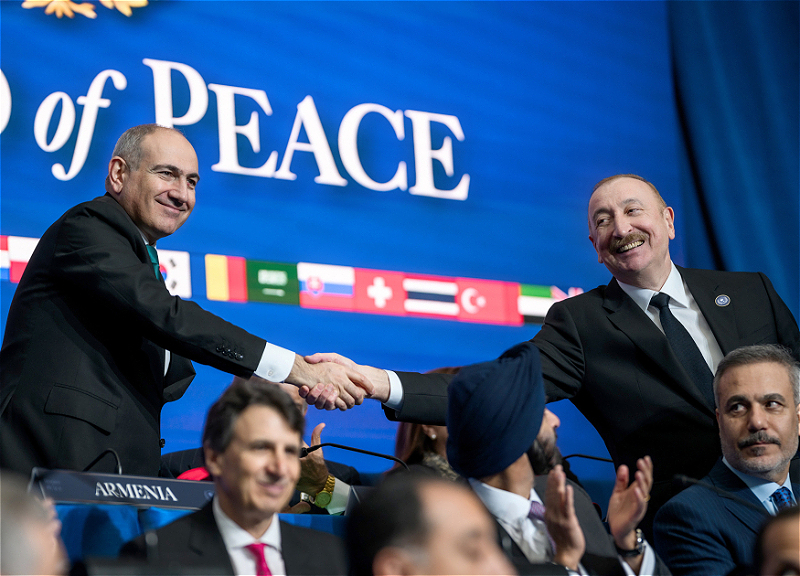
Of particular significance was the meeting of the leaders of Azerbaijan and Armenia at the 'Peace Council.' The handshake between Ilham Aliyev and Nikol Pashinyan, noted by President Trump, vividly illustrated Azerbaijan's and its leadership's contribution to strengthening global peace and security.
'Against the backdrop of the word PEACE written in large capital letters, the President of Azerbaijan and the Prime Minister of Armenia shake hands. What might seem like a coincidence actually carries deep symbolic meaning,' noted the significance of the gesture by Hikmet Hajiyev, Assistant to the President of Azerbaijan and Head of the Foreign Policy Department of the Presidential Administration, in a post on social media platform X.
'These two are two good but tough individuals,' said Donald Trump in his speech. 'We achieved peace between two very important countries, something I will never forget. So, they started a bit weakly, but finished very strongly. And you can be proud of yourselves. It was wonderful. Thank you.'
'I thank each of you for making peace possible and showing what true leadership can achieve. When you put aside weapons, death, and destruction and invest in your people and prosperity, it opens the path to great accomplishments. So, I thank both of you for your work. I think you have demonstrated excellent leadership,' said U.S. Vice President JD Vance in turn.
Mission of the 'Peace Council'
One of the key agenda items of the 'Peace Council' was the creation of a special financial fund for Gaza, as well as the implementation of recovery and humanitarian projects. The idea of establishing Stabilization Forces in Gaza was proposed by the U.S. President at the Sharm El Sheikh summit and was included in a 20-point plan for a comprehensive resolution of the crisis.
Azerbaijan does not intend to join the Stabilization Forces – President Ilham Aliyev stated this in a January interview with local television channels. '[...] The second factor we conveyed to our American partners was that my country is a victim of aggression, a country that suffered great losses in both the First Karabakh War – to a lesser extent, but still – and the Second Karabakh War. And every Azerbaijani citizen is valuable to us. We have no intention of risking the lives and health of Azerbaijanis for anyone,' the head of state declared.
This position is based on a responsible approach to foreign policy, the protection of regional priorities, and consideration of Azerbaijani public opinion. Azerbaijan is a country that recently emerged from war, so the issue of sending a military contingent to another conflict zone raises certain sensitivities in society. What is particularly important is that for President Ilham Aliyev, preserving the life and safety of every citizen of the country, our young servicemen who are the future of Azerbaijan, is of paramount importance. This approach underpins the balanced decisions of the Azerbaijani leader.
At the same time, Azerbaijan is ready to play an active role as an investor in humanitarian missions and investment projects in Gaza within the framework of the 'Peace Council.' The country possesses significant practical experience in post-conflict recovery and development. Large-scale projects implemented in Karabakh and East Zangezur are seen as examples of effective post-conflict territorial restoration. Azerbaijan is ready to share this important experience on international platforms.
Azerbaijan has already provided humanitarian aid to Palestine – both through UN institutions and on a bilateral basis. In the future, the country may consider investing in projects on commercial terms. However, at this stage, Azerbaijan's participation in the announced $7 billion framework is not envisaged.
This was also noted by Hikmet Hajiyev, Assistant to the President of Azerbaijan and Head of the Foreign Policy Department of the Presidential Administration. In his post on social media platform X, he emphasized that Azerbaijan, as a founding state, supports the goals and objectives of the Peace Council. According to him, in the future, Azerbaijan may consider participation in investment projects in Gaza within the framework of the Peace Council: 'However, we would like to clarify one issue. Azerbaijan's participation in the financial project for Gaza worth 7 billion USD, announced at today's Peace Council meeting, is not envisaged.'
***
Thus, the creation of the 'Peace Council' reflects the objective need to reorganize the architecture of international security. Amid the crisis of traditional institutions, a new platform is being formed, designed to provide a more flexible and effective mechanism for responding to conflicts.
Azerbaijan's participation as a founding state in the 'Peace Council' underscores the country's increased political weight, recognition of its international authority, and ability to propose practical models for conflict resolution.
Active diplomacy, successful experience in promoting a peace agenda, and a responsible stance on military involvement shape Azerbaijan's image as one of the significant actors in the process of establishing a new international security system.
In a broader geopolitical context, the launch of the 'Peace Council' indicates a gradual redistribution of centers of influence in global politics and a transition to more flexible formats of state coordination. In these conditions, states with practical experience in conflict resolution, post-conflict recovery, a sustainable internal development model, and the ability to pursue a strong independent foreign policy line gain additional strategic importance.
Thus, Azerbaijan's role in the 'Peace Council' extends beyond formal membership and becomes part of a larger process – the formation of a new configuration of global governance, in which Baku acts not as an observer but as an active participant and co-author of solutions.