Card-to-card problem: how 71% of Azerbaijan's e-commerce ended up beyond the reach of tax reporting
A number that should alarm every regulator
In 2024, card-to-card (C2C) transfers accounted for 71% of the total e-commerce volume in Azerbaijan.
This is neither a statistical anomaly nor a methodological error. It is a structural reality of the national payment system, documented in a joint diagnostic study by the Central Bank of the Republic of Azerbaijan (CBAR) and Mastercard Advisors, published in 2025 under the title "The Next Wave of Digitization in Azerbaijan."
The scale of the study leaves no room for doubt about the representativeness of its data. The diagnostic covered surveys of 810 small and medium-sized enterprises (SMEs) and 600 consumers across eight cities, over 18 stakeholder interviews—with teams from the Central Bank, other government agencies, banks, and fintech companies—as well as six focus groups and an analysis of transaction data across the entire payment system.
The study’s findings pose a fundamental question for the regulator, the banking sector, and tax authorities: how did a payment mechanism originally designed for person-to-person transfers become the dominant method of settlement in e-commerce within just three years—and what does this mean for the country’s fiscal system?
This article, based on data from the joint CBAR and Mastercard Advisors study of 2025, demonstrates how a card-to-card transfer mechanism, designed for everyday personal use, became the dominant channel for commercial payments in Azerbaijan within three years—approximately 16 billion manats per year outside the tax reporting system. The analysis reveals that the causes lie not in entrepreneurial bad faith, but in the structure of incentives: tax thresholds, POS acquiring fees, sparse banking infrastructure in the regions, and a blurred boundary between personal and commercial accounts among the majority of SMEs. The consequences extend far beyond fiscal losses—from the suppression of the fintech ecosystem to the regulator’s informational blindness. The study proposes a roadmap of 22 initiatives capable of doubling the level of payment digitization by 2027, but the key question remains open: will the institutional response keep pace with a market that has already built a parallel payment system?
II. Trajectory: from zero to dominance in three years
To appreciate the speed of transformation, one need only trace the trajectory.
Before 2021, the share of C2C transfers in e-commerce volume was close to zero. In 2022, it reached 59%. In 2023—69%. By 2024—71%. By transaction count, the picture is similar: 37% in 2022, 50% in 2023, and 54% in 2024. In three years, a parallel payment system grew from nothing to the status of a market standard.
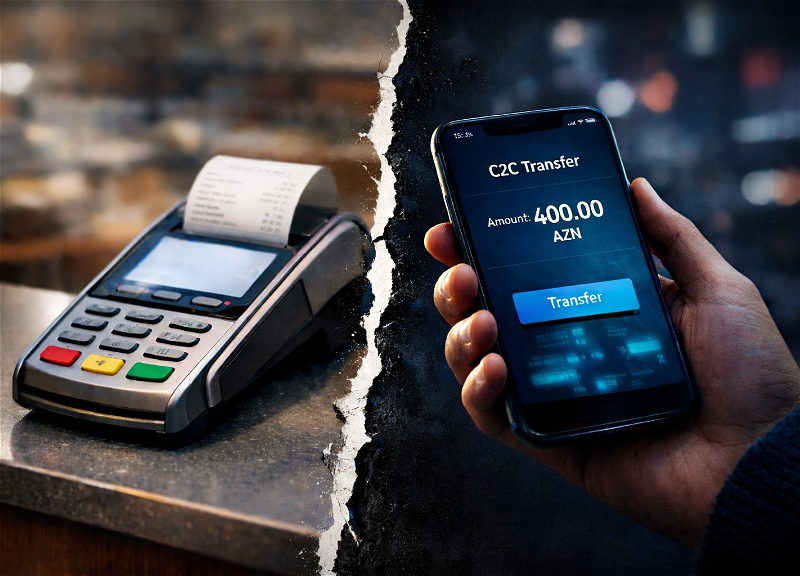
The mechanics of a C2C transfer are straightforward. The user enters the recipient’s card number, specifies the amount, and confirms the transaction. Funds arrive on the recipient’s card instantly. This functionality was created for everyday tasks—splitting a restaurant bill, sending money to a relative, paying for a small service between acquaintances. According to the study, 90% of consumers in Azerbaijan use their payment cards for C2C transfers.
However, what began as a personal peer-to-peer tool has undergone a qualitative transformation. Merchants began providing customers with their personal card numbers, asking them to transfer funds directly to their accounts instead of paying through a POS terminal. Consumers, already accustomed to this format, do not resist.
The result: a system designed for interpersonal transfers now functions de facto as the payment infrastructure of informal commerce.
A critically important fact: C2C transaction data is currently included within the e-commerce statistics published by CBAR and is not reported as a separate category. This means that headline figures about "e-commerce growth" in Azerbaijan include a significant share of transactions that do not actually pass through the commercial acquiring system. This statistical conflation distorts the real picture of digitization.
III. Anatomy of causes: how four factors created the perfect storm
It would be analytically incorrect to describe the mass use of C2C for commercial purposes as a spontaneous phenomenon that arose "on its own." The study’s data makes it possible to reconstruct the systemic logic in which the actions and inactions of various participants—from fiscal authorities to the entrepreneurs themselves—created conditions under which bypassing the formal payment infrastructure became not the exception, but the norm.
Factor one: the tax and fiscal architecture
The structure of tax incentives in Azerbaijan inadvertently encourages small entrepreneurs to move into the shadows. The threshold of 200,000 manats in annual turnover, which allows businesses to retain simplified taxpayer status, creates a powerful incentive for entrepreneurs to keep their "visible" turnover below this line. According to the study, 47% of SMEs cite tax implications as the primary factor in their reluctance to accept digital payments. Every transaction through a POS terminal is automatically documented and increases registered turnover. A C2C transfer to a personal card does not.
Added to this is the cumulative cost of "formality": a 1% simplified tax on cash withdrawals from commercial accounts.
The VAT refund program—one of the flagship instruments for incentivizing cashless payments—was unable to overcome this asymmetry: the incentive operates on the consumer side (a partial VAT refund), while the decision about payment method is made by the merchant. According to CBAR, by 2024 the number of users on the VAT refund portal exceeded 2.7 million, yet this did not prevent the C2C share from growing from 59% to 71%.
Factor two: the banking sector
Azerbaijan has 22 banks with significantly varying digitization capabilities. Of these, only four can provide fully digital onboarding for SMEs—in Türkiye, all banks have this capability.
In 2022, only 10% of new bank customers in Azerbaijan were acquired through digital channels, compared to 36% in Türkiye. 73% of new cards were sold through branches, with only 12% through digital channels.
The cost of banking services compounds the problem. 57% of consumers consider banking fees excessive (67% in the regions). The cost of basic banking services as a share of average salary stands at 0.6%—twice that of Türkiye (0.3%). Banks charge a commission of 0.5–1% for payroll services, whereas in Türkiye, payroll customers are offered free transfers, bonuses, and zero-fee credit cards. 69% of SMEs also consider the cost of business banking services too high.
In effect, the banking system has not created a product that could compete with a simple C2C transfer in terms of convenience, speed, and cost. For the merchant, C2C means instant crediting, zero fees, and no documentation. POS acquiring means fees, tax visibility, and additional costs when cashing out.
Factor three: infrastructure deficit
POS terminal density in Azerbaijan stands at 8.5 per 1,000 people. For comparison: Georgia has 23.9, Kazakhstan 51.6, and Türkiye 60.7. 56% of SMEs surveyed have never had a POS terminal, and only 30% currently have one. Of those who have a terminal, only about 48% use it actively.
The regional distribution of banking infrastructure is characterized by a deep imbalance. In Baku, there are 11.1 bank branches and 70.5 ATMs per 100,000 adults. In the regions—2.8 branches and 19.1 ATMs. 58% of employed individuals (61% in the regions) receive their income in cash, and 46% of them continue to store it as cash (53% in the regions). Where the formal payment acceptance infrastructure is thinnest, C2C becomes not an alternative but the only available digital channel.
Factor four: SME and consumer behavior
59% of SMEs in Azerbaijan use personal bank accounts for business purposes, despite the legal requirement to maintain a commercial account. In the regions, this figure reaches 64%. The boundary between personal and commercial financial space is de facto blurred for the majority of entrepreneurs. Under these conditions, a C2C transfer to a personal card is not a workaround but a continuation of the logic in which personal and business wallets are already indistinguishable.
41% of unbanked SMEs do not have a bank account due to insufficient financial literacy. 62% of Azerbaijani SMEs have never used a commercial card for business expenses. Consumer resistance is minimal: for the buyer, the functional difference between "transferring to a friend" and "paying for goods" has been erased—the interface is the same, the speed is the same, the habit has been formed.
The combined effect of these four factors creates what economic theory calls a "rational trap": each participant acts optimally from the standpoint of their short-term interests, but the collective result is suboptimal for the economy as a whole. The merchant saves on fees and taxes. The buyer gets convenience and speed. The bank sees transaction activity.
But the state loses its tax base, the regulator loses information, the fintech sector loses its market, and the payment system loses its integrity.
IV. Scale assessment: anatomy of the informal payment flow
One of the study’s key tasks was to distinguish between two types of transactions conducted through the same C2C mechanism (card-to-card transfer): genuine interpersonal transfers—when an individual sends funds to another individual for personal purposes—and payments of a commercial nature, when the same channel is used by a buyer to pay a merchant for goods and services.
The results of this analysis: a substantial share of C2C transfers in 2023 was linked to commercial activity—approximately 40% of approximately 40 billion manats in total C2C transaction volume. This amounts to roughly 16 billion manats passing outside the formal commercial reporting system. For context, this is comparable to a significant portion of the country’s total personal consumption expenditure (PCE).
Consumer survey data confirms this estimate from the other side—the demand side. 55% of consumers report that merchants insist on receiving payment via C2C transfer. Outside Baku, this figure rises to 66%. Additionally, 45% of consumers agree that they can pay for goods and services in more places using C2C than with POS terminals.
The picture is unambiguous: C2C transfers for commercial purposes are not a side effect or a behavioral anomaly of individual consumers. This is a systemic practice, predominantly initiated by merchants and accepted by consumers as the norm. The market has created a parallel payment infrastructure that operates outside the framework of formal tax reporting.
V. The fiscal dimension: what international experience already shows
The study refrains from direct estimates of tax losses for Azerbaijan’s budget. However, it cites results from international empirical research that allow an assessment of the relationship between payment methods and tax revenue.
In Türkiye, it has been established that a 1% increase in the share of card payments leads to a 1.6% increase in VAT revenue, while a 1% increase in cash withdrawals is accompanied by a 1.7% decline in VAT revenue. In Greece, a similar study showed that a 1% increase in the card share of personal consumption expenditure leads to a proportional 1% increase in VAT revenue.
These findings are unambiguous. The relationship between payment method and tax transparency is not theoretical but empirically confirmed. When a transaction passes through a POS terminal and is deposited into a merchant’s commercial account, it enters the tax reporting system. When the same transaction is made as a C2C transfer to a personal card, it is statistically indistinguishable from sending money to a relative.
The study’s authors state this directly: C2C transfers, originally intended as a money transfer instrument, are now being used to support the informal economy and obstruct government tax collection. This is not an indictment but a diagnostic observation supported by data.
To understand the scale, a simple extrapolation suffices. If 16 billion manats in commercial C2C transactions bypass the POS reporting system, and if the correlation between formal payments and VAT in Azerbaijan even approximately mirrors the Turkish and Greek models, then the fiscal consequences amount to hundreds of millions of manats in lost tax revenue annually.
A precise calculation requires a separate study—but the order of magnitude cannot be ignored.
VI. Side effects: fraud, fintech suppression, and informational blindness
Fiscal losses are the most obvious, but far from the only consequence of the mass use of C2C for commercial payments. The study identifies three additional vectors of negative economic impact.
Fraud and loss of trust
When making a C2C transfer, sensitive information—the recipient’s card number—is transmitted in the open. This creates vulnerability to fraudulent schemes: card data interception, phishing, unauthorized charges. The study’s authors emphasize: as fraud incidents increase, consumers become increasingly wary of digital payments overall, leading to a loss of trust in the payment system and a reverse flow back to the cash economy. A paradoxical vicious cycle emerges: an instrument that is formally digital, through its side effects, reinforces the return to cash.
Suppression of the fintech ecosystem
44% of consumers prefer C2C transfers for e-commerce purchases. This directly undermines the business model of payment facilitators (PFs)—companies that play a critical role in developing the e-commerce ecosystem. Globally, the number of PFs grew from 1,500 in 2021 to a projected 4,229 by 2025, and the PF share of the global acquiring market increased from 5% to 10%. In Azerbaijan, fintech companies operating in this space are in their early stages of development. The mass migration of transactions to the C2C channel deprives them of their economic base and undermines their competitiveness before they can achieve scale.
Information asymmetry
The third and perhaps most strategically significant consequence is the regulator’s informational blindness. C2C transactions are not categorized by purpose. The regulator cannot distinguish a parent’s transfer to a student child from daily inflows to the card of a merchant processing hundreds of orders. Without analytical disaggregation—which is technically possible, as Mastercard’s methodology demonstrates, but has not yet been implemented at a systemic level—CBAR lacks the ability to adequately assess the real volume of e-commerce, the level of digitization, and the scale of the informal economy.
VII. Geography of inequality: the capital and the regions
The C2C phenomenon is geographically uneven and significantly more pronounced outside the capital. While nationally 55% of consumers report that merchants require payment via C2C, in the regions this figure reaches 66%.
The causes of this imbalance are infrastructural, and they have been examined in detail above. The key conclusion is that the regional gap in banking network density and POS terminals makes C2C the only practically available digital channel for the majority of entrepreneurs and consumers outside Baku.
61% of employed residents in the regions receive their income in cash, and 53% of them continue to store it as cash. In conditions where formal payment infrastructure is sparse and cash remains the primary medium of exchange, the C2C transfer becomes the only available bridge between the digital and cash worlds. Where formal infrastructure is thinnest, the informal system is densest.
VIII. The illusion of digitization: 17 million cards and 18% real activity
The context of the C2C problem becomes even more alarming when overlaid on the overall picture of card activity.
By the end of 2023, approximately 17 million payment cards had been issued in Azerbaijan. This figure alone might create the impression of a mature market. However, the structural analysis of data presented in the study significantly corrects this impression.
Of Azerbaijan’s 7.9 million adult population (bankable population), only 59% hold payment cards. Of these 59 percentage points, 10 account for inactive cardholders, 31 for those who use cards exclusively for cash withdrawals and C2C transfers, and only 18 for those who actually use cards for purchases.
The transaction structure confirms this diagnosis: 44% of total card transaction volume consists of cash withdrawals, 31% of C2C transfers, and only 25% of POS transactions. Pension cards show particularly telling statistics: 96% of their transactions are cash withdrawals. For salary cards, this figure is 63%.
In this context, the 71% C2C share in e-commerce is not an isolated problem but part of a broader systemic picture. Payment cards in Azerbaijan are predominantly used not as an instrument for cashless purchases but as a means of accessing cash and a channel for informal transfers. The growing number of issued cards, often cited as an indicator of digitization progress, masks a significantly more modest reality of purchase usage.
IX. Questions that demand answers
The study’s authors—the Central Bank and Mastercard Advisors—did not stop at diagnosis. Based on an analysis of over 60 initiatives in more than 40 countries with comparable levels of digitization, they selected 22 initiatives most relevant to Azerbaijan and developed implementation roadmaps. The diagnostic work has been completed. The data has been collected and systematized. What remains open is the question of the speed and nature of the response.
The first question is statistical. Should commercial C2C transactions be separated into a distinct reporting category in CBAR’s statistics? As long as they are included in overall e-commerce statistics, published data on payment digitization in the country is systematically inflated. Separation will require analytical effort but will allow all market participants—from the regulator to investors—to work with a realistic picture.
The second question is one of identification. The study demonstrates that threshold-based methods (frequency and volume of inflows to a single card) can identify recipients who are de facto merchants with high accuracy. Can these thresholds be implemented at the banking system level—not as a punitive mechanism, but as a tool for informing merchants and facilitating their soft migration into the formal POS acquiring space?
The third question concerns incentives. International experience cited in the study offers concrete models. The Cashless Poland program subsidized POS fees for new merchants, resulting in a 77% increase in the number of POS terminals over four years. Egypt invested 1 billion Egyptian pounds in expanding its terminal network. In South Korea, entrepreneurs can deduct 0.5% of their total credit card sales volume from their VAT obligations (the rate was subsequently increased to 2%, with a cap of 5 million won). In Italy, SMEs with revenues up to €400,000 can claim a tax deduction of 30% of fees paid for accepting electronic payments. What combination of subsidies, deductions, and regulatory relief can shift the economic balance so that formal POS acquiring becomes more profitable for the entrepreneur than C2C?
The fourth question is institutional. Azerbaijan has 22 banks with significantly varying digitization capabilities. Only some of them can provide full digital onboarding for SMEs. In 2022, only 10% of new bank customers in Azerbaijan were acquired through digital channels, compared to 36% in Türkiye. Can the regulator establish minimum digital service standards for banks serving small businesses as a licensing condition?
The fifth question is one of enforcement. The Law on Banks of the Republic of Azerbaijan regulates the types of permitted activities for banks (Article 32) and establishes requirements for conducting commercial activity through bank accounts. 59% of SMEs use personal accounts for business. The gap between the norm and practice is obvious. The question is not about tightening sanctions but about creating conditions under which compliance with the law becomes economically more attractive than its violation.
X. Conclusion: the speed of the problem and the speed of the response
The data published in the joint study by the Central Bank of Azerbaijan and Mastercard Advisors describes a payment system in which the informal channel of commercial settlements grew from zero to absolute dominance in less than four years.
This speed itself contains a crucial signal: economic agents respond to incentives far faster than institutions can adapt the regulatory environment.
71% of e-commerce passing through C2C channels. Approximately 16 billion manats in estimated commercial transactions per year outside the formal reporting system. 55% of consumers to whom merchants offer only C2C. 18% of the adult population actually using cards for purchases. These figures are not a verdict—they are a diagnosis. And the value of this diagnosis is determined by how quickly and precisely it is answered.
The study proposes 22 concrete initiatives based on the experience of over 40 countries. Projections show that with systemic implementation of these measures, the level of consumer payment digitization could double by 2027—from 32% to 65%. The diagnosis is complete. The toolkit has been defined. The roadmaps have been developed.
The question comes down to one thing: will the speed of the institutional response match the speed at which the market created the problem?
Data source: "The Next Wave of Digitization in Azerbaijan," Central Bank of the Republic of Azerbaijan × Mastercard Advisors, 2025. The study is based on surveys of 810 SMEs and 600 consumers in 8 cities, 18+ stakeholder interviews, transaction data analysis, and benchmarking of 60+ initiatives in 40+ countries.
🌐 Read in other languages: