Peace or… Kocharyan? What Will Armenia Choose?
In Yerevan, there is a growing understanding that the sustainable development of the country is directly tied to the final normalization of relations with Baku.
Peace with Azerbaijan is becoming a key condition for economic security, integration into regional development, and, consequently, the long-term stability of Armenia. Good neighborly relations with Azerbaijan are increasingly seen as a fundamental prerequisite for the survival and modernization of the country.
Against this backdrop, internal political discourse in Armenia is becoming increasingly intense. As the peace agenda takes center stage in state strategy, accusations from the prime minister's team against the revanchist camp are growing louder, with the government alleging deliberate attempts to undermine the emerging architecture of stability.
In this context, a statement by Ruben Rubinyan, the vice-speaker of the Armenian parliament, accused the opposition, including former President Robert Kocharyan, of sabotaging the peace process.
Specifically, Rubinyan stated: "Members of Kocharyan’s team and two oligarchs never declare that they would sign a peace treaty if they come to power. They resort to all kinds of rhetoric: either Armenia needs additional guarantees, or additional guarantors must be found, or they will negotiate the text—anything but the simple words: if we come to power, we will sign a peace treaty!"
"Why? Because they have been tasked with destroying the architecture that, after so many years of deprivation and sacrifice, has finally given us a chance to breathe... An architecture that, for over two years, has ensured that no soldiers die from enemy fire on our borders. An architecture that will lift us out of blockade and allow the people of Armenia to prosper... the people, not them!" Armenian media quoted the vice-speaker as saying. According to Rubinyan, 2026 is a very important year, and "we must defend peace and not allow Kocharyan and the oligarchs to decide the fate of our country."
Behind such statements lies the recognition of the need to adapt to a new regional reality— the peace agenda is becoming a strategic guideline on which Armenia’s security and stability depend. In Yerevan, a strategic rethinking is underway: peace with Baku is no longer just a foreign policy goal but a central element of national security and Armenia’s economic future. After decades of confrontation, it is increasingly evident that normalization of relations with Azerbaijan can provide the country with an exit from blockade, investment attractiveness, and long-awaited stability.
As for the opposition, with parliamentary elections scheduled for June 7 approaching, their activity has noticeably intensified. For instance, today, according to Armenian media reports, Suren Surenyants, chairman of the political council of the "Democratic Alternative" party, stated that "the Armenian-Azerbaijani conflict cannot be considered resolved," sending a protest letter to the UN office in Armenia. Public reaction to the initiative is eloquently illustrated by a photo from the "action," showing only a couple of participants.
Or, for example, war criminal and terrorist Robert Kocharyan, aspiring to return to power, openly promotes revanchist and militaristic ideas. At his latest press conference, he attempted to discredit the peace agenda. For instance, he called the TRIPP project "the greatest threat to Armenia’s security" and labeled the supply of petroleum products from Azerbaijan as "propaganda fuel."
Kocharyan’s rhetoric deliberately undermines the real peace strategy and is effectively aimed at returning the country to a hopeless past of conflict and economic isolation.
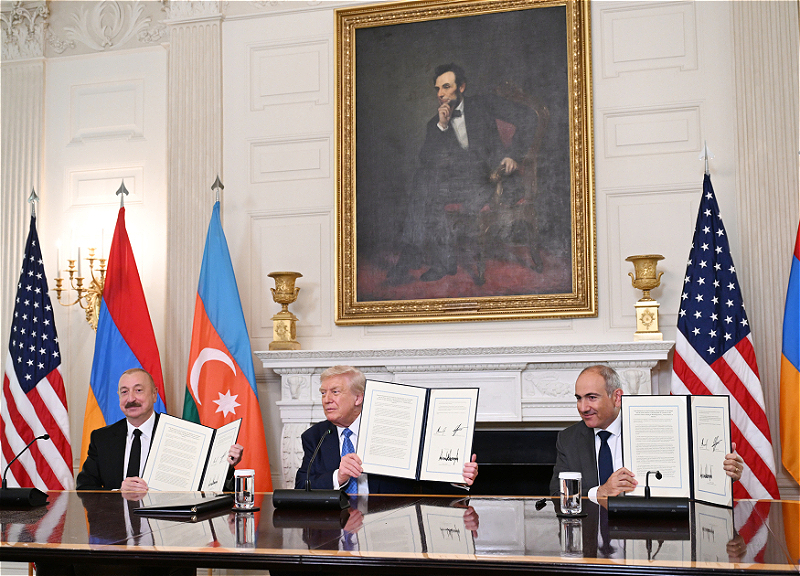
Such revanchist attempts at sabotage are unfolding against the backdrop of tangible progress in the peace process: from the Washington Summit to the leaders’ meeting in Abu Dhabi, negotiations have advanced to the point where bilateral trade between the countries has already begun.
President Ilham Aliyev, in a recent interview with France 24, emphasized that Azerbaijan and Armenia have entered a period of peace: "There are no more shootings, no casualties, no wounded. Azerbaijan has unilaterally lifted restrictions on the transit of goods to Armenia. We have also started supplying critically important petroleum products to Armenia, which effectively marks the beginning of our trade relations. So, we see that peace has already been achieved."
Today, Armenia receives vital goods via the most convenient and economically efficient route: grain through direct transit across Azerbaijani territory, and petroleum products directly from Azerbaijan. In other words, Baku’s gestures have a direct and measurable impact on Armenia’s economic stability, providing access to critical resources and creating conditions for strengthening economic resilience.
It is also worth noting recent political steps by Baku—the transfer of a group of Armenian prisoners to Armenia as another indicator of its commitment to humanitarian principles and a practical result of the peace agenda, as well as the return of Armenians remaining in the Karabakh region.
Against this background, provocations aimed against peace cannot but cause bewilderment.
Overall, everything happening in Armenia today—both the authorities’ statements about ending the era of confrontation and prioritizing a peaceful and prosperous future for the two peoples, as well as the activation of revanchists—only confirms the need for fundamental changes to the country’s constitution. This must definitively rule out any possibility of repeating territorial claims against Azerbaijan.
The President of Azerbaijan has clearly outlined Baku’s position—without changes to the constitution, the signing of a peace agreement will not take place. "I would separate the normalization of relations from an official peace agreement because normalization is already happening. As I said, all these positive developments point to this," the head of state said in an interview with France 24.
"But the Armenian constitution, which was adopted long ago during the occupation of Karabakh, contains a reference to the Declaration of Independence of Armenia, which includes a clause stating that the so-called ‘Nagorno-Karabakh’ and Armenia should unite. This is a territorial claim against Azerbaijan. Our position, for many years since the end of the Second Karabakh War, has been absolutely clear. This must be changed. And, as far as I know, Armenia plans to hold a referendum. Once this is done, there will be no obstacles to the official signing of a peace agreement. But I would like to emphasize once again that, for Azerbaijan, peace has already been achieved. The normalization process is progressing successfully. And I hope that once these legal formalities are completed, we will achieve official peace," stated President Ilham Aliyev.
As can be seen, peace with Azerbaijan is effectively becoming a dividing line in Armenian politics: either a return to the logic of confrontation, backed by figures of the former regime, or a course toward final normalization and economic unblocking.
As the elections approach, this line of division only deepens, turning the issue of peace into the central theme of the upcoming political campaign and the main test of the country’s strategic choice. The decision lies with the Armenian people.