Khojaly Tragedy: Events, International Testimonies, and Informational Breakthrough
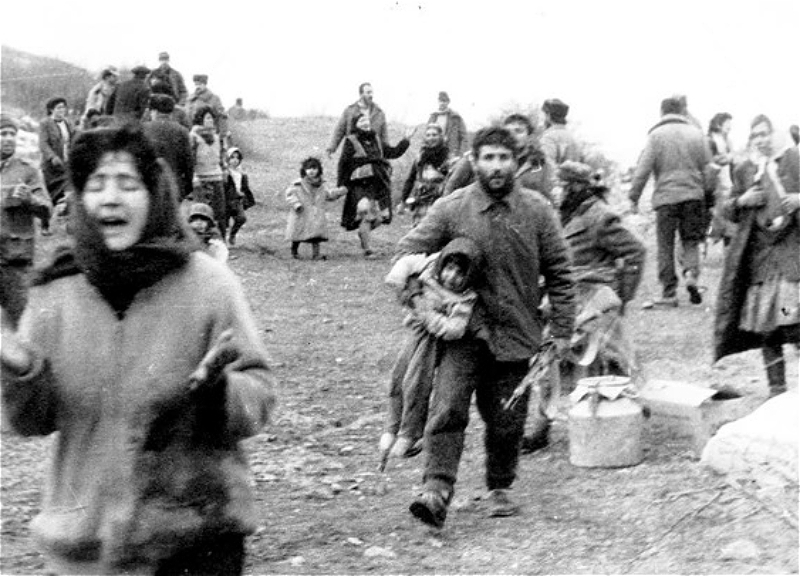
In the night of February 25-26, 1992, during the occupation of Karabakh, events unfolded that have gone down in history as the Khojaly Tragedy. The city of Khojaly became the target of a large-scale military operation aimed at the demonstrative destruction of a significant number of civilians.
Today, this tragedy is classified as an act of genocide and remains one of the most tragic pages in national history.
Military-Political Context
By the beginning of 1992, Khojaly was under a de facto blockade. The city held strategic importance: it housed the only airport in the region. The situation around the settlement sharply deteriorated in February 1992. It was subjected to systematic artillery shelling, while armed formations were concentrated in the areas of Askeran and Khankendi.
Considerable attention in numerous publications is given to the role of the 366th Guards Motorized Rifle Regiment of the former Soviet Army, stationed in Khankendi.
From a classified report by Colonel V. Savelyev:
“Colonel Zarvigarov (regiment commander – N.A.) and other officials, with official permission from the army and district command ‘to eliminate combat points from where the regiment is being fired upon,’ joined forces with Armenians in operations conducted towards Khojaly. As a result, within one day, 49 Azerbaijanis were shot in the squares… Based on the order of the chief of staff, Lieutenant Colonel Sergey Kraulenin, the commander of the 1st Motorized Rifle Battalion, Colonel Arkady Moiseev, the commander of the 2nd Battalion, Seyran Ohanyan, the commander of the 3rd Battalion, Gavriil Nabokikh, Captain Iskhak Likhodey… paid more attention to Armenians during the evacuation of civilians. During the withdrawal of the population from the combat zone, 58 Azerbaijanis were killed… And no one even intended to bury the killed Azerbaijanis properly. They simply dug a half-meter-deep pit, threw all the bodies in, and buried them. According to the colonel, in the evenings, it became unsettling to hear the howling of dogs and jackals around these pits. The smell of blood was everywhere (see: Izvestia, 1992, February 28; Pravda, 1992, April 19).
Part of the personnel and armored vehicles of the regiment, which was stationed in Khankendi (then Stepanakert) and included many Armenians among its ranks, participated in the operation to capture the city of Khojaly. Armenian servicemen of the regiment were actively involved in transferring the regiment’s weapons to Armenian terrorist groups.
From an interview with the newspaper Izvestia (March 9, 1992):
“General-Colonel Yevgeny Podkolozin stated that… the commander of the 2nd Battalion, Major Seyran Ohanyan, stole 17 BMPs, 4 ZSU ‘Shilka’ units, and several light tracked armored tractors.”
On the night of February 25-26, the assault and capture of the city were carried out.
Materials from Human Rights Watch (Helsinki Watch)
One of the first international sources to document the tragedy was the human rights organization Human Rights Watch (at that time, Helsinki Watch). In its 1992 report on the conflict in Nagorno-Karabakh, the organization recorded the deaths of a large number of civilians during the capture of Khojaly.
The report noted that the Armenian forces’ offensive was accompanied by “indiscriminate shooting” at retreating civilians. Human Rights Watch highlighted that most of the victims were killed while attempting to flee the city. The organization classified the incident as a serious violation of international humanitarian law and emphasized the responsibility of the attacking side for failing to adhere to the principles of civilian protection.
The document stressed that Armenian armed formations and the forces supporting them bear direct responsibility for the deaths of civilians. It separately noted that the circumstances surrounding the deaths of civilians require international investigation and legal assessment.
From the report of the international human rights organization Human Rights Watch (formerly Helsinki Watch): “Namig Aliyev, head of the Department for Legality, Law Enforcement, and Defense (correct name – Department for Law Enforcement and Defense – N.A.) of the Azerbaijani Parliament and a member of the parliamentary group investigating the events in Khojaly, told Helsinki Watch in April that 213 Khojaly victims were buried in Agdam. Some of the deceased, brought to a temporary hospital in Agdam, were identified as military personnel. Many of the killed men, who had no documents, were not identified as either military or civilian.
Aliyev also reported that 33 of the bodies received for examination had been scalped, had missing body parts, or were otherwise mutilated” (Bloodshed in the Caucasus: Escalation of Armed Conflict in Nagorno-Karabakh. Human Rights Watch / Helsinki (formerly Helsinki Watch) Report, September 1992, pp. 19-24; See also: Thomas de Waal. Black Garden. Armenia and Azerbaijan Between Peace and War. Translated from English by O. Alyakrinsky. – Moscow: Tekst, 2005, p. 404).
Thus, the Human Rights Watch report became one of the first international testimonies confirming the scale of the tragedy and the fact of mass civilian deaths.
Subsequently, these data were refined by the ‘Khojaly’ Parliamentary Investigative Commission and the investigative team of the Azerbaijani Prosecutor’s Office. According to their data, 631 people were killed, including 63 children, 106 women, and 70 elderly individuals. Eight families were completely wiped out. 487 people became disabled, including 76 children. 1,275 people were taken hostage, and 150 people went missing.
International Journalism and Research Assessments
Despite Armenian interpretations of the events, international human rights structures have documented the fact of mass casualties among Azerbaijani civilians.
Even the British journalist and conflict researcher Thomas de Waal, known for his pro-Armenian stance, in his book “Black Garden,” called the events in Khojaly the bloodiest episode of the first Karabakh war. He noted that the tragedy became a turning point in the escalation of the conflict.
According to the Russian human rights center Memorial, there were documented cases of scalping living people. Investigative materials indicate that under the command of Armenian Major Seyran Ohanyan (who later became the “Minister of Defense” of the illegal regime in Nagorno-Karabakh and then Minister of Defense of the Republic of Armenia) and the commander of the 3rd Battalion of the 366th Motorized Rifle Regiment, Yevgeny Nabokikh, who led the capture of the city, more than 50 officers and warrant officers of Armenian nationality participated in the genocide.
Armenian historian and diplomat Jirair Libaridian, who during the bloody massacre in Khojaly served as the chief advisor to the first President of Armenia, Levon Ter-Petrosyan, noted in his article that “it is very difficult for an Armenian to write about Khojaly” because “something unacceptable was committed, something that led to mutilations and killings of Azerbaijani civilians by Armenian forces in Karabakh.”
Source: Jirair Libaridian, “An Armenian perspective on Khojali”, 19 February 2014
“After the events, journalists from various parts of the world arrived in Khojaly. Here are some reports given after arriving at the site of the tragedy: Jean-Yves Junet, journalist, France: ‘We witnessed the Khojaly Tragedy, saw the bodies of hundreds of killed civilians – women, children, elderly, and defenders of the city. It is a horrific scene. Armenians surpassed the fascists, killing 5-6-year-old children, civilians’; according to Rory Patricks, a journalist from England, she saw dozens of mutilated civilian bodies, not defenders of the city. They saw children, women, and elderly shot at point-blank range’; V. Belykh, correspondent: ‘From time to time, they bring bodies of the deceased with gouged-out eyes, cut-off ears, scalped heads, severed heads… There is no limit to the atrocities’; The Times (London): ‘Many were mutilated, and from one girl, only the head remained’; Izvestia (Moscow): ‘The video camera showed children with cut-off ears. One old woman had half her face cut off. Men were scalped’; Le Monde (Paris): ‘Among the killed in Khojaly, women and children, three were scalped, with pulled-out nails’; Leonid Kravets: ‘I saw about 200 killed on the slope. A militia captain found his 4-year-old son among the bodies with a crushed skull and lost his mind. One child had a severed head. I saw mutilated bodies of women, children, and elderly everywhere…’; according to a doctor from a sanitary train: ‘…a 3-year-old child with a bandaged stump instead of a leg shot off by a large-caliber machine gun… A girl with a face cut off by a knife… Most of the people had frostbite, facing amputation.’”
Source: Chaladze, T. Khojaly. How It Was… [Electronic Resource]. - https://1news.az/news/20150226094515271-KHodzhaly-Kak-eto-bylo
From the book by Namik Aliyev “Karabakh War. Book One (Analytical Chronicle of Events, September 1991 – December 1992)” (Baku: Elm və təhsil, 2023, pp. 111-112): “Analysis of information shows that Armenian occupation forces continue to pursue a scorched-earth policy to leave no Azerbaijani settlements in Karabakh and along the entire perimeter of the border with Azerbaijan. They are amassing forces and resources to deliver decisive strikes in various locations along the state border with Azerbaijan, creating new hotspots of tension. The goal is singular – to strip the border area and create a buffer zone around the Republic of Armenia and the annexed Karabakh (the Israeli variant). This explains the convening of a closed session of the Armenian Parliament on February 25 at the initiative of Levon Ter-Petrosyan, who outlined his program on Karabakh.
The Armenian side primarily destroys Azerbaijani settlements that, by the will of history, found themselves surrounded by Armenian villages. The villages of Karki (Nakhchivan AR), Yukhary Veysaly (Fizuli district) have been captured. The villages of Yukhary Askipara, Barkhudarly, and Sofulu (Gazakh district), Agdaban (Kelbajar district) are under attack. The settlement of Bashkend (Artsvashen) in the Krasnoselsky district of the Republic of Armenia, located within the territory of the Gadabay district, has been turned into a fortified area with developed infrastructure.”
“February 28, 1992. Agdam. At 20:30, Agdam was subjected to rocket fire from the Armenian village of Khanabad in the Khojaly district. About 20 rockets of the ‘Kristal,’ ‘Alazan,’ and ‘Nurs’ types hit the city, killing 2 residents and injuring 2 others. Over 5 buildings, including residential houses, the district police department, and shops, were completely or partially destroyed.
March 11, 1992, 20:00, Radio Liberty: ‘…Military actions have extended beyond Karabakh (the upper part – N.A.), as Armenians are shelling Agdam…’ (see: ibid., p. 115).
Informational Breakthrough: Latvian Edition of ‘Baltic Time’
A special place in disseminating information about the Khojaly Tragedy was taken by a 16-page special issue of the newspaper of the Latvian Popular Front, ‘Baltic Time,’ published in November 1992. Symbolically, the front page bore the slogan: ‘God is not in strength, but in truth.’
This issue became an example of overcoming the informational blockade. It published: a detailed chronicle of events in Karabakh; materials and photographs from Khojaly; an article on the role of the 366th Guards Motorized Rifle Regiment; publications about the nationalist party ‘Dashnaktsutyun’; materials on the terrorist activities of the organization ASALA; excerpts from Yuri Pompeev’s work ‘Bloody Whirlpool of Karabakh’; appeals from the public regarding the aggression of the Republic of Armenia.
Dozens of copies of the issue were sent by subscription to Germany and the USA. Thus, information about the events in Khojaly gained additional dissemination in Europe and across the ocean.
The editorial team expressed gratitude to the Azerbaijani society ‘Sodruzhestvo’ and its chairman Viktor Zotov, the Latvia-Azerbaijan Cultural Association and its president Faig Safarov, as well as other representatives of the Azerbaijani diaspora. The editor of the issue was the honored journalist of Azerbaijan, Tatyana Chaladze.
On November 5, 1992, information about the special issue appeared in the newspaper ‘Zerkalo.’ On November 7, Tatyana Chaladze arrived on flight No. 8167 Riga-Baku with copies of the newspaper and headed to the combat zone. On November 11, the newspaper ‘Azerbaijan’ in issue No. 35 (478) published the materials of the issue translated into Azerbaijani. The newspaper ‘Latvijas Laiks’ also published an extensive report with photographs from the conflict zone.
This work became an example of the professional courage of a journalist striving to convey information about the events to the global community. I was fortunate, in my professional capacity at the time, to assist Tatyana Chaladze in her truly selfless work to bring the truth about Karabakh to the attention of the world community.
Question of Responsibility
Azerbaijan has insisted for decades on an international legal assessment of the events as an act of genocide and on holding accountable those involved in the operation. Thanks to the successful ‘Justice for Khojaly’ campaign, dozens of countries have recognized these events as genocide.
However, in public and political discourse, among those considered to bear political or command responsibility, names such as Levon Ter-Petrosyan, Robert Kocharyan, Serzh Sargsyan, Seyran Ohanyan, Vitaly Balasanyan, and many other criminals are constantly mentioned. A vast amount of evidence and testimonies of their guilt has been collected. They themselves have testified to their crimes.
Official Baku consistently emphasizes the need for an international investigation into the crimes committed by Armenian nationalism. However, while some politicians in the world are guided by double standards, and international law is in deep crisis, Azerbaijan itself has convicted the first group of war criminals, issuing fair sentences in accordance with Azerbaijani legislation, which incorporates norms of international law on war crimes.
Memory and Historical Significance
Every year on February 26, Azerbaijan holds mourning events, international conferences, and informational campaigns. Khojaly has become a symbol of national grief and the struggle for the restoration of territorial integrity.
After the restoration of territorial integrity and sovereignty of Azerbaijan over previously occupied territories, the memory of the victims is perceived as part of overall historical justice. Many acknowledge the contributions of journalists, public figures, and representatives of the diaspora who, in the early 1990s, helped spread the truth about the events.
The Khojaly Tragedy remains one of the key episodes of the Karabakh conflict, requiring comprehensive, documentary, and legal study. Materials from Human Rights Watch, publications in foreign press, and archival testimonies continue to play a crucial role in shaping international understanding of these events.
Prof. Dr. Namik Aliyev,
Member of the Parliamentary Commission of the Supreme Council of the Azerbaijani Republic for the Investigation of Crimes Committed in Nagorno-Karabakh, including in the city of Khojaly (in 1992)