From Lobbying to Street Hysteria: A Cheap Show and a Loud Failure
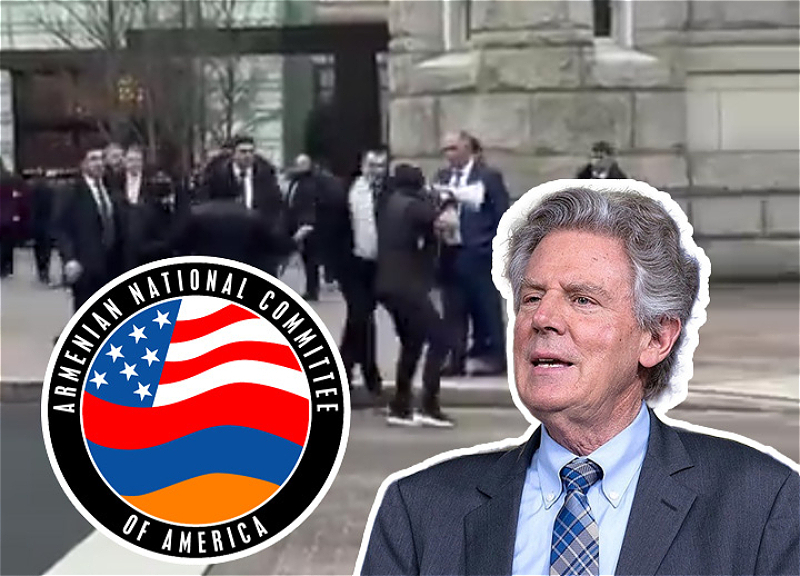
In the U.S. capital, Washington, D.C., an incident occurred during the participation of Azerbaijani leadership in the first meeting of the Peace Council, vividly demonstrating that anti-Azerbaijani forces, having suffered a strategic defeat in the region, are increasingly resorting to primitive, aggressive, and openly marginal methods of pressure outside the South Caucasus.
A group of radically inclined individuals attempted to stage a provocation, accompanied by unethical language, insults, and efforts to breach a secured area. However, thanks to the coordinated actions of the Security Service of the President of Azerbaijan and the Washington police, the situation was swiftly brought under control. No serious violations were recorded—and this became the main disappointment for the organizers of the incident, who had hoped for escalation and media attention.
Video recordings, which quickly spread across social media, became irrefutable evidence of the true nature of the event. Profanity, aggressive outbursts, and attempts at physical intimidation have nothing to do with democracy or freedom of expression. What we see is the recognizable hallmark of radical anti-Azerbaijani groups that have lost the ability to speak the language of facts, arguments, and international law.
It is telling that the first wave of support for these actions came from Armenian chauvinistic circles in the U.S., primarily from structures long known for their systematic and aggressive bias. Specifically, this refers to ANCA—an organization that has acted for decades as an informal coordinator of anti-Azerbaijani campaigns in the American political arena. Such centers consistently distort concepts, presenting provocations and pressure as 'civic activism' and street aggression as a 'fight for values.'
In reality, we are witnessing activities aimed at undermining interstate dialogue, discrediting Azerbaijan, and exerting pressure on Baku’s sovereign decisions. These structures deliberately work to maintain hotbeds of tension and encourage revanchist sentiments, ignoring the new realities of the region.
Immediately following ANCA, one of the most notorious representatives of the Armenian lobby in the U.S. Congress, Frank Pallone, issued his usual statements. His activities have long gone beyond ordinary political bias and taken on an openly hostile stance toward Azerbaijan. For years, Pallone has acted as a mouthpiece for Armenian nationalism, consistently ignoring international law, UN resolutions, and the real outcomes of the conflict.
The particular cynicism of his position is evident in his attempts to politically rehabilitate the former occupation of Azerbaijani territories, deny the Khojaly tragedy, and promote discriminatory initiatives against Azerbaijan, including the infamous Section 907 amendment. Under the guise of rhetoric about 'human rights,' Pallone has effectively justified ethnic cleansing, supported separatism, and encouraged continued confrontation.
His visit to Baku for COP29 deserves special mention, which Pallone seemingly viewed as an opportunity to stage a cheap political show and impose pre-prepared accusatory clichés on Azerbaijan. However, reality proved to be a cold shower for him: instead of a platform for moralizing, he faced facts, a well-reasoned position, and tough but correct diplomacy. The outcome was telling—the congressman was forced to leave the country without political dividends, unable to impose his script and suffering a reputational fiasco.
Pallone has not reconsidered his stance even after the final collapse of Armenia’s Karabakh venture; on the contrary, he has intensified his aggressive campaign, attempting to portray Azerbaijan’s legitimate actions as 'persecutions' and 'threats.' Such a position is not a defense of values or a fight for human rights but blatant political sabotage aimed at undermining Azerbaijan’s sovereignty and encouraging Armenian revanchist illusions.
At the same time, Pallone is not autonomous in this setup. He is merely a public face and political tool of a broader system of external pressure. Behind his demarches and hysterical rhetoric, one can clearly see the orchestrators—radical pro-Armenian lobbying centers that shape the agenda, assign roles, and select performers among both politicians and so-called 'activists.' In this logic, Pallone serves as a loudspeaker.
As for anti-national elements, they represent the grassroots level of the same scheme. Their task is to create the illusion of 'spontaneous protest,' amplify informational noise, and shape an image of supposed internal discontent, behind which external interests actually stand. This is one chain, one control center, and one goal—pressure on Azerbaijan using hybrid methods, where street provocation complements office lobbying.
The choice of date and location for the provocation was also not accidental. The attempt to destabilize the situation on the day of a major international event was a challenge to the host side. In fact, radical groups grossly violated security rules in the U.S., endangering public order and the reputation of the American capital itself. It is no coincidence that their actions were immediately suppressed—U.S. state structures clearly demonstrated that they have no intention of indulging destructive antics.
The true reason for such hysteria is obvious. After the restoration of Azerbaijan’s territorial integrity and the dismantling of separatist structures in Karabakh, Baku’s opponents are left with neither political nor legal arguments. All they have left are shouts, provocations, and attempts to shift the conflict into the informational and street sphere outside the region.
However, disappointment awaits them here as well. Azerbaijan today is a confident actor in international politics, operating within the framework of international law and enjoying growing understanding and support. Attempts to tarnish this reality through marginal actions only highlight the weakness and political helplessness of their organizers.
The incident in Washington served as yet another reminder: anti-Azerbaijani forces and their patrons continue to bet on destruction. But this strategy is doomed. The world is changing, the region is entering a new phase, and loud provocations increasingly remain merely a backdrop to Baku’s confident and consistent course.