Heads of religious communities in Azerbaijan criticize U.S. commission report
Representatives of religious communities in Azerbaijan express concern and deep regret over the unfounded claims regarding the religious situation in Azerbaijan in 2025, as contained in the "Annual Report for 2026" by the U.S. Commission on International Religious Freedom (USCIRF).
"Taking into account the existing realities, we strongly reject the assessments presented in this report," states the declaration by the heads of religious denominations in Azerbaijan.
The statement emphasizes that the unfounded claims against Azerbaijan in the report, such as alleged violations of religious freedom and pressure on religious communities, reflect a biased lobbying position of certain groups.
"These claims do not correspond to reality; on the contrary, they ignore the significant efforts of our country to promote religious tolerance both within the state and at a global level. Such an approach by USCIRF is particularly disappointing against the backdrop of strengthening bilateral relations in various spheres following the return to power of President Donald Trump and the advancement of the peace agenda between Azerbaijan and Armenia thanks to his historic role in Washington on August 8 of last year.
This also raises concern during a period when our country— in recognition of Azerbaijan’s role in promoting peace and stability at regional and international levels and as evidence of its commitment to interreligious dialogue on a global scale—was invited to the Peace Council, established under the leadership of the U.S. President, and subsequently joined this Council as a founding state," the document states.
The authors of the statement point out that Azerbaijan, with its centuries-old traditions of diversity and multiculturalism, has always been committed to promoting dialogue, mutual understanding, and trust between different cultures and religions. They recall that the Constitution of Azerbaijan explicitly prohibits discrimination and guarantees equality of rights and freedoms for every individual regardless of their religion and beliefs: "In addition to these legal guarantees, Azerbaijan creates conditions for all citizens to preserve and further develop their religious, ethnic, and cultural identities. This occurs against the backdrop of growing risks and security challenges in the context of the misuse of religion or beliefs. The President of the country and relevant national structures regularly meet with representatives of religious communities, prioritizing their needs and aspirations."
The document highlights that Azerbaijan is one of the countries where mosques, churches, and synagogues operate side by side.
"Our communities live in such a favorable environment in their daily lives, performing their religious rituals without any interference from the government or society," the heads of the communities note.
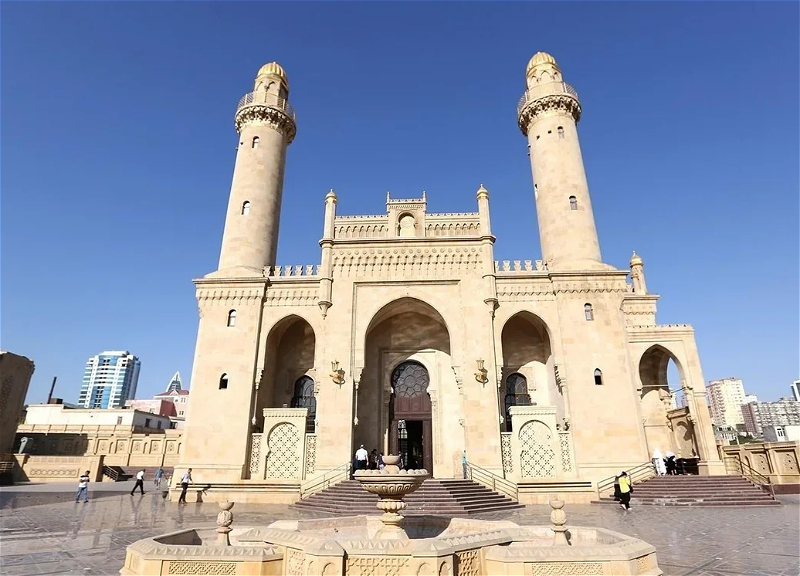
They point out that special attention in the country is given to the construction, protection, and restoration of religious sites and places of worship, and this activity covers not only mosques but also places of worship of other religions, such as the reconstruction and protection of the Catholic Church of St. Mary in Baku, the ongoing construction of a second Catholic church in honor of St. John Paul II, the restoration of the Orthodox Cathedral, the reconstruction of a Zoroastrian temple, and the restoration of a temple in Kish.
"It is a fact that the largest synagogue in the region is located in Azerbaijan. As a manifestation of our society’s respect for religious pluralism and inclusivity, in 2025, the first meetinghouse of The Church of Jesus Christ of Latter-day Saints was opened in Azerbaijan. Unfortunately, these efforts by the Azerbaijani government are not reflected in the report," the authors of the statement note.
In this regard, they express particular regret over the misrepresentation in the USCIRF report of the efforts to repair and restore all historical and cultural monuments without exception in the liberated regions of Karabakh and East Zangezur. The mentioned restoration projects are carried out with the participation of experienced specialists and architects, with an emphasis on preserving the characteristics of all cultural and religious heritage, the statement stresses.
The authors note that Azerbaijan’s unique approach to promoting interreligious dialogue within the country is also consistently encouraged through significant global initiatives and has earned widespread recognition from the international community. They recalled that Azerbaijan’s long-standing tradition of religious pluralism and tolerance is regularly praised by prominent international religious leaders: Pope John Paul II, Pope Francis, and other representatives. "Pope Francis highly praised Azerbaijan as a multi-confessional model for a world divided by violent extremism. The fact that his visit to Baku in 2016 took place precisely during the 'Year of Multiculturalism' in Azerbaijan is another indicator of the Pope’s high appreciation of tolerance and inclusivity in our country. He called our country an example for the world, emphasizing the significance of Azerbaijan as a place where different denominations peacefully coexist," the statement indicates.
Additionally, the Grand Imam of Al-Azhar Al-Sharif and Chairman of the Muslim Council of Elders, Ahmed Al-Tayeb, has repeatedly welcomed Azerbaijan as an example of interreligious harmony and intra-Islamic unity, the document recalls.
"Azerbaijan’s efforts to protect and restore religious sites extend beyond its borders. The support and participation of the Heydar Aliyev Foundation in the restoration of cultural and Christian heritage in the Vatican, including the facades of the Papal Basilica of St. Paul Outside the Walls, were gratefully received by the Holy See.
Azerbaijan is the initiator and host of the World Forum on Intercultural Dialogue, established in 2008 under the 'Baku Process,' which promotes dialogue and social inclusivity as the foundations of sustainable peace and development. This Forum has been repeatedly noted in the reports of the UN Secretary-General as a key global platform for promoting intercultural dialogue, which is consistently confirmed in a number of UN General Assembly resolutions.
In 2024, Azerbaijan once again solidified its role as a leader in multiculturalism by hosting, within the framework of COP29 (UN Climate Change Conference) in Baku, the Global Summit of Religious Leaders with the participation of 300 religious leaders and representatives from 55 countries and 30 international organizations," the statement emphasizes.
Taking into account all the aforementioned examples, the heads of religious communities expect that USCIRF will reconsider its approach to Azerbaijan, objectively reflecting the situation in this country based on existing facts and realities, and will evaluate the republic’s contribution to tolerance and efforts to protect interreligious and interdenominational dialogue.
"We hope that the necessary measures will be taken to address the injustice shown towards Azerbaijan by including it in the 'Special Watch List' in an entirely unfounded and unsubstantiated manner," the statement concludes.