Armenian 'Justice': 'Peace' on Paper, Revanchism in Mind? Analyzing the Court Ruling Against the Last Separatist Leader
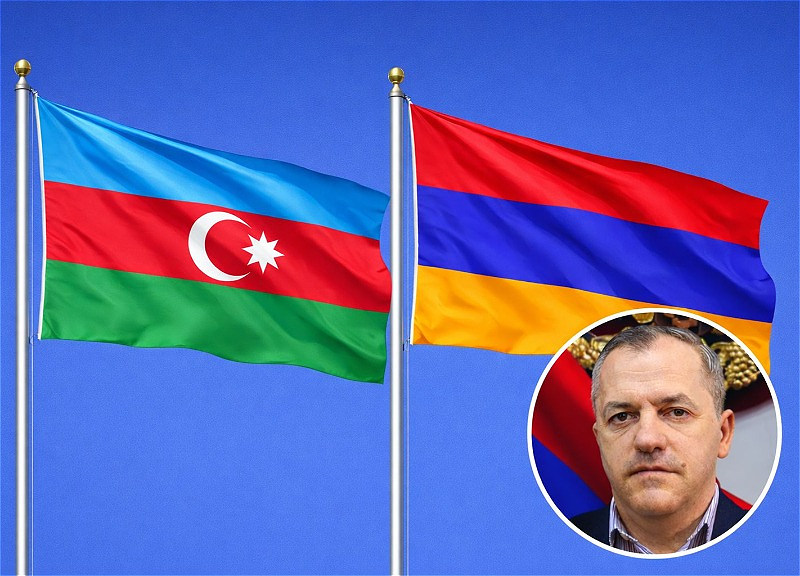
On the backdrop of the progressing normalization of relations between Baku and Yerevan, Armenian revanchists are undertaking new provocations aimed at derailing the peace agenda.
The focus is perhaps on the most 'gray' and faceless leader of the former separatist regime—Samvel Shahramanyan, who, seemingly fully aware of and trying to compensate for his mediocrity, strives to prove that he 'also exists.'
Donning the well-worn mask of a 'long-suffering leader in exile,' this 'someone' decided to remind the world of himself by filing a civil lawsuit 'for the protection of honor and dignity and refutation of facts' against the Ministry of Science and Education of Armenia—for reflecting in a history textbook his own decision to dissolve the puppet regime. The lawsuit was filed back in September, and it is necessary to revisit it now in light of a court ruling that, in terms of absurdity and provocation, is in no way inferior to the complaint itself but rather logically concludes it.
The court denied the lawsuit, yet it did not refrain from an absurd passage in the reasoning of its ruling, stating that Shahramanyan’s decision to dissolve the self-proclaimed entity 'was made under the use of force or direct threat thereof,' and therefore, allegedly, 'has no legal force.'
Notably, such reasoning had no direct relevance to the subject of the proceedings. Shahramanyan’s lawsuit did not—and could not—concern the legal assessment of the dissolution of the occupation regime, and the court should have limited itself strictly to the scope of the claims presented.
This raises a legitimate question: on what grounds did the Armenian court deem itself entitled to interfere in the internal affairs of Azerbaijan by making decisions against its sovereignty and territorial integrity? Such 'justice' appears nothing less than an attempt to legitimize former separatist structures and justify the revanchist fantasies of former Armenian rulers, who, by the way, have noticeably intensified their activities as the parliamentary elections scheduled for June 7 approach.
All these attempts against peace are occurring at a time when the peace process is gaining new momentum in the spirit of the Washington Summit and the recent meeting of leaders in Abu Dhabi. Today, this process has advanced to the point of initiating bilateral trade.
It is important to emphasize that the initiative to give practical substance to the peace agenda comes precisely from Azerbaijan—specific gestures from Baku, demonstrating its goodwill and commitment to peace, are not merely declarative but pragmatic and actionable. It is the decisions of the President of Azerbaijan that have a direct and measurable impact on Armenia’s economic stability, providing access to critically important resources and creating conditions for strengthening its economic resilience. As a result, Armenia now receives vital goods via the most convenient and cost-effective route: grain through direct transit across Azerbaijani territory, and petroleum products directly from Azerbaijan. Moreover, in Abu Dhabi, the leaders agreed to continue exploring opportunities to expand bilateral trade and economic cooperation.
This agreement gains additional substance through the exchange of lists of goods for mutual supplies, as reported by Armenian media, with Armenia’s Minister of Economy Gevorg Papoyan recently stating as much. According to his words, the parties exchanged lists of products for mutual supplies and discussed them: 'We understand that markets must be open for both sides: our market for them, and their market for us.' Among Armenian export products, he previously mentioned aluminum foil and raw materials for its production, ferromolybdenum, textiles, and other goods.
It is also worth noting recent political steps by Baku—the transfer of a group of Armenian prisoners to Armenia as another indicator of its commitment to humanitarian principles and a practical result of the peace agenda, as well as the return of Armenians remaining in the Karabakh region to Armenia.
Against this backdrop, provocations aimed against peace and undertaken in Armenia even at the level of the judiciary cannot fail to cause bewilderment. No less questionable is the fact that a so-called 'government in exile' of the 'Nagorno-Karabakh Republic' continues to operate in Yerevan. How does this align with Prime Minister Pashinyan’s own statements calling this structure a threat to national security and unrecognized by official Yerevan? And how does it correspond with his declarations about turning the page on confrontation and the need to focus on creating a peaceful and prosperous future for the two peoples?
Collectively, everything happening in Armenia today only confirms the absolute necessity of amending the country’s constitution. This is not a formality but a fundamental step that must definitively eliminate the possibility that, in the future, anyone in Armenia might be tempted, under any 'convenient' circumstances, to once again raise territorial claims against Azerbaijan—whether under the guise of court rulings, pseudo-political structures, or revanchist rhetoric.