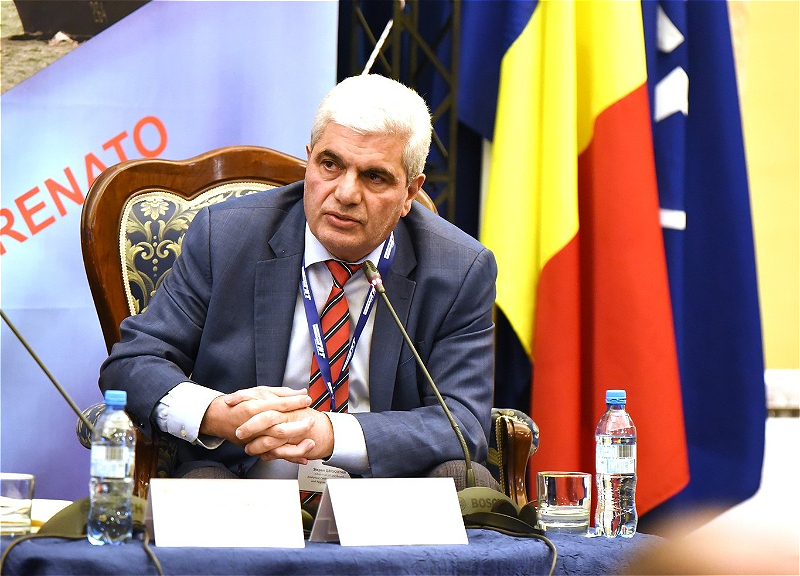
Stepan Grigoryan for 1news.az: Moscow May Intensify Pressure on Armenian Authorities Closer to Elections
On the eve of the upcoming parliamentary elections in Armenia, internal and external factors of pressure on Yerevan are becoming increasingly noticeable.
The intensification of competition between external power centers, attempts to influence political processes, and the parallel promotion of a peace agenda with Azerbaijan create a complex and contradictory context.
1news.az spoke with Stepan Grigoryan, Chairman of the Center for Globalization and Regional Cooperation and an Armenian political analyst, about the real risks of destabilization, the role of external players, and whether the region has a chance for lasting peace.
- Armenia's Foreign Intelligence Service has reported pressure from “a certain country” and attempts to interfere in the elections. Against this backdrop, there is information about Russia's plans to invest around $163 million in “soft power” tools in Armenia, while the EU has already allocated €15 million to protect electoral processes. How real is the possibility of Moscow using internal political forces in Armenia to interfere in the pre-election period?
- The current Armenian authorities are actively working with the USA, Canada, the EU, France, Germany, India, China, and many other countries. With some of them, Armenia is building strategic relations. Additionally, the Armenian leadership has taken steps to normalize relations with Azerbaijan and Turkey without Russia's mediation. Bilateral negotiations with Azerbaijan have yielded results: we have a paraphrased Peace Agreement, the start of the delimitation process of the Armenian-Azerbaijani border, trade between our countries, and partial unblocking of communications. All of this cannot fail to concern the Kremlin, as for many years Russia maintained its influence in the region by exploiting the confrontation between Armenia and Azerbaijan.
There is no doubt that the Kremlin would like to restore its influence in Armenia, but it seeks to achieve this by “appointing” pro-Russian political forces loyal to it in our country. Attempts to influence pre-election processes in Armenia serve the realization of these plans by the Russian authorities. Russian propaganda media, as well as their “proxies” in Armenian media, are already actively used here. Political forces associated with the three former presidents of Armenia, as well as Russian and Armenian oligarchic circles, are actively fighting to restore Russia's influence in Armenia. It is not excluded that closer to the elections to the National Assembly of Armenia, scheduled for June 7 of this year, harsher methods of struggle against the current Armenian authorities may be applied.
- Armenia's refusal of Russian humanitarian aid to Karabakh Armenians provoked a sharp reaction from Moscow. Can this be seen as an attempt by Russia to maintain political influence as a tool of pressure?
- As I understand it, this refusal was related to the upcoming elections, as there is a danger that pro-Russian political parties in Armenia could use this in their election campaigns. Our electoral legislation qualifies such actions not as “humanitarian aid,” but as pre-election bribes and voter buying in favor of certain political parties.
- President Ilham Aliyev, during a meeting with the President of the European Council António Costa, stated that peace between Azerbaijan and Armenia will be eternal. At the same time, Prime Minister Nikol Pashinyan, speaking at the European Parliament, emphasized: “We will not allow a new conflict, a new war.” How can these synchronized peaceful signals from Baku and Yerevan be assessed?
- The statements by the leaders of Armenia and Azerbaijan were made on the same day. I do not think this was coincidental. I am confident that both in Baku and Yerevan, there is an understanding that not all interested players in our region are pleased with the peace process between our countries. Therefore, mutual positive steps and messages should continue. I also want to draw attention to a very important fact: recently, Prime Minister of Armenia Nikol Pashinyan stated that the draft constitutional amendments of the country will not reference the Declaration of Independence of Armenia adopted in 1990. This is a very difficult yet bold step by the Armenian leader. I hope that the response from Baku will come in the form of signing the Peace Agreement.
- The Prime Minister of Armenia stated that the leadership of the Armenian Apostolic Church is effectively promoting the “Artsakh” agenda, which, in his words, leads to a new war. At the same time, he claims that the church is managed externally—“through KGB channels,” which, according to the Prime Minister, poses a threat to the country's state security. If the confrontation between the authorities and the church intensifies, how do you assess the chances of the current authorities’ political survival?
- Here, I see not a confrontation between the Prime Minister of Armenia and the Armenian Apostolic Church, but a confrontation between Nikol Pashinyan personally and Catholicos Karekin II and a narrow circle of hierarchs around him. Yes, much of what the Prime Minister says is true; however, for Armenians worldwide, the Church plays a huge role, so this confrontation has not increased the rating of the Armenian authorities.
- Can Pashinyan’s statement be interpreted as a signal of Armenia’s readiness to finally close the chapter of enmity with Azerbaijan?
- Nikol Pashinyan sends many messages aimed at establishing peace and normal relations with Azerbaijan, and I have no doubts about the consistency of his policy on these issues.