Looking back at the past or looking to the future? Why the 907th amendment must become history
There are historical paradoxes that become especially noticeable over time.
One of them is still enshrined in American legislation — against the backdrop of the transition of relations between Baku and Washington into a phase of genuine strategic partnership, it continues to serve as a reminder of a time when these relations were defined by lobbyism and the political stereotypes of the last century. This refers to the 907th amendment to the Freedom Support Act, which restricts direct American state assistance to Azerbaijan and which the U.S. Congress adopted in 1992.
Since 2001, the U.S. president has been vested with the right to annually suspend these restrictions and to notify the legislative branch of the decision taken. This makes it possible to further develop bilateral cooperation, preventing the restrictions from hindering its practical development. Last year's decision by Donald Trump to extend the suspension of its effect once again brings this legal anachronism to the center of attention.
The U.S. State Department notified Congress of the extension of the suspension of the 907th amendment. According to the official protocol, on July 28 the document was sent to the Senate Committee on Foreign Relations, and on August 10 to the House Committee on Foreign Affairs.
But the very need to periodically suspend a provision created more than three decades ago only underscores the main contradiction — today, when the geopolitical map of the South Caucasus has changed and Baku and Washington have reached a new level of partnership, why does this amendment continue to remain part of American legislation at all?
Under conditions in which relations between the U.S. and Azerbaijan have long moved beyond the realities in which the 907th amendment appeared, the issue should no longer be about yet another temporary suspension, but about its final repeal.
A historical paradox
To understand why the question of repealing the 907th amendment is of fundamental importance today, it is necessary to return to the circumstances of its emergence.
In 1992, when the Soviet Union had just collapsed, the American Freedom Support Act was adopted as an instrument for assisting the newly independent states. However, an «exception» was made with regard to Azerbaijan. The 907th amendment was included in the document, restricting the possibility of providing it with direct state assistance from the United States.
For Azerbaijan, this decision became especially painful against the backdrop of the aggression unleashed by Armenia, the First Karabakh War, and the deep economic crisis faced by the young independent republic. At the same time, no similar restriction was introduced with regard to the occupying country — Armenia.
It is precisely here that the first key paradox of the 907th amendment arises.
President Ilham Aliyev, speaking about the history of the amendment's emergence, emphasized precisely this asymmetry:
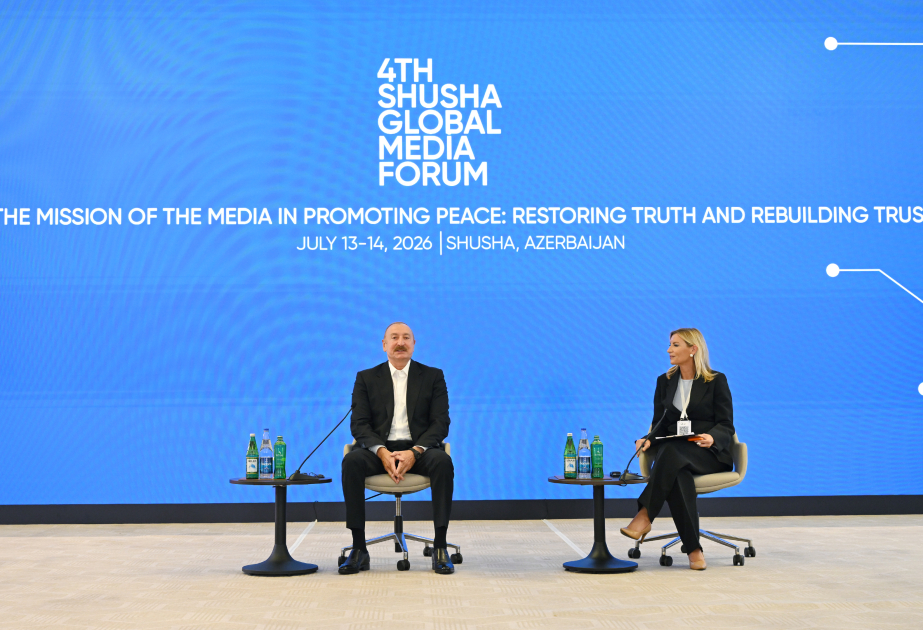
«This was an extremely unfair step by the U.S. Congress toward Azerbaijan in 1992. When the U.S. Congress adopted the Freedom Support Act with the aim of providing financial assistance to the newly independent states that emerged after the collapse of the Soviet Union, the 907th amendment was introduced by senators who held a pro-Armenian position. By the way, among them was President Biden. At that time he was a senator — and this probably explains the numerous difficulties we encountered in relations with the Biden administration. This amendment deprived Azerbaijan of access to American financial assistance. The reason for this, as was claimed, was supposedly Azerbaijan's blockade of Armenia. First of all, this did not correspond to reality. We did not carry out a blockade of Armenia. Armenia occupied our territory, and the occupied territories were located precisely between Armenia and Azerbaijan. Thus, had it not been for the occupation, there would have been no so-called blockade. Secondly, for us this was of course extremely painful at that time: the country was very poor, and we turned out to be the only republic of the former Soviet Union against which the U.S. Congress introduced discriminatory measures,» the head of state noted at the IV Shusha Global Media Forum.
Behind the very fact of the adoption of the 907th amendment stood a broader political context. In Washington, the Armenian-Azerbaijani conflict was perceived through the prism of arguments actively promoted by the Armenian lobby. As a result, the legislative decision turned out to be conditioned not so much by an objective assessment of the events taking place as by the significant influence of the American domestic political situation.
A political paradox
The 907th amendment survived a thirty-year period of fruitless negotiations, the Second Karabakh War, and a fundamental change in the regional balance. The South Caucasus itself has changed, relations between its states have changed, and the role of Azerbaijan has changed as well. However, the legal shell of the amendment has remained practically unchanged.
Naturally, along with the change in the region, the substance of the question itself is changing. The amendment, which was once adopted in the context of a specific conflict and a specific political situation, today continues to exist outside those circumstances that were initially used to justify it.
It is precisely this that turns the 907th amendment from an instrument of policy into a political artifact — a provision that has been preserved in American legislation after the historical reality that gave rise to it has radically changed.
Subsequent events showed the paradoxical nature of the very construction of the amendment.
Already since 2001, U.S. presidents have received the opportunity to annually suspend its effect, since Washington's practical interests required cooperation with Baku. The result was a peculiar divergence between the law and real American policy — the amendment continued to exist formally, while its effect was regularly suspended in accordance with the interests of the United States itself.
This continued for decades. Each new presidential waiver of the application of the restrictions only confirmed the obvious — real U.S. policy had long moved forward, while the legislation continued to retain within itself a provision that remained in the past.
Moreover, its original logic was built around a conflict in a region that today is in a completely different geopolitical phase. Azerbaijan has fully restored its territorial integrity and state sovereignty, while Baku and Yerevan have moved on to forming a new system of relations based on a peace agenda and regional connectivity.
Thus, the historical context itself already shows the main flaw of the 907th amendment: American legislation continues to preserve a decision taken for one geopolitical reality, while that reality itself has long ceased to exist.
An international paradox
The history of the subsequent decades shows an even more obvious contradiction. After the terrorist attacks of September 11, 2001, when the U.S. faced a new system of threats, Washington began annually suspending the effect of the 907th amendment in the interests of its own national security.
This was an acknowledgment of a simple reality — cooperation with Baku had become necessary for Washington itself.
Azerbaijan made a significant contribution to international efforts to combat terrorism, provided crucial transit opportunities for international forces, and took part in the peacekeeping mission in Afghanistan. Azerbaijani servicemen served in that country, including ensuring the security of Kabul airport.
And here another paradox arises. Formally, American legislation continued to restrict the possibility of providing Azerbaijan with direct state assistance. In practice, however, the American executive branch year after year found grounds to ensure that this restriction did not hinder cooperation.
The result was a kind of institutional collision — the law continued to restrict relations, while the real national security interests of the U.S. required their expansion.
In other words, Washington for decades effectively circumvented the problem instead of eliminating it. In other words, the White House corrected in practice what Congress had once enshrined in legislation.
Suspending the amendment solves a practical problem. Its repeal solves a political and legal problem. This is a fundamental difference.
Temporary suspension allows the U.S. to interact with Azerbaijan. But at the same time it leaves in force the very provision that presupposes a special restrictive regime with regard to Baku.
For a state that today is regarded by Washington as a strategic partner, this is becoming increasingly difficult to explain.
The answer to this question has long gone beyond the topic of material American support. Today it concerns the very correspondence of American legislation to the reality of American-Azerbaijani relations and to the new geopolitical picture of the South Caucasus. That is precisely why what matters fundamentally is not another temporary suspension of the 907th amendment, but the elimination of the very provision that continues to preserve in U.S. legislation the logic of a long-gone era.
A regional paradox
How far the regional reality has moved from the one in which the 907th amendment appeared is also shown by Azerbaijan's policy.
Today Baku is not merely talking about the need for a new stage of relations with Armenia, but is also taking concrete steps aimed at restoring regional ties.
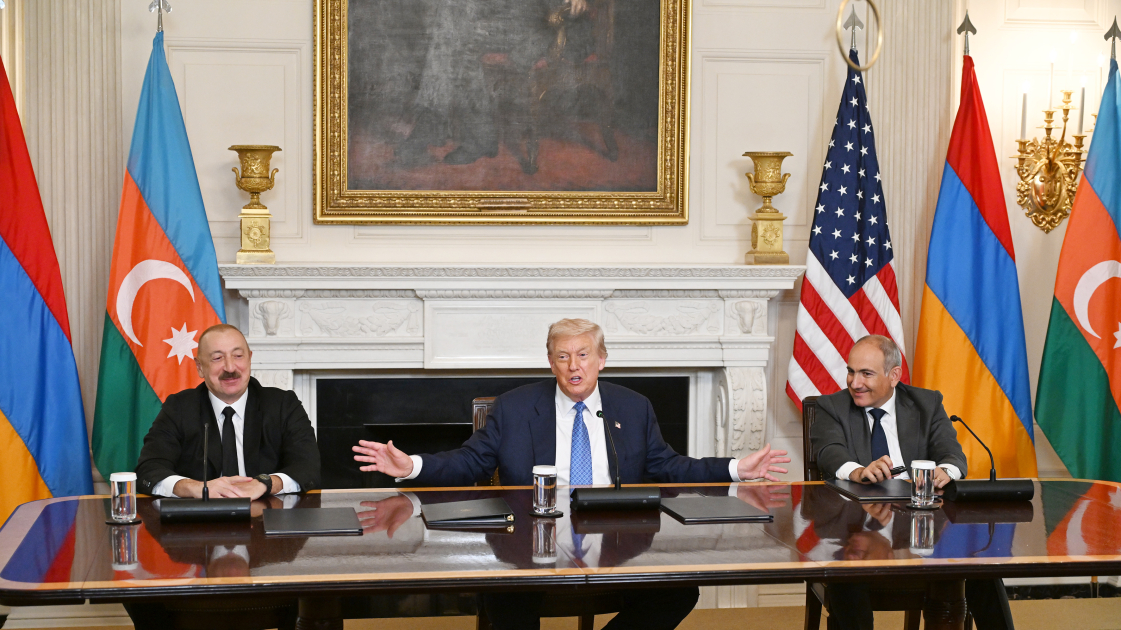
President Ilham Aliyev cites precisely these changes as one of the main arguments in favor of the view that the amendment has definitively lost its original basis: «Today this amendment has completely lost its relevance. First, because Azerbaijan and Armenia initialed a peace agreement at the White House in the presence of President Trump.
Second, Azerbaijan unilaterally lifted all transit restrictions with regard to Armenia, and since that moment more than 40 thousand tons of various cargo have been transported to Armenia through our territory — from Russia, Kazakhstan and other directions. Moreover, Azerbaijan itself began supplying petroleum products to Armenia — as of today the volume of supplies, as far as I recall, has exceeded 10 thousand tons. This is especially important now, when many countries are experiencing difficulties with access to fuel sources, and Armenia has a reliable supplier in the person of Azerbaijan. If it were not for this, they would probably have to look for gasoline and diesel fuel all over the world today.»
This is no longer the language of the conflict of the early 1990s; this is the language of a state that regards regional ties as part of the future architecture of peace.
That is precisely why the preservation of the 907th amendment today looks increasingly not merely outdated, but internally contradictory — its original political logic no longer corresponds to the reality in which the U.S. itself is today trying to play an active role.
At first glance, the question can be viewed exclusively through an economic prism — can Azerbaijan receive American state assistance? But such an approach today misses the main point.
Over the past decades, Azerbaijan's economic potential has changed radically; it is no longer a state that needs international support. Today Azerbaijan itself acts as a donor of international assistance. This manifested itself especially clearly during the COVID-19 pandemic.
Consequently, the repeal of the 907th amendment today matters not from the point of view of Azerbaijan receiving material assistance. It is about something else — about eliminating the political and legal asymmetry that is preserved in American legislation.
The remaining amendment continues to legally fix Azerbaijan's special status in American legislation. Even with the annual suspension of its effect, the very fact of the existence of this provision preserves the legacy of an approach formed under the conditions of the early 1990s.
For Baku, the repeal of the 907th amendment means the elimination of this historical asymmetry — a provision that continues to single out Azerbaijan in American law on the basis of the circumstances of a long-gone era. For Washington, it means an acknowledgment that its own policy toward the South Caucasus has changed and that the legal framework must correspond to this new reality.
That is precisely why today the question of repealing the 907th amendment goes far beyond the topic of American state assistance. It is about the equality of the parties, political consistency, and the ability of legislation to correspond to a reality that has long since changed. «This amendment is completely outdated and must be definitively repealed,» is how the President of Azerbaijan Ilham Aliyev speaks about it. «But unfortunately, despite the firm position of President Trump — during our meeting last August in Washington, at the White House, President Trump signed in my presence a one-year waiver of this amendment, and now it is not in effect — its symbolic and political significance still remains.»
Under the administration of Donald Trump, American-Azerbaijani relations have entered a qualitatively new phase. This is no longer merely about situational interaction. On the agenda are strategic partnership, energy security, transport connectivity, digital transformation, artificial intelligence, trade, investment and defense cooperation.
The Azerbaijani leader describes this turning point as follows: «I must say that relations between the Trump administration and Azerbaijan are developing excellently, and we are sincerely glad that they have reached the level of strategic partnership. Our historic meeting with President Trump in August last year in Washington, the subsequent meeting in Davos in January of this year, the invitation for Azerbaijan to become one of the founders of the Peace Council initiated by President Trump, the visit of Vice President JD Vance, the signing in Baku of a joint declaration with the vice president on the establishment of a strategic partnership, as well as many other facts testify that our relations are now at the highest, unprecedented level — such a thing has never happened before.»
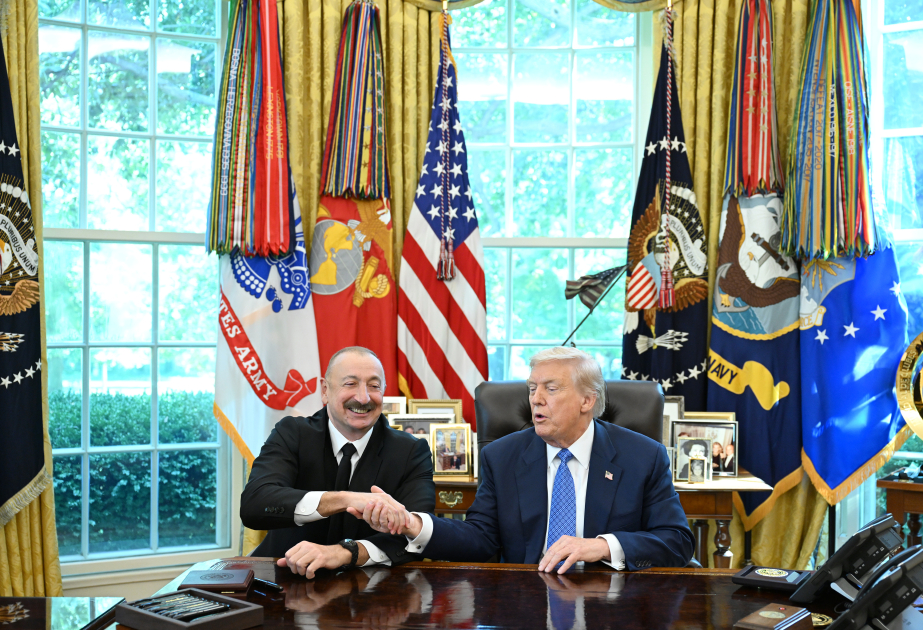
This political assessment by the head of state demonstrates the scale of the changes that have taken place. Relations that developed under the influence of restrictions and stereotypes are today discussed in the category of a real strategic partnership. Even more telling is that cooperation has already moved into the practical plane: «At present we are actively working on implementing all the provisions of the declaration on strategic partnership. In particular, the working groups that have been created are working very actively in such areas as trade and investment, digital transformation and artificial intelligence, energy security and transport connectivity, defense and supplies of defense products. At the same time, the United States lifted all embargoes on arms supplies to Azerbaijan, and soon after that similar steps were taken by the United Kingdom and the member states of the European Union. In my view, this quite clearly characterizes the spirit of our bilateral relations, their format, as well as their potential for the future.»
And here the main institutional question arises. If the U.S. executive branch has already changed its practical policy, if Washington sees in Baku a partner in matters of security and regional connectivity, if strategic cooperation is being formed between the two states, then preserving the 907th is becoming increasingly difficult to justify even from the point of view of American interests.
The transport agenda acquires particular significance in this context.
The South Caucasus is gradually ceasing to be a peripheral space between major geopolitical centers and is turning into a strategic hub where transport, energy and trade routes intersect.
The Zangezur corridor, TRIPP, the Middle Corridor — the expansion of regional communication infrastructure creates a completely new economic and strategic configuration.
For the U.S., this means the opportunity to strengthen its presence in the region by creating conditions for trade, transit and long-term stability. This is precisely where the fundamental difference lies between the policy of the past and the new reality.
President Ilham Aliyev noted: «As I have already said, when President Biden was a senator, he was one of the initiators of the introduction of sanctions against Azerbaijan, and this was precisely his vision of the situation in the region — that the region should be torn apart by conflicts and confrontations! After all, under such conditions it is always easier to achieve one's goals. But President Trump is a completely different person, with a completely different character. He strives for peace and regards peace as an opportunity. And now that Azerbaijan and Armenia have already achieved peace, many opportunities are opening up before us. For example, the TRIPP corridor, which bears the name of President Trump and connects Azerbaijan with its exclave of Nakhchivan. As far as we know, practical work on the corridor will hopefully begin as early as this year. The launch of the corridor will completely change the map of transport links within the region, which will lead to the strengthening of security throughout the South Caucasus. We are in acute need of this. It will also contribute to the growth of optimism regarding cooperation in the South Caucasus.»
In such a system of coordinates, the 907th amendment looks even more alien.
It was created within the logic of confrontation — the new policy is built around connectivity. It appeared during wartime — today the central word of the regional agenda is becoming peace.
It restricted U.S. relations with Azerbaijan — today Washington itself is interested in expanding these relations.
That is precisely why the current notification from the State Department has a dual significance. On the one hand, it shows that there are fewer and fewer practical obstacles to cooperation between Washington and Baku. On the other, it is a reminder that legally the issue remains unresolved.
The U.S. president can suspend the effect of the 907th. But the final elimination of this provision requires a decision by the legislative branch. And here the question goes beyond bilateral relations. The repeal of the amendment would be a signal about the ability of the American political system to acknowledge a change in circumstances and to adjust its legislation in accordance with the new reality.
Ilham Aliyev formulated this position extremely clearly: «I believe that the sooner Congress fully repeals this amendment, the better it will be for everyone: for Azerbaijan — because we will cease to be subjected to discrimination, and for the U.S. Congress — because it will demonstrate its responsibility, its ability to acknowledge the mistakes it has made, as well as its readiness to act taking into account the current geopolitical situation. We hope that this will happen.»
These words in fact also contain the answer to the main question.
Azerbaijan does not need the repeal of the 907th in order to prove its economic independence. Nor does it need it in order to gain recognition of its regional weight — that weight has already been confirmed in practice.
It is needed for something else — to definitively eliminate from bilateral relations the legal trace of a policy that was formed under completely different conditions.
And this is also important for the United States itself. The foreign policy of any state inevitably changes along with circumstances. Legislation that fails to keep pace with this change gradually turns from an instrument of policy into its relic.
The 907th amendment has found itself in precisely such a position. Both the South Caucasus and the U.S. already live in a new reality. The annual suspension of the 907th only confirms this. But between «suspend» and «repeal» there is a fundamental difference. The first is an acknowledgment of the necessity of cooperation while preserving the old restriction. The second is an acknowledgment that the restriction itself no longer has any grounds.
Therefore, the final repeal of the 907th amendment would be not a symbolic gesture, but a decision in the interests of the United States itself — to bring its own legislation into line with its own foreign policy.
In 1992, Congress took a decision proceeding from one picture of the South Caucasus. Today it faces a completely different picture. The repeal of the 907th amendment will not change history. But it will show that Washington is capable of drawing conclusions from it.