From Napoleonic ambitions to anti-records: France delivers its verdict on the Macron era
Not so long ago, Emmanuel Macron liked to speak of France as a country that ought to reclaim its role as one of the main centers of power in Europe.
Today the French president does indeed appear to be returning the country to the center of attention — only now for a somewhat different reason.
Macron enters the final year of his presidency with record-low support, a politically weakened government, and noticeably diminished foreign policy influence.
According to the results of a joint study by the company Ipsos and the network of private engineering schools CESI, Emmanuel Macron's approval rating among the residents of France has collapsed to 16% — the lowest figure in all his time as head of state.
According to the survey, in which 1,000 French citizens over the age of 18 took part, Macron's approval rating has fallen by 6 percentage points since July 2026. At the same time, the number of respondents who spoke negatively about the president's work has risen since July by percentage points — to 81%.
The figures cited are not simply another poor result in a series of opinion polls; if until recently Macron could point to political circumstances, unpopular decisions, or temporary public fatigue, now the explanation is becoming far more prosaic — a significant share of the French simply no longer approves of his work.
It is especially symbolic that Macron approaches the last year of his presidency in such a state. The constitution does not allow him to run for a third term, which means the question is no longer whether Macron will manage to be reelected. Something else is more interesting: will he manage to conclude his presidency in such a way that his political legacy looks at least close to the scale he once imagined for himself?
So far the answer does not look very encouraging.
A president who too often explains to the French why they are wrong
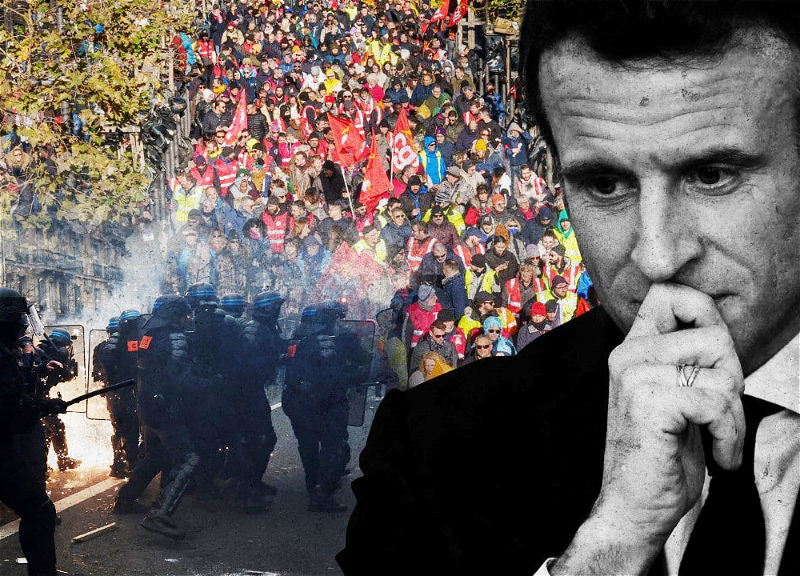
Macron's relations with French society have long been far from idyllic. One of the first serious signals was the "yellow vests" in 2018.
The cause of the mass protests was an increase in fuel prices, but very quickly the protest went far beyond a single tax decision. It turned into an expression of broader dissatisfaction with the cost of living, social inequality, and the president's policies.
Several years have passed, but the questions that then brought people out into the streets have not gone anywhere. Purchasing power remains the main source of concern for the French today as well: 54% of the participants in the latest Ipsos and CESI poll named it their chief worry.
Herein lies one of the most unpleasant features of the current situation for Macron. Problems that seemed like a temporary social explosion at the beginning of his presidency have, by the end of his second term, turned into a permanent part of the political agenda.
Macron's main problem does not even lie in any one specific decision. Over the years of his rule, a gap has accumulated between the political picture seen by the Élysée Palace and the one seen by the ordinary Frenchman.
In the latest poll, 40% of the French are worried about the future of the social sphere. Against this backdrop, for many citizens, talk of Europe's strategic autonomy, a new architecture of European security, and France's global role sounds somewhat detached.
One can reason about the fate of Europe as much as one likes, but political reality begins with a far more down-to-earth question — how much a person can afford to buy in a store on the same salary.
It is precisely here that the Macron project runs into its most unpleasant problem. The president positioned himself as a reformer capable of modernizing France while at the same time preserving its social model. However, for a significant part of society, reforms are increasingly associated not with modernization but with the need to endure something.
The issue of pension reform proved especially painful. Raising the retirement age became one of the most vivid examples of how presidential resolve can turn into political capital — and simultaneously into a source of mass irritation.
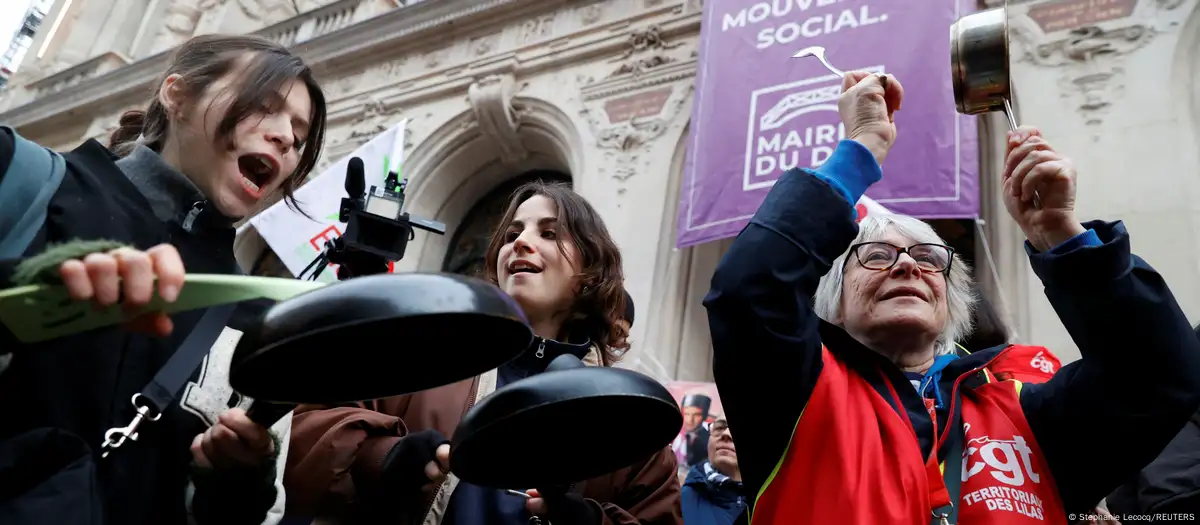
Yes, Macron managed to push the reform through. But the political price proved high. And herein lies one of the features of his presidency: the Élysée Palace often achieves a formal result, but pays for it with such a drop in trust that the next political round turns out to be even more difficult.
Parliament as a "source of problems"
After the 2024 parliamentary elections, French politics definitively entered a regime of chronic instability. Macron dissolved the National Assembly in the hope of reformatting the political space, but the result turned out to be the opposite of what was desired.
None of the main political forces obtained the ability to govern the country. The French president found himself between the left bloc, the right, and Marine Le Pen's National Rally, with none of the sides ready to unconditionally play by the Élysée Palace's rules.
As a result, France got what for the Fifth Republic had long been considered almost an exception — governments are formed without a stable majority and work practically constantly under the threat of a parliamentary defeat.
The turnover of prime ministers has become not a political sensation but almost a part of the French political landscape. The current prime minister, Sébastien Lecornu, has headed the government since September 2025, but his rating today is also far from successful. Only 20% of those polled approve of the head of government's work — the lowest figure of his entire political career.
The result is a rather unusual construction: the president has a historically low rating, the prime minister has his own anti-record, and the government has to deal simultaneously with the budget, debt, social policy, and the search for at least minimal parliamentary support.

The French political system nevertheless continues to work. But it increasingly resembles a car that moves forward mainly because the engine has not yet completely stalled.
Budget arithmetic against presidential ambitions
Another front of problems is French public finances.
For years France maintained one of the highest levels of government spending in Europe. At the same time, the country accumulated a budget deficit and public debt, and after the pandemic this problem became even more acute. Now the need to cut spending and look for ways to reduce the deficit has turned into one of the main political conflicts in Paris. The government has to look for ways to cut spending and at the same time convince the population that social guarantees will not be destroyed.
The task is practically impossible from a political point of view.
Cutting spending irritates those who fear a deterioration of social protection. Increasing the tax burden irritates business and the wealthier strata. Abandoning austerity increases pressure from the financial markets and European institutions.
And within this triangle, the space for beautiful presidential speeches is rapidly shrinking.
Macron came into French politics as a representative of a new generation who promised to overcome the old confrontation between left and right. In the end, French politics did indeed change — but it did not disappear at all. It simply became even more fragmented.
And the promised overcoming of the old political camps turned into a situation in which it is ever harder for the president to find a stable majority.
Foreign policy: plenty of ambitions, fewer opportunities
If at home Macron has to fight for political space, then on the international stage he has to fight for ever more elusive influence.
The French president has consistently tried to present himself as one of the main European leaders. Paris sought to play a more independent role in matters of European security and the future of Europe's relations with the United States.
But between a political statement and the ability to implement it there is a rather substantial difference.
Macron has repeatedly come forward with the loudest initiatives among European leaders, calling on Europe to think more actively about its own security and not to rely exclusively on Washington.
However, French diplomacy ran into a simple problem: leadership cannot merely be proclaimed. It requires economic resources, military capabilities, political support at home, and the readiness of allies to follow Paris.
And here the picture turned out to be far more complicated.
European countries are by no means always ready to accept French proposals in the form in which the Élysée Palace formulates them. The United States still retains a key role in European security. And within France itself, public support for a costly foreign policy is far from limitless.
As a result, Macron found himself in a somewhat paradoxical position. He wanted Europe to be less dependent on the United States, but at the same time he is forced to take the American factor into account in practically all key security issues. He wanted to strengthen French influence in Europe, but ran up against the need to persuade the European partners themselves. He wanted to present France as an independent center of power, but domestic economic and political problems objectively limited Paris's capabilities.
Africa: from special influence to withdrawal
The change in French influence has manifested itself even more painfully in Africa.
For decades France maintained special political, economic, and military positions in a number of countries of West and Central Africa. Under Macron, Paris tried to renew relations with African states and move away from the old model of Franco-African ties.
But the result turned out to be very far from the initial expectations.
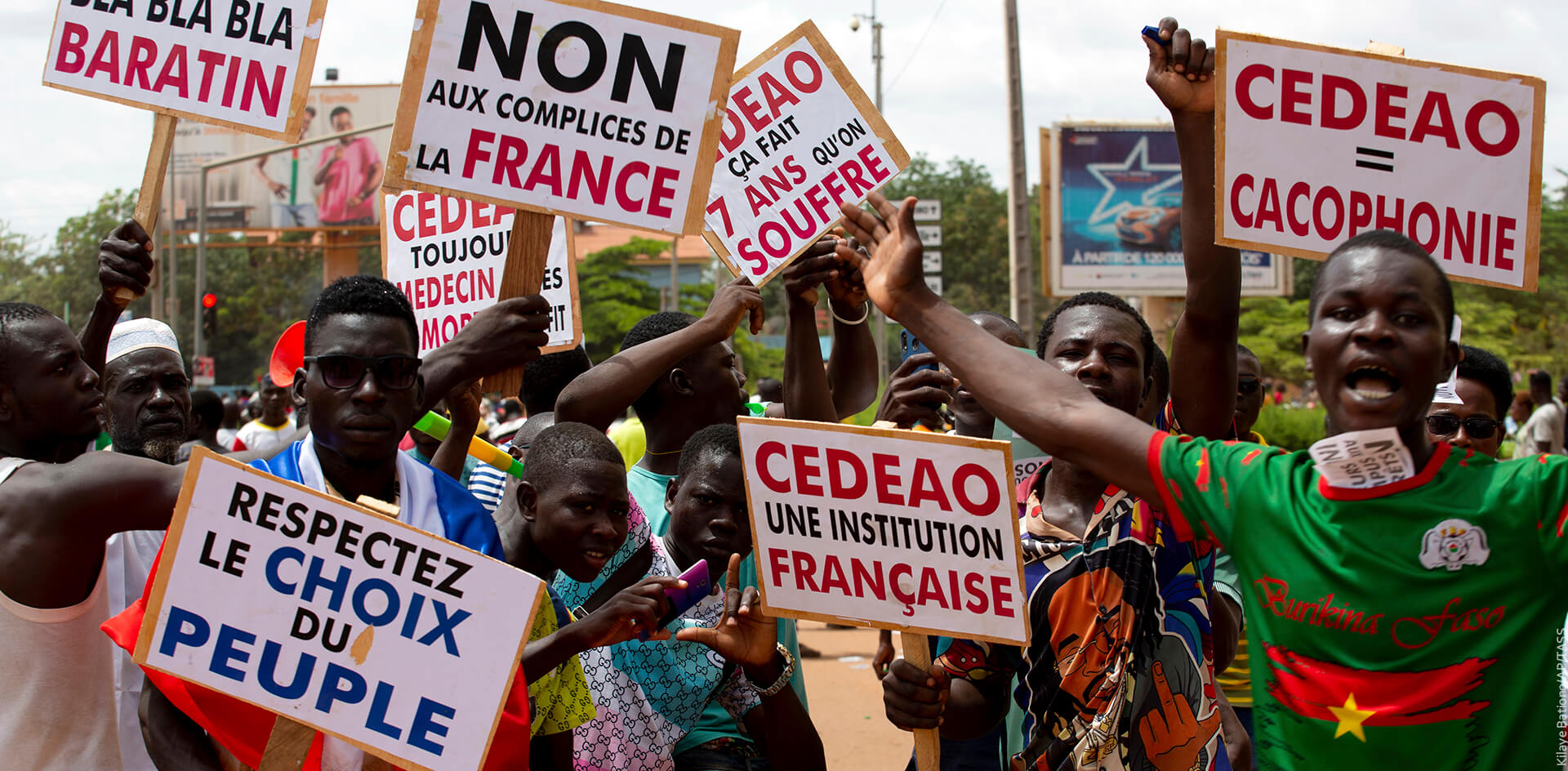
French troops were forced to leave a number of Sahel states, including Mali, Burkina Faso, Niger, and Chad. Paris's military and political presence in the region has noticeably shrunk.
In fairness: the reasons for this process cannot be reduced exclusively to Macron's own actions. The change of political regimes, the growth of anti-French sentiment, and the intensifying competition from other external players have deeper roots.
But for the sitting French president this nevertheless remains a serious political legacy.
A country that until recently was perceived as one of the main external players in a significant part of Africa has been forced to reduce its presence on the Black Continent.
Paris still remains a major European power. But the era when French statements in the former colonies were automatically perceived as a political benchmark is clearly becoming a thing of the past.
And here again the same gap arises between ambitions and reality.
France prepares for life after Macron
There is, finally, one more reason why the president's current rating is especially telling.
Macron can no longer change the main circumstance of his political future — in 2027 he will leave the Élysée Palace. The president himself stated in April that after leaving office he no longer intends to engage in politics.
That is why the current 16% is no longer only an assessment of the sitting president. It is a kind of preliminary verdict on the Macron era.
At the same time, the question of exactly who will replace him remains open.
The latest polls show that the main intrigue of the next presidential campaign will unfold around the right-wing and national-populist camp, above all the National Rally, and its rivals from the traditional center-right space and the center-left forces.
Special attention is focused on Marine Le Pen and Jordan Bardella. The National Rally long ago ceased to be a peripheral force in French politics and has turned into one of the main contenders for power.
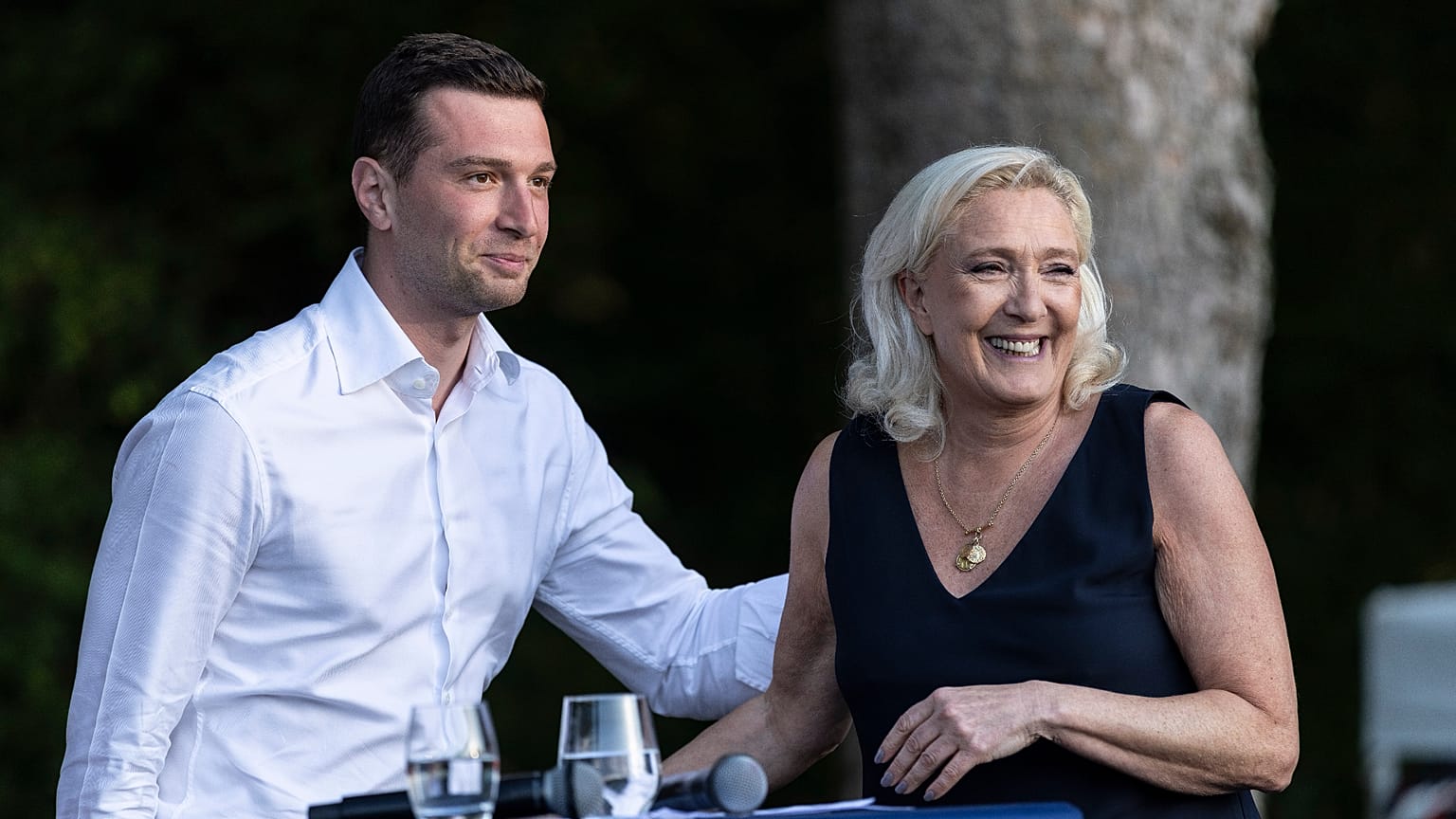
At the same time, the final scenario will depend not only on the first round but also on which alliances form before the second. It is precisely here that French politics retains its main question: will the traditional "republican front" against the right hold, or will voters disillusioned with the old parties finally decide that it is time to continue the experiment without them.
Macron's final year
Emmanuel Macron came to power with loud promises to renew France and restore its confidence in its own strength. He wanted to become the president who would overcome the old party confrontation, modernize the economy, and make France one of the main centers of power of a new Europe.
Now less than a year remains until the end of his second term.
And at this moment the president's rating stands at 16%, the prime minister has his own anti-record, French society is concerned above all with the cost of living and the future of the social sphere, parliament remains extremely fragmented, and Paris's foreign policy ambitions increasingly run up against the limits of real influence.
Perhaps the most ironic detail is that Macron no longer needs to convince the French of his ability to change the political system. He has already changed it.
Only now France is trying to understand what exactly it has received in return.
The next president will inherit a country in which the old political rules have been destroyed, the new ones have not yet formed, and society's demand for change has not gone anywhere. And that is why the 2027 elections will be not merely a vote for Macron's successor.
It will be a vote on the question of what France should become after Macron, and how far the country is ready to move away from his political legacy.