After September 11: Azerbaijan's path from the international coalition to Karabakh

Today marks 25 years since the September 11 attacks — an event that forever changed the world's understanding of the threat of international terrorism.
In New York, this date was marked this year with an unusual symbolic project: in the sky above the city, 2,977 drones recreated the silhouettes of the World Trade Center towers.
Each beam of light symbolized one of those who died. Artists, victims' families, survivors, and emergency services personnel took part in creating the installation.
Much has changed over the quarter century. The very nature of terrorist threats has changed, new tools and technologies have emerged, but one conclusion drawn after September 11 remains unchanged — it is impossible to counter terrorism alone.
That is precisely why, after the tragedy in New York, a broad international coalition was formed, uniting states with different interests, political views, and geography. Azerbaijan became one of the first countries to unequivocally support international efforts to combat terrorism.
For Baku, this was not merely a demonstration of solidarity. Azerbaijan itself had for many years faced the consequences of terrorism and therefore understood well how destructive this threat can be. It affects not only people's safety, but also the stability of states, economic development, and the future of entire regions. That is why the country's participation in the international fight against terrorism gradually took on a practical character.
After September 11, Azerbaijan became one of the partners of the international counterterrorism coalition. In the years that followed, the country took part in international missions, provided logistical capabilities, and contributed to ensuring security in strategically important regions..
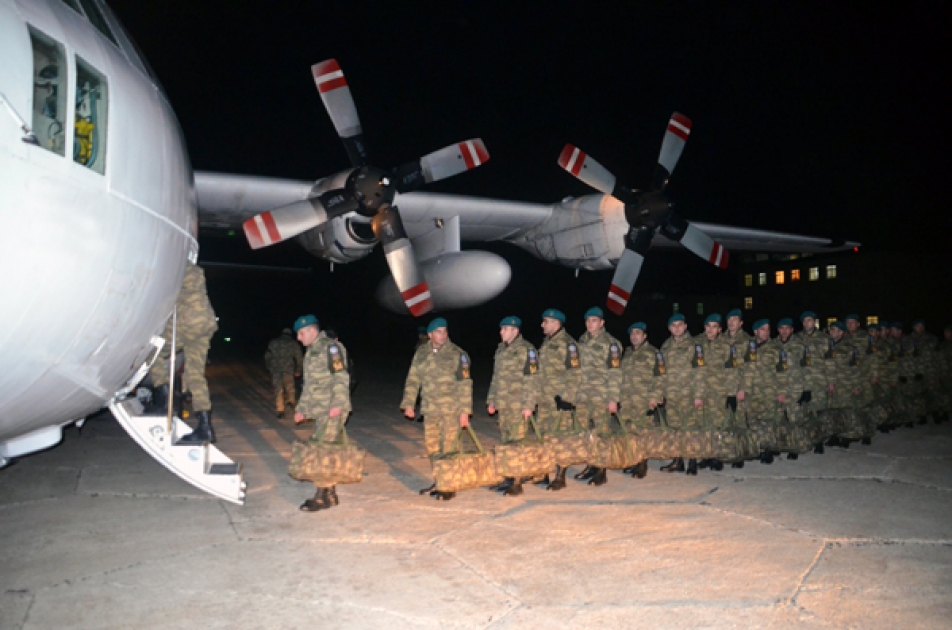
Afghanistan occupies a special place in this series. Since November 20, 2002, Azerbaijani servicemen took part in the International Security Assistance Force (ISAF). The Azerbaijani contingent, together with Turkish forces, in particular carried out tasks to guard the television tower in Kabul and ISAF's central ammunition depot, and also participated in patrolling and guarding Kabul International Airport. After the ISAF operation ended in 2014, Azerbaijani peacekeepers continued to serve in Afghanistan as part of NATO's new non-combat mission "Resolute Support," remaining there until the summer of 2021.
Overall, the mission lasted nearly two decades and ended in 2021 amid the withdrawal of international coalition forces from Afghanistan. It is important to note that Azerbaijani peacekeepers remained in that country until the very end, leaving it among the last in August 2021, providing security at Kabul Airport.
The country's contribution was not limited to the presence of servicemen. Azerbaijan played a key role in ensuring the Northern Distribution Network for supplying NATO forces, providing important logistical and transport support for cargo bound for Afghanistan.

Thus, Baku's participation in the international fight against terrorism gradually became part of a broader policy in which security was viewed not only as a national but also as an international issue.
For Azerbaijan, the fight against terrorism had another dimension as well. States facing terrorist threats must channel significant resources into ensuring security. Countering terrorism is not only about protecting people's lives. It is at the same time about protecting the conditions in which a state can develop. It is precisely this connection that Azerbaijan consistently raised on the international stage.
A telling example is the country's first-ever presidency of the UN Security Council in May 2012. Among the numerous issues on the international agenda, Azerbaijan singled out the problem of combating terrorism.
For Baku it was fundamentally important to keep this topic at the center of the world community's attention. Terrorist organizations use new technologies, change their methods, and find new channels of financing and communication. Consequently, the international response must also constantly adapt to changing conditions. Thus, on Azerbaijan's initiative, a declaration was adopted aimed at mobilizing international efforts in the fight against terrorism.
This was an important indicator of how the country's role was changing — from a state that supported the international coalition after September 11 to a state that itself brings issues of combating terrorism to one of the main platforms of international security.

However, participation in international missions was only one side of this experience.
For many years, Azerbaijan faced the consequences of aggression, occupation, and the presence of illegal armed formations on its territory. For the country, the issues of territorial integrity, security, and the fight against armed threats were not abstract international matters — they were directly related to its own national security.
That is precisely why subsequent events acquired special significance for Azerbaijan.
Three years after the historic Victory in the Second Karabakh War and the restoration of territorial integrity, in September 2023 Azerbaijan carried out a brilliant counterterrorism operation in Karabakh, eliminating the separatist regime in less than 24 hours and fully restoring its state sovereignty.
Thus, Azerbaijan's international experience in fighting terrorism found its continuation in the context of its own national security.
Here, alongside the counterterrorism operation, it is important to see one of the lines that led to it.
For two decades, Azerbaijan actively participated in international efforts against terrorism, sent servicemen on international missions, provided logistical support, raised the problem of terrorism on authoritative platforms, and consistently advocated for the unification of states in the face of the terrorist threat.
In 2023, the country acted on its own where the restoration of state sovereignty was at stake.
The history of the past 25 years has shown: terrorism is not confined to a particular region, religion, or nationality. Its consequences can be felt by states located thousands of kilometers apart.
Therefore, the fight against this threat inevitably requires international cooperation. A military response alone is not enough — information sharing, joint security measures, countering the financing of terrorist structures, strengthening international law, and eliminating the conditions that allow terrorist organizations to reproduce are all necessary.
Over the quarter century, Azerbaijan has traveled its own path in this fight. After September 11, the country joined international efforts, participated in practical operations and missions, and on the diplomatic stage worked to keep the problem of terrorism on the global agenda.
Today, its own experience of conducting a counterterrorism operation has been added to this experience.
And this, perhaps, is the main meaning of today's date — in particular, for Azerbaijan. September 11 is a reminder of the price at which the world came to realize the scale of the international terrorist threat. And Azerbaijan's history shows how the country's role changed: from joining the global counterterrorism coalition to independently resolving issues of national security and restoring sovereignty.
For the international community, the lesson remains the same as it was a quarter century ago — terrorism cannot be regarded as someone else's problem. Without joint action by states, it is impossible to keep the threat away from one's own borders for long.
And for Azerbaijan, this fight has yet another dimension — its own historical experience, in which international politics, national security, and the full restoration of territorial integrity and state sovereignty turned out to be closely interconnected.