Chip in for air defense: businesses in Russia have been told to fend off drones themselves
Privatization of profits and nationalization of losses is the classic formula of Russian oligarchic capitalism.
However, what is unfolding in the Russian Federation today takes this concept to a fundamentally different, absurdly tragicomic level. The country's military and political leadership, which pompously announced a large-scale geopolitical campaign and dragged the state into the largest armed conflict in Europe since World War II, has quietly and cynically acknowledged its own inability to perform the main, basic function of any state — to ensure the security of its own territory, infrastructure, and citizens.
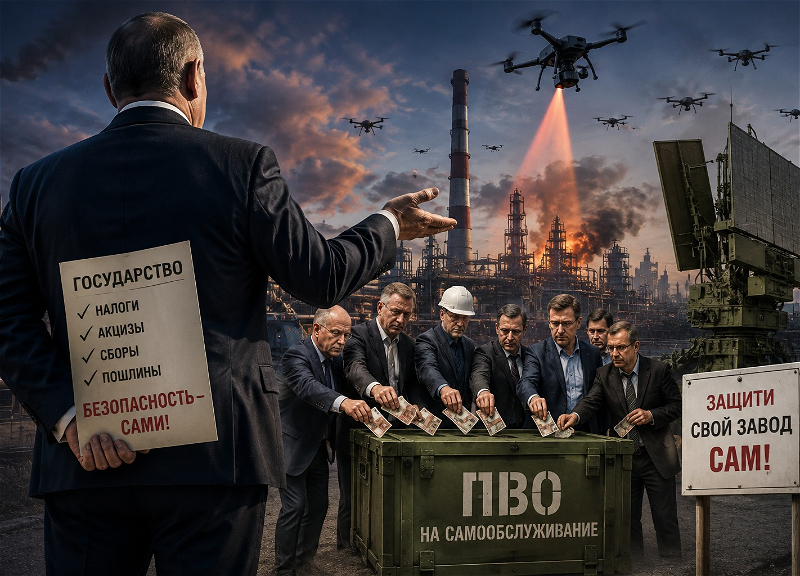
Responsibility for protecting industrial facilities, oil refineries, and key enterprises from regular drone attacks is now effectively being shifted onto the shoulders of businesses themselves. The legislative formalization of this policy came in the form of a decree by Russian President Vladimir Putin on a mechanism of external administration. The document gives the authorities the right to seize control from the owners of critical infrastructure enterprises, including the energy and transport-logistics sectors, if their facilities have been damaged by drone attacks due to "insufficient protection." Entrepreneurs are now being unobtrusively invited to create their own mini-armies, hire private guards, or call in "Wagner fighters" in order to fend off incoming drones on their own, while the state air defense system is busy with other tasks.
The story of this madness did not begin yesterday. Such theses first began to be cautiously tested back in the spring, around May, on the air of federal channels and in Telegram channels marked with a "Z." At the time, the arguments of individual media personalities and the most radical deputies that large corporations should buy themselves electronic warfare (EW) systems and anti-aircraft installations and hire gunners were perceived by the expert community and ordinary observers as yet another fit of delirium brought on by hyperpatriotic frenzy. It was not taken seriously; people mocked the stupidity of propagandists completely detached from the realities of law, economics, and basic common sense. It was impossible to believe that such surrealism could become the basis for managerial decisions. However, what seemed like an absurd invention of aggressive dilettantes turned out, upon closer inspection, to be a carefully planned informational and psychological processing of society. The delirium of Z-bloggers was merely the artillery preparation, which was followed by the offensive of the Kremlin's "strategy." Now the idea of private air defense is taking on entirely official forms, turning the once-unified state monopoly on violence into a chaotic hodgepodge of corporate armies.
The absurdity of "sovereign" protection: pay taxes and buy an anti-aircraft gun
To appreciate the full depth of this managerial dead end, it is worth turning to the elementary logic of state organization, which Moscow has chosen to forget. For years, citizens and enterprises paid astronomical taxes, billions in excise duties, and special levies that were channeled into financing an ultra-expensive army "with no equivalents in the world," air defense systems, and countless security agencies. Society was guaranteed that in exchange for loyalty and money, the state would ensure complete security. When reality collided with propagandistic illusions, it turned out that the state machine is capable of efficiently collecting funds but is entirely incapable of protecting stationary oil refineries hundreds of kilometers from the front line. In response to the entirely legitimate question from business about where the promised air defense is, the Kremlin offers an elegant proposal: "Protect yourselves."
From the standpoint of common sense, this looks like an absolute phantasmagoria. The state, with its own hands, unleashes a large-scale conflict, provokes retaliatory strikes on its own critical infrastructure, and then throws up its hands and tells business that protecting facilities is the commercial risk of the entrepreneurs themselves. If a refinery or a plant produces goods, paying billions into the budget, but at the same time must purchase EW systems at its own expense, install anti-drone nets, buy expensive radar stations, and form its own firing teams, a natural question arises: what exactly is business continuing to pay the state for? For the right to be fined if a drone nonetheless punches through a makeshift net? This is the final collapse of the institutional system, in which the concept of "national security" is turned into a self-service commercial offering.
The paradox of the situation also lies in the legal nonsense created by such decisions. In the legislation of any normal country, it is hard to imagine a private enterprise equipped with heavy weaponry, combat electronic warfare assets, or anti-aircraft systems. Even assuming that an oil giant decides to purchase specialized equipment, it will immediately run into a wall of regulatory restrictions, licensing, weapons circulation rules, and a direct ban on the use of such means by civilians. But in a system where laws are rewritten on the fly to suit momentary circumstances, this absurdity troubles no one. Business is placed in conditions where it is obliged to violate or circumvent existing norms, turning into semi-legal military structures simply in order to keep its production facilities from being turned into burning torches.
Mercenaries on the oligarchs' payroll and the mechanism of perfect raiding
The practical implementation of this "strategy" opens up even bleaker and more dangerous prospects for Russian business. Who exactly is supposed to physically carry out the protection of plants and power stations? Amid a shortage of personnel and the absence of systemic state solutions, the only real force on the market of "security services" remains veterans of various private military companies, former "Wagner fighters," and dubious structures with combat experience but utterly vague notions of the law.
The transition of big business to the practice of hiring private armed contingents for protection against aerial threats means the actual legalization and flourishing of feudal armies inside the country. Enterprises are forced to pump money and weapons into groups whose loyalty is determined exclusively by the size of the monthly check, rather than by an oath or duty of service.
This process inevitably sets in motion a most dangerous scenario for Russian statehood itself. The creation of dozens of large and hundreds of small corporate armies subordinate to top managers or business owners will inevitably lead to a redivision of spheres of influence. In conditions where the central government demonstrates weakness and an inability to control security on its own territory, having one's own armed resource becomes not merely a means of protection against drones, but also an argument in internal corporate and political conflicts. Today this private security force scans the sky in search of enemy UAVs, and tomorrow it may receive an order to occupy the office of a competing firm or to block the operations of a neighboring enterprise.
Moreover, in this "innovative" scheme another, far more cynical goal is clearly visible — the creation of an ideal mechanism for squeezing out undesirable businesses. The requirement that owners provide full air and anti-drone defense of their facilities at their own expense creates an unattainable quality criterion. Any drone strike on a plant's territory can now easily be interpreted as "negligence" on the part of the owner, "failure to ensure anti-terrorist protection," or outright sabotage. If an enterprise was unable to buy a sufficiently effective EW system or did not hire the "right" private military company connected to the right people in the security agencies, this becomes a perfect pretext for opening criminal cases, removing management, and subsequently nationalizing or redistributing assets in favor of structures loyal to the Kremlin.
Thus, business finds itself in a trap where both exits lead to catastrophe. Don't spend money on a private army and EW systems — and your enterprise is destroyed by incoming strikes, while the Investigative Committee accuses you of criminal negligence. Spend enormous sums on creating your own security perimeter — and you fall under suspicion of creating "illegal armed formations" or become a target for a raider seizure by security officials who dislike the appearance of armed men at the facility. Such an environment completely destroys any remaining investment climate and turns industrial management into a Russian lottery for survival.
The bankruptcy of the system to the accompaniment of sarcasm
What back in the spring seemed like an immature fantasy of Z-propagandists is today taking shape as the bitter reality of Russian life. This evolution from absurd conversations in television studios to concrete managerial steps by the Kremlin vividly demonstrates the depth of the intellectual and systemic crisis in which the authorities find themselves. Instead of acknowledging mistakes, instead of seeking real diplomatic or at least effective military solutions, the country's leadership prefers to pretend that shifting state functions onto commercial structures is a manifestation of strategic wisdom and flexibility.

In this situation, it is hard to refrain from grim sarcasm. If one follows the logic of the Kremlin's innovators to its conclusion, then the Russian state system is in for a fascinating and profound transformational reform. The next logical step should be a proposal for citizens to purchase air defense systems on their own to protect their residential buildings and apartments. Residents of high-rises should band together in homeowners' associations, chip in for man-portable anti-aircraft missile systems, organize round-the-clock watches on rooftops, and hire veterans of local conflicts to protect their balconies from falling debris. And why not? If an oil refinery with billions in turnover is obliged to defend itself, then why should an ordinary taxpayer count on anything more?
And it goes further. Firefighting could be privatized, with residents of burning settlements invited to buy firefighting planes on their own, or the protection of law and order in the streets could be shifted exclusively onto people's volunteer patrols armed with sticks. In this scheme, the state would be left with only one function — the most pleasant and undemanding one: to collect taxes on time, issue fines for improperly installed rooftop machine-gun nests, and regularly hold lavish parades displaying equipment which, however, will never arrive to defend a specific plant or home.
The stupidity of the decision to effectively privatize air defense lies in the fact that it does not solve the security problem but only multiplies the chaos. It clearly shows the whole world and Russian society that behind the loud rhetoric about a "great power" and "unbreakable armor" lies absolute impotence when it comes to defending real rather than imaginary frontiers. By shifting the concern for security onto business, the Kremlin is with its own hands destroying the main myth on which Russian power has rested for the past two decades — the myth that in exchange for absolute control and the renunciation of freedoms, citizens and businesses receive guaranteed protection and stability. Today there are neither freedoms, nor stability, nor protection. There is only a bloated bureaucratic apparatus, which at the moment of real danger offers its citizens and entrepreneurs the chance to save themselves on their own — while not forgetting to file their tax returns on time.