Azerbaijan and the Middle Corridor: from route to system
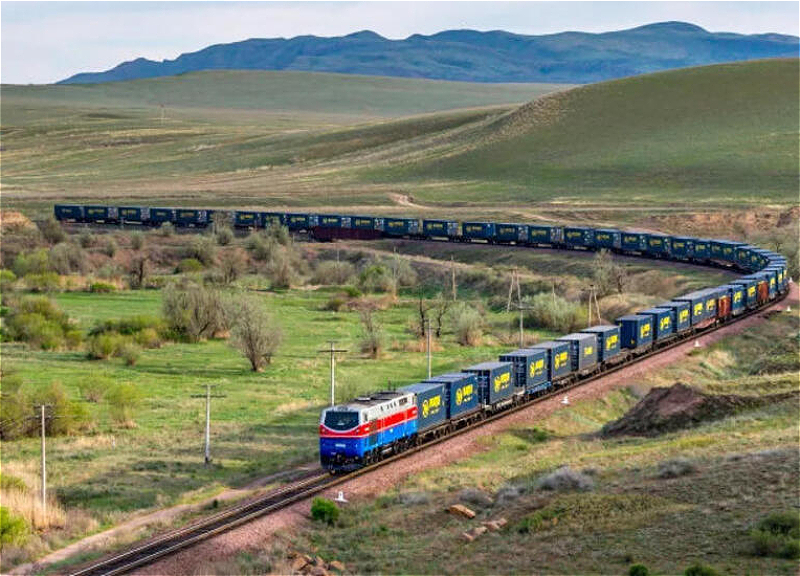
A series of recent events once again draws attention to the growing importance of the Middle Corridor and Azerbaijan’s role in its formation and operation.
Notably, this topic has been consistently raised in Baku and beyond at various levels: during the meeting of the heads of government of the Organization of Turkic States (OTS), during the visit of Azerbaijani President Ilham Aliyev to Georgia, as well as in his meetings with the foreign and transport ministers of Kazakhstan and the Prime Minister of Lithuania.
During President Ilham Aliyev’s visit to Georgia on April 6, the transit-energy agenda emerged as one of the key topics of discussion. The mention of the Baku-Tbilisi-Ceyhan pipeline, the Southern Gas Corridor, and the Middle Corridor in the same context demonstrated that these are no longer seen as separate initiatives but as a unified infrastructural framework through which the region integrates into global energy and trade flows. Thus, the Middle Corridor is not merely a transport route but a concept shaping a multimodal connectivity system, where pipeline infrastructure, railways, maritime transport, and logistics hubs begin to operate under a single logic, ensuring the continuity of flows from the Caspian to Europe.
A practical continuation of this approach followed on April 8 in Baku, where President Ilham Aliyev received Kazakhstan’s Foreign Minister Yermek Kosherbayev and Transport Minister Nurlan Sauranbayev. The very format of the meeting is noteworthy. The simultaneous visit of the heads of Kazakhstan’s foreign policy and transport ministries to Baku indicated that the discussions were not limited to political aspects but also addressed specific parameters of the route’s operation. This may be directly linked to decisions announced a few days earlier at the meeting of OTS heads of government, where the Kazakh side proposed to develop the Trans-Caspian route by strengthening its institutional framework, introducing digital monitoring, and enhancing connectivity.
In essence, Kazakhstan is now advocating for the transformation of the Middle Corridor into a managed multifunctional system. The key focus here is not so much on building new infrastructure but on eliminating fragmentation between existing segments. The proposal to establish a digital monitoring center, as well as the preparation of an intergovernmental agreement with Azerbaijan, is aimed precisely at this—synchronizing tariffs, procedures, and logistics.
This indicates that the Trans-Caspian route is gradually evolving into a comprehensive system where transport, energy, digital solutions, and investments are beginning to work in tandem. Such a format is essential to secure cargo flows not just temporarily but on a long-term basis. Signs of this are already visible—transport volumes are increasing, container turnover is growing, and delivery times are shortening. The route is starting to be perceived as a real alternative rather than a backup option in the system of intra-continental communications in Eurasia.
As the corridor’s workload increases, issues that previously hindered its efficiency are being addressed more actively. On the Caspian segment, steps are already being taken to expand the fleet, modernize port infrastructure, and more closely integrate port operations with railways. This is gradually reducing cargo processing times and making the maritime segment more predictable for carriers.
Similar efforts are underway at railway and border junctions. Participating countries are moving toward the unification of procedures, improvement of tariff policies, and the introduction of digital solutions, including real-time transport monitoring systems. This accelerates cargo transit and reduces administrative costs, turning the corridor into a more convenient tool for businesses.
It is also significant that the development of the route is now viewed as a unified process along its entire length—from Central Asia to Europe. Alongside the modernization of segments in Kazakhstan and Azerbaijan, work is also being carried out on other sections, including infrastructure development in Turkey and Georgia, as well as increasing the capacity of key hubs. This means that the sustainability of the Middle Corridor is being strengthened across its entire span.
As a result, the corridor is gradually entering a more mature phase, where the focus is not only on expanding infrastructure but also on improving the quality and coordination of its operations.
Against this backdrop, the growing interest of external participants in the corridor is entirely understandable and justified. The visit of Lithuanian Prime Minister Inga Ruginienė to Azerbaijan clearly demonstrated this. For Vilnius, the Middle Corridor is not an abstract project but an opportunity to integrate into a new logistical architecture being formed bypassing Russia. Lithuania seeks to link its key assets—the port of Klaipėda and the Rail Baltica project—with the Trans-Caspian direction through Turkey, the South Caucasus, and the Caspian. In this capacity, it could serve as the northern gateway to Europe for cargo from Central Asia, while Azerbaijan solidifies its role as the southern link in this chain.
Thus, several events that occurred within just a few days reveal the same trend. The Middle Corridor has moved beyond the discussion stage and is entering a phase of practical fine-tuning. At this point, it is no longer about creating the route itself—it is already formed—but about distributing roles within it. Securing key segments and functions is becoming the central issue for all participants in the process. In this context, Azerbaijan’s role as the central link of the corridor and the coordinator of a significant part of its infrastructure is becoming increasingly important and, in many ways, defining.
Ilgar Velizade