Central Bank complaint ranking for July: Unibank finally reaches first place, with Yelo Bank and Rabitabank close behind
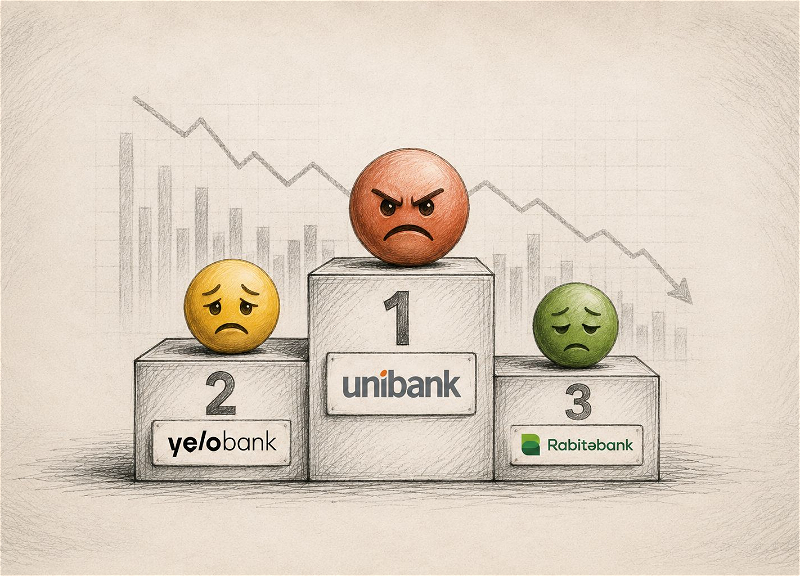
The Central Bank's July table turned out to be the coolest of the entire 2026: the sector-wide average complaint index fell to 1.06, against 1.26 a month earlier and 1.66 in February. The "high index" category — the red zone — is empty for the second month running, while the yellow band has narrowed from nine positions to seven. Yet the cooling market has produced a new leader, and it got there without any deterioration in its own indicator.
The market has cooled, but it has not levelled out
The Central Bank included seventeen banks in the July list — the same number as a month earlier. The spread between the top and the bottom row narrowed from 2.06 to 1.66 points, the maximum value dropped from 2.27 to 1.95, and the aggregate level of tension, measured as the average index across the table, fell to its lowest since the beginning of the year. For a series that opened at 3.36 in February and at 6.89 in January, this is a marked shift in the background.
A lower average, however, does not mean the sector has become more uniform. The upper part of the table was reshuffled almost entirely: only two banks from June's top five remained in July's top five. Six positions moved by five rows or more, while two banks — Turanbank and AFB Bank — moved eleven and fourteen rows respectively, and in opposite directions. This is a picture not of stabilisation but of high mobility at a reduced overall level.
That is precisely why a single monthly snapshot explains very little on its own. The complaint index is calculated as the ratio of a bank's share in the total number of complaints to its share of the customer base, and where the absolute number of complaints is small, even a handful of cases can move the indicator several times over. Meaning emerges only from long series — and in July it is the long series that produce the most interesting result.
Unibank: seven months at the top of the table
July's anti-ranking was headed by Unibank with an index of 1.95. Formally this is an increase — the bank stood at 1.85 in June. In practice, a gain of 0.10 points falls within the range of ordinary monthly fluctuation and explains nothing in itself. Unibank came first not because it deteriorated, but because everyone above it dispersed: AFB Bank collapsed by fourteen rows, Accessbank by seven, Bank of Baku by three, and Expressbank moved into the lower half of the table. Unibank stayed where it was — and that proved sufficient.
This is the central conclusion of the month. Since January the bank has not once left the top five: fifth place in January, fifth in February, fifth in March, second in April, second in May, fifth in June and first in July. Seven consecutive months, without a single exception. Over the same period six different banks passed through the upper part of the table as anti-leaders — Bank Avrasiya, Bank BTB, Expressbank, Yapı Kredi, Expressbank again, and AFB Bank. All of them came and went. Unibank never left.
Its range of values over these seven months — from 1.64 to 2.34 — is equally telling: the bank has had no catastrophic month, but it has had no genuinely clean one either. This is a fundamentally different story from a one-off spike. A one-off spike is explained by a specific event: a system failure, a disputed fee, an unsuccessful product decision. A sustained presence in the upper part of the table over six months is not covered by such explanations.
The same two-scenario model applies here that we return to from edition to edition. A customer turns to the Central Bank in two situations. The first: the bank's internal complaint-handling process is weak, an appeal made to the bank receives no answer within a reasonable time, and the person goes to the regulator not because of the substance of the problem but because nobody listened. The second: the problem is systemic and cannot in principle be resolved at the level of a call centre or a branch, because it comes down to product terms, tariffs or procedures. The first scenario produces spikes; the second produces a plateau. Unibank has had seven months of plateau.
Yelo Bank: a decline that changes nothing
Second place went to Yelo Bank with an index of 1.77. Formally this is an improvement — down 0.29 points from June. But the improvement takes place inside a persistently high corridor and does not even move the bank out of the top three.
Yelo Bank's trajectory over the year looks like this: 0.93 in January, 1.68 in February, 1.80 in March, 1.49 in April, 1.96 in May, 2.06 in June and 1.77 in July. The bank began the year in the lower half of the table, in twelfth place, has not fallen below the seventh row since February, and has spent the past five months in the top five. Its indicator has almost doubled from the January level and has since hovered around the two-point mark.
We have already described Yelo Bank as a "quiet chronic case" — a bank that produces no dramatic swings and therefore rarely becomes a headline, yet does not return to clean values either. July confirms that characterisation with one correction: the bank's position can hardly be called quiet any longer. A fall of 0.29 points to a level of 1.77 is movement within a poor norm, not an exit from it.
Rabitabank: the chronic case nobody notices
The third row belongs to Rabitabank with an index of 1.62. This is its highest value of 2026 and its strongest showing by position since the series began, if "strongest" is taken to mean advancement up the anti-ranking.
Rabitabank is a rare case of a bank whose values barely move. Over seven months its index has not left the 1.24–1.62 corridor: 1.32 in January, 1.47 in February, 1.24 in March, 1.46 in April, 1.39 in May, 1.24 in June and 1.62 in July. Not a single month below 1.24 and not a single month above 1.62. The bank has never headed the table, has never given grounds for a separate analysis — and has never dropped into the green zone.
This kind of stability is deceptive. An absence of spikes is usually read as a sign of manageability, but what is being managed here is a level that has stayed above the sector average all year. In July, when the average index fell to 1.06, Rabitabank rose to 1.62 — diverging from the market in the opposite direction. For a bank that has remained above the average for seven consecutive months, this is no longer background noise but a defining trait.
Turanbank: a pause mistaken for a correction
Fourth place was taken by Turanbank with an index of 1.54 against 0.40 in June — an almost fourfold increase and a climb of eleven rows, the sharpest upward movement in the entire July table.
This result requires a longer context than a single month. In the spring we examined Turanbank's trajectory in detail: the bank that had headed the anti-ranking in May 2025 had, by the spring of 2026, sunk to the very bottom of the table — sixteenth place in April at 0.32, fifteenth in May at 0.36, fifteenth in June at 0.40. For three consecutive months it held within a narrow range close to the lower boundary, and this looked like the result of work on service quality.
At the time we noted that three clean months do not yet amount to a system, and that only a longer series could confirm durability. July has shown what the spring run actually was. A reading of 1.54 returns Turanbank to the upper part of the table, at a level comparable to its January value of 2.03, when the bank held fourth place. Between January and July the bank managed to spend three months at the bottom and return, without in substance changing its position within the system.
This is a material refinement of the spring picture. An improvement that lasted three months and disappeared in the fourth is more accurately described as a pause than as a correction. A structural change in service quality does not look like this: it accumulates and holds, rather than rolling back to previous values within a single month.
The volatile group: why a sharp improvement is not yet quality
The largest movement of July was AFB Bank's fall from first place to fifteenth: from 2.27 to 0.47, down 1.80 points. The temptation to call this a breakthrough is considerable, but the bank's annual series does not permit it. AFB Bank has passed through 3.83 in January, 2.95 in February, 1.45 in March, absence from the April table, 1.59 in May, 2.27 in June and 0.47 in July. The amplitude is more than eightfold, and the direction changes almost every month.
In the May edition we wrote that AFB Bank's improvements did not look like the result of systematic work, and advised treating them with caution. June vindicated that caution — the bank returned to first place. The pendulum has now swung back, and there are no grounds for trusting the July reading any more than the June one.
Two more banks belong to the same group. Accessbank, which had stood at 1.99 for two consecutive months in third place, fell to 0.89 and tenth place in July, down 1.10 points.
Azər-Türk Bank travelled the opposite path: 0.39 in June, 1.18 in July, a threefold increase and a climb of eight rows; over the year its values have ranged from 0.39 to 2.78. Bank VTB Azerbaijan fell from 1.32 to 0.34, its best result of the year, yet it stood at 1.10 in April and 0.20 in May.
The overall conclusion for this group is a single one: an isolated monthly value carries no information about service quality at such banks. They can meaningfully be assessed only by multi-month averages and by amplitude — and on both criteria the position of AFB Bank and Azər-Türk Bank remains unstable.
Slow trends in the middle of the table
Between the volatile group and the chronic cases sits a number of banks whose changes occur slowly and therefore rarely attract attention.
Bank Respublika rose from twelfth place to sixth, from 1.04 to 1.35. Its line over the year — 0.61, 0.88, 0.93, 1.11, 1.48, 1.04, 1.35 — represents a gradual drift upwards to more than double the January level. We drew attention to this trend in the May edition; July shows that it has not been interrupted. At the same time the bank has made no sharp movements at all — it is precisely this gradualness that makes such a dynamic hard to notice.
Bank of Baku, by contrast, has eased the pressure: 1.23 against 1.92 in June, seventh place instead of fourth. For a bank that held within the 1.63–1.92 range from April to June, this is the first substantial decline of the quarter, although it has yet to reach the green zone.
Yapı Kredi Bank Azerbaijan has declined for the third month in a row — 1.92 in April, when the bank headed the table, then 1.75, 1.51 and 1.40 in July. The movement is small but unidirectional, and in terms of consistency of direction it is the best result in the upper half of the list.
The lower half: where the dynamic is genuinely positive
The most convincing improvement of July was delivered by Expressbank. In the May table the bank headed the anti-ranking at 2.65 — and we wrote about it directly, noting that the figure stood below the sector's historical highs but nonetheless placed the bank first. Over two months Expressbank has travelled the path 2.65 — 1.51 — 0.71, cutting its index by almost three quarters and moving outside the top ten for the first time this year: thirteenth row out of seventeen. No other bank in the July table has shown a comparable two-month dynamic. This is the case where a decline looks not like fluctuation but like a result: it has occurred for the second consecutive month, in large steps and in a single direction.
ABB took ninth place with an index of 0.95. A position in the middle of the table says little in itself, but the bank's annual series deserves separate attention: 0.96, 0.84, 0.95, 0.93, 0.74, 1.06, 0.95. Seven months within the 0.74–1.06 corridor is the smallest amplitude in the entire sample. ABB has had no spike whatsoever over the year and not a single month in the top third of the table. For a bank with the country's largest customer base such evenness means more than one-off records: the wider the coverage, the harder it is to hold an indicator steady without jumps, since any change in procedures or tariffs affects more customers at once. ABB holds its level without records — and has been doing so for seven months.
A similar logic applies to Kapital Bank: 0.86 in July, and a corridor of 0.75–0.89 over the year. This is the second most stable series in the table, likewise with a very large customer base.
PAŞA Bank deserves separate mention, closing the July list at 0.29. Its annual series — 0.26, 0.46, 0.65, 0.52, 0.43, 0.21, 0.29 — has no equivalent in the sector: not a single month above 0.65 and seven consecutive months at or close to the minimum. In June the bank posted the absolute system-wide low of the year, 0.21. Taking 2026 as a whole, PAŞA Bank remains the benchmark of the table, and this is the one assessment in our series that requires no qualification: it follows from any monthly release by the regulator rather than from interpretation.
Who did not make the table
The regulator notes that banks absent from the list received no complaints during the month. Bank Avrasiya, Azerbaijan Industrial Bank and Ziraat Bank Azerbaijan did not appear in July.
The case of Bank Avrasiya is worth noting in particular. In January the bank headed the anti-ranking at 6.89 — a record for the entire series. It has not appeared in the table once since February: six consecutive months with no registered complaints. Azerbaijan Industrial Bank last featured in the May list at 1.42, and Ziraat Bank Azerbaijan in the April list at 0.31. Bank BTB left the banking sector in February, holding anti-leader status at the time; it now operates as a non-bank credit organisation.
CBA complaint index: four-month dynamics (April – July 2026)
|
№ |
Bank |
July |
June |
May |
April |
|
1 |
Unibank |
1.95 |
1.85 |
2.01 |
1.88 |
|
2 |
Yelo Bank |
1.77 |
2.06 |
1.96 |
1.49 |
|
3 |
Rabitabank |
1.62 |
1.24 |
1.39 |
1.46 |
|
4 |
Turanbank |
1.54 |
0.40 |
0.36 |
0.32 |
|
5 |
Yapı Kredi Bank Azerbaijan |
1.40 |
1.51 |
1.75 |
1.92 |
|
6 |
Bank Respublika |
1.35 |
1.04 |
1.48 |
1.11 |
|
7 |
Bank of Baku |
1.23 |
1.92 |
1.72 |
1.63 |
|
8 |
Azər-Türk Bank |
1.18 |
0.39 |
1.04 |
1.07 |
|
9 |
ABB |
0.95 |
1.06 |
0.74 |
0.93 |
|
10 |
Accessbank |
0.89 |
1.99 |
1.99 |
0.87 |
|
11 |
Kapital Bank |
0.86 |
0.75 |
0.89 |
0.85 |
|
12 |
Premium Bank |
0.76 |
0.83 |
— |
0.65 |
|
13 |
Expressbank |
0.71 |
1.51 |
2.65 |
1.82 |
|
14 |
Xalq Bank |
0.68 |
1.06 |
0.31 |
0.93 |
|
15 |
AFB Bank |
0.47 |
2.27 |
1.59 |
— |
|
16 |
Bank VTB Azerbaijan |
0.34 |
1.32 |
0.20 |
1.10 |
|
17 |
PAŞA Bank |
0.29 |
0.21 |
0.43 |
0.52 |
|
|
Table average |
1.06 |
1.26 |
1.29 |
1.11 |
Methodology. The complaint index is calculated by the Central Bank as the ratio of a bank's share in the total number of complaints received to its share of the sector's customer base. Customers are defined as account holders with a balance of 100 manats or more who have carried out at least one transaction over the previous three months. Repeat appeals, as well as applications for credit relief, credit requests and matters outside the regulator's remit, are excluded from the calculation.
A value above one means that the bank's share of complaints exceeds its share of the market; a value below one means the reverse. The regulator separately emphasises that the indicator does not signal any threat to a bank's financial soundness or the continuity of its operations, and that it may change from month to month depending on the number of complaints and the size of the customer base.
Data source: the Central Bank of the Republic of Azerbaijan, "Bank müştərilərinin bank xidmətlərindən istifadəsi üzrə şikayət indeksi", July 2026. Average calculations by the First News Intelligence Unit.
Read in other languages: